Stettenfels Castle
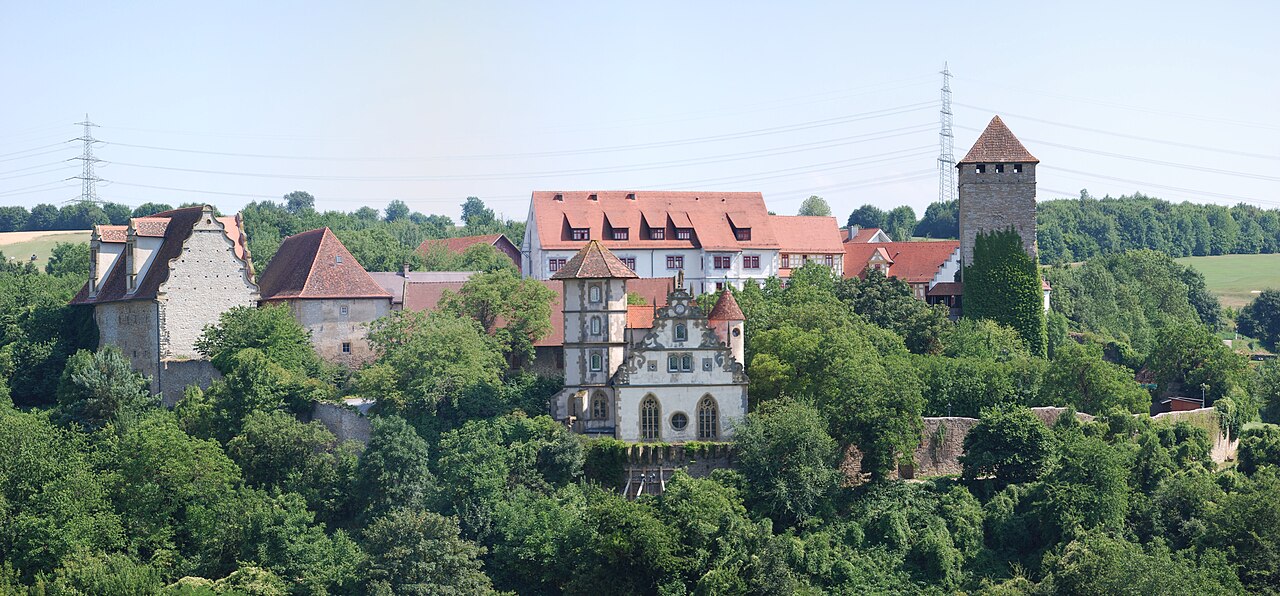
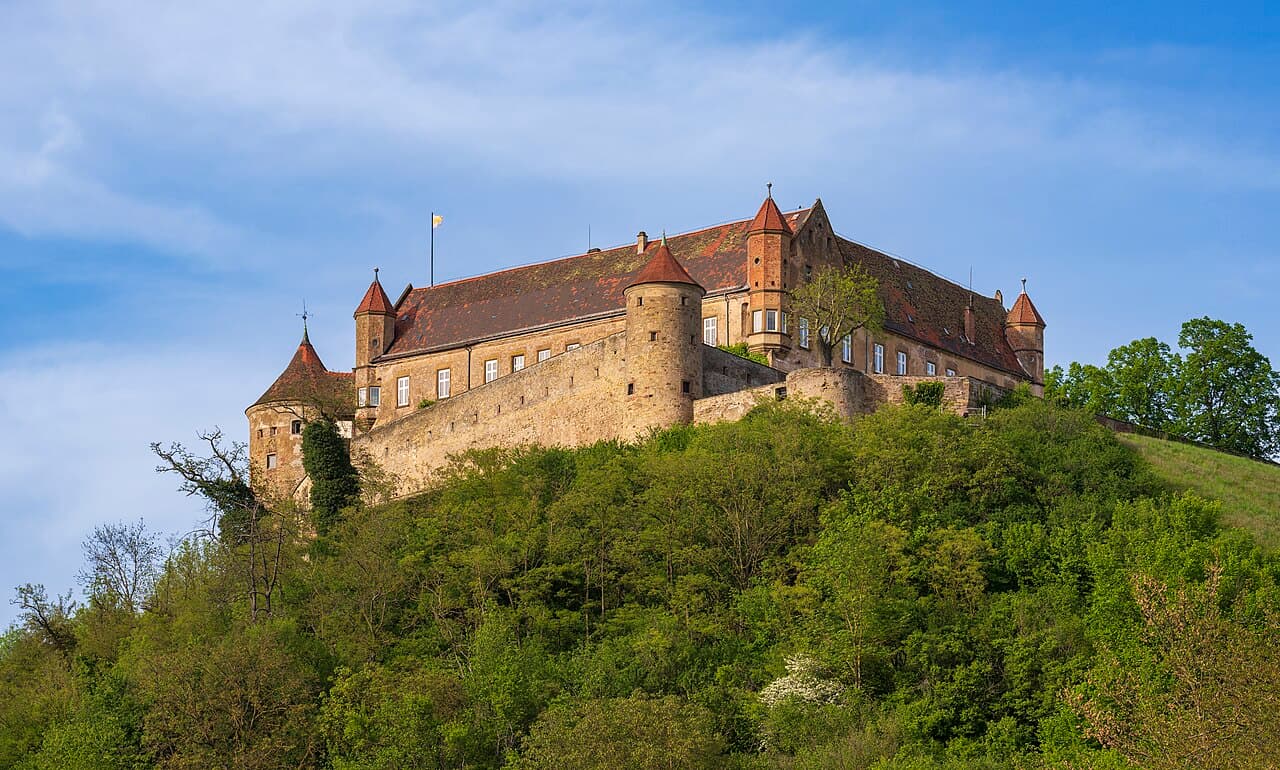
Stettenfels Castle stands prominently on a sandstone ridge east of the historic town center of Untergruppenbach in Germany. This high medieval hill castle was originally constructed in the 11th century, during a period when many fortifications were established throughout the region to assert imperial control and defend strategic points. Its location on elevated terrain provided natural defensive advantages, complemented by a broad moat and imposing fortifications.
Architectural features and layout
The castle is built around a distinctive triangular courtyard, which is accessed via a massive bridge that spans the wide moat. The moat itself is a significant defensive feature, enclosing the castle and incorporating three old towers that once served as lookout and defense points. The bridge leads to a fortified gatehouse, which provides the main entrance to the inner courtyard.
Within the courtyard, a prominent fountain serves as a central focal point, surrounded by various residential buildings that reflect the castle's evolution over centuries. One of the most notable architectural elements is the historic staircase tower, originally part of the Renaissance remodeling but extensively rebuilt in recent times. While most of the buildings visible today date back to the Renaissance period, the staircase tower's reconstruction demonstrates the ongoing preservation efforts.
Historically, the residential buildings and staircase tower featured timber balustrades along their facades, a typical architectural detail of the period. However, the ground-floor archways that once served commercial or economic functions have largely been walled up, reflecting changes in use and preservation priorities. Beyond the moat to the east lie historic farm buildings and modern restaurant facilities, integrating the castle grounds with contemporary amenities.
Historical development and ownership
Early history and medieval ownership
Constructed in the 11th century, Stettenfels Castle was likely established as an imperial fortress during the high medieval period. The castle's early history is marked by frequent changes in ownership, reflecting the complex political landscape of the Holy Roman Empire. In the early 14th century, ownership was divided among several noble families, including the von Hirschhorn, the patrician Wigmar family, and the noble von Helfenberg family.
Following the extinction of the von Helfenberg line in 1356, their holdings passed to Burkhard, Knight of Sturmfeder. His son, Burkhard the Younger, expanded the estate through marriage with the Hirschhorn family, founding the Stettenfels branch of the Sturmfeder family. By the late 15th century, the von Helmstatt family controlled the castle.
Renaissance transformation and later ownership
After Duke Ulrich of Württemberg captured the castle during the Landshut War of Succession in 1504, it became a fief of Württemberg. In 1507, Marshal Konrad Thumb von Neuburg was granted the castle, and his son sold it in 1527 to Philipp von Hirnheim, who introduced the Reformation to the nearby village of Gruppenbach.
In 1551, Anton Fugger, a member of the wealthy Fugger family, acquired the castle. His son, Hans Fugger, commissioned a major renovation in 1576, transforming the medieval fortress into a Renaissance chateau under the direction of architect Wendel Dietrich. This renovation included the addition of elegant residential buildings and enhancements to the courtyard. After a devastating fire in 1594, Dietrich oversaw the rebuilding efforts, preserving the Renaissance character of the castle.
In the 18th century, the Fuggers attempted to establish a Capuchin hospice on the grounds, but this project was halted when the buildings were destroyed by Württemberg authorities in 1735. Subsequently, Duke Karl Eugen of Württemberg acquired the castle in 1747.
Modern era and 20th-century history
The castle passed through various hands in the 18th and 19th centuries, including ownership by the municipality of Gruppenbach and several private individuals such as Friedrich Korn, Anton Mayer, and Friedrich Bürkle. In 1901, lawyer Dr. Walter Putsch purchased the castle and undertook renovations in a contemporary style.
From 1918, the von Haldenwang family owned the property until 1924, when cobbler Siegfried Levy acquired it and established a stud farm. The castle was forcibly taken from Levy in 1937 during the Nazi regime's "Aryanization" policies, and parts of the castle were demolished in 1939 to construct an Ordensburg for Nazi training, though the project was never completed due to the outbreak of World War II.
After the war, the castle was managed by American authorities before being used as a retreat and retirement home by the Lutheran Church from 1946 to 1951. It was then restituted to Levy's widow and sold to Friedrich Spieser in 1957. Architect Roland Fleiner Weimar acquired the castle in 1994 and has maintained it since.
Current use and cultural significance
Today, Stettenfels Castle is open to the public and serves as a vibrant cultural venue. The castle hosts community concerts, theater events, and a popular medieval festival featuring jousting tournaments, jugglers, and artisans. This festival, held annually since 2005 on May 1 and the following weekend, attracts thousands of visitors and hundreds of participants.
The castle grounds also support agriculture, including vineyards on the slopes and a stud farm on the plateau. The moat has been adapted to include a fixed stage for performances, enhancing the castle's role as a community hub.
Rooms within the castle are available for private events such as receptions, and a permanent beer garden operates on the grounds, blending historical ambiance with modern hospitality. The combination of well-preserved Renaissance architecture, medieval defensive features, and active cultural programming makes Stettenfels Castle a significant heritage site in the region.
Frequently asked questions (FAQ)
- How do I visit Stettenfels Castle and what are the opening hours?
- Stettenfels Castle is open to the public, with visiting hours typically available during community events and festivals. It is best to check the castle's official website or local tourist information for current opening times and event schedules.
- What is the historical significance of Stettenfels Castle?
- Stettenfels Castle is a well-preserved example of a high medieval hill castle with significant Renaissance renovations. It reflects the political and architectural history of the Württemberg region from the 11th century onward.
- Can I attend events or festivals at the castle?
- Yes, the castle hosts annual medieval festivals with jousting, music, and artisans, as well as concerts and theater performances, making it a lively cultural venue.
- What architectural styles are represented in Stettenfels Castle?
- The castle combines its original high medieval fortress features with extensive Renaissance-style renovations from the 16th century, especially those led by architect Wendel Dietrich.
- Is the castle accessible for visitors with mobility issues?
- While efforts have been made to maintain accessibility, the historic nature of the castle, including moats and uneven terrain, may present challenges. Visitors with mobility concerns should inquire in advance about accommodations.
Photo gallery

Information
Sources & official resources
Verify the information above using these authoritative references.
Loading map...
Visitor reviews
No reviews yet. Been here? Write the first review and help other travelers!
Write the first reviewVisited this castle? Share your experience
Your review helps other travelers and adds first-hand knowledge to our encyclopedia.