Sterrenberg Castle
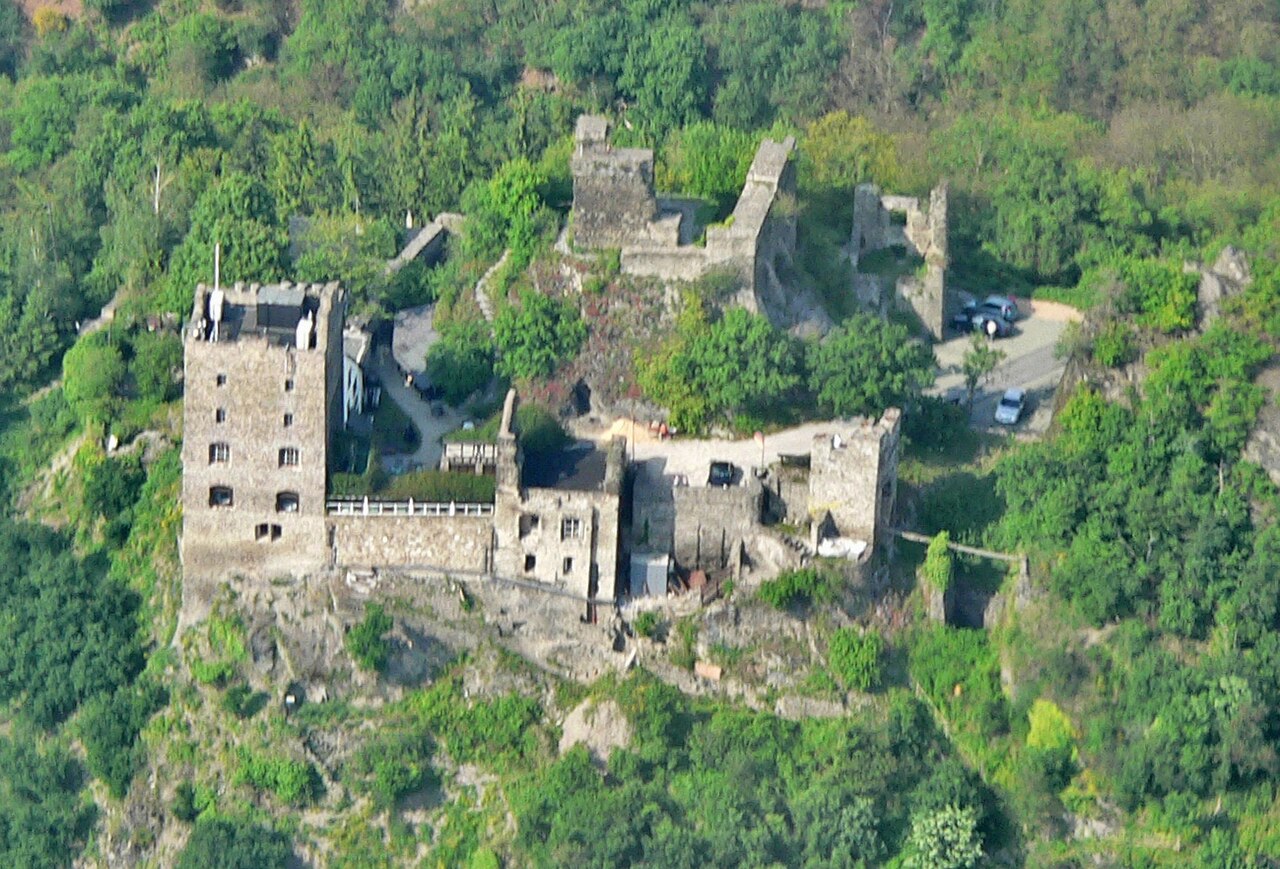
Sterrenberg Castle, perched above the Rhine River in Kamp-Bornhofen, Germany, is a remarkable example of a high medieval hill castle with enduring architectural and historical significance. Its origins trace back to the 11th century, making it one of the region’s earliest fortified sites. The castle’s commanding position atop a hill at approximately 217 meters above sea level allowed it to control vital river traffic and local trade routes, particularly the toll station at Bornhofen. This strategic location contributed to its role as an imperial stronghold and a focal point of regional power struggles during the Middle Ages.
The castle’s earliest documented mention is somewhat uncertain but possibly dates to 1034, when it was referenced as an imperial castle. By 1190, it was clearly recorded as a fief held by the noble family of Werner von Bolanden, who administered the castle alongside the customs point in Bornhofen. The Bolanden family’s tenure lasted until the late 13th century, during which time they appointed castellans who often took their names from the castle itself, such as the Herren von Sternberg and Schenk von Sterrenberg. The castle’s bergfried, or central keep, and the first inner shield wall are surviving elements from this early phase, showcasing the defensive priorities of the time.
Medieval history and ownership transitions
In the late 1200s, Sterrenberg’s ownership became more complex. Part of the castle was pledged to the Counts of Katzenelnbogen, a powerful noble family in the region. Concurrently, other noble lines such as the Counts of Sponheim-Bolanden and Count Albrecht I of Schenkenberg emerged as heirs, reflecting the fragmented feudal landscape. By 1310, the castle came under the control of Archbishop and Elector Baldwin of Luxembourg on behalf of the Electorate of Trier, acquired as an imperial pledge. However, Count Diether VI of Katzenelnbogen retained partial possession, leading to a rivalry that culminated in 1315 with Baldwin’s victory and Diether’s death in a noble tournament.
Earlier, in 1294, knights Siegfried and Ludwig Schenk von Sterrenberg purchased the neighboring Liebenstein Castle, ending their joint ownership of Sterrenberg. Over subsequent decades, Sterrenberg became a key administrative center for the Electorate of Trier’s holdings on the right bank of the Rhine, overseeing territories extending toward the Taunus hills and administering the nearby Hirzenach provostry. As the sole Trier castle south of the Lahn River on the right Rhine bank, it held significant regional authority.
Fortifications and architectural development
The castle’s defensive structures evolved considerably between the early and mid-14th century. Under the direction of local rulers such as Burgrave Heinrich IV Beyer of Boppard and Friedrich Walpot von Polch, the castle was fortified with a system of inner and outer shield walls. The inner shield wall, built after Trier’s acquisition, features a robust double-wall construction with solid masonry shells filled with rubble, a technique designed to withstand siege warfare. Restoration in the 19th and 20th centuries preserved these walls, including the addition of a pointed arch gate and battlements with angled arrow slits typical of the mid-1300s.
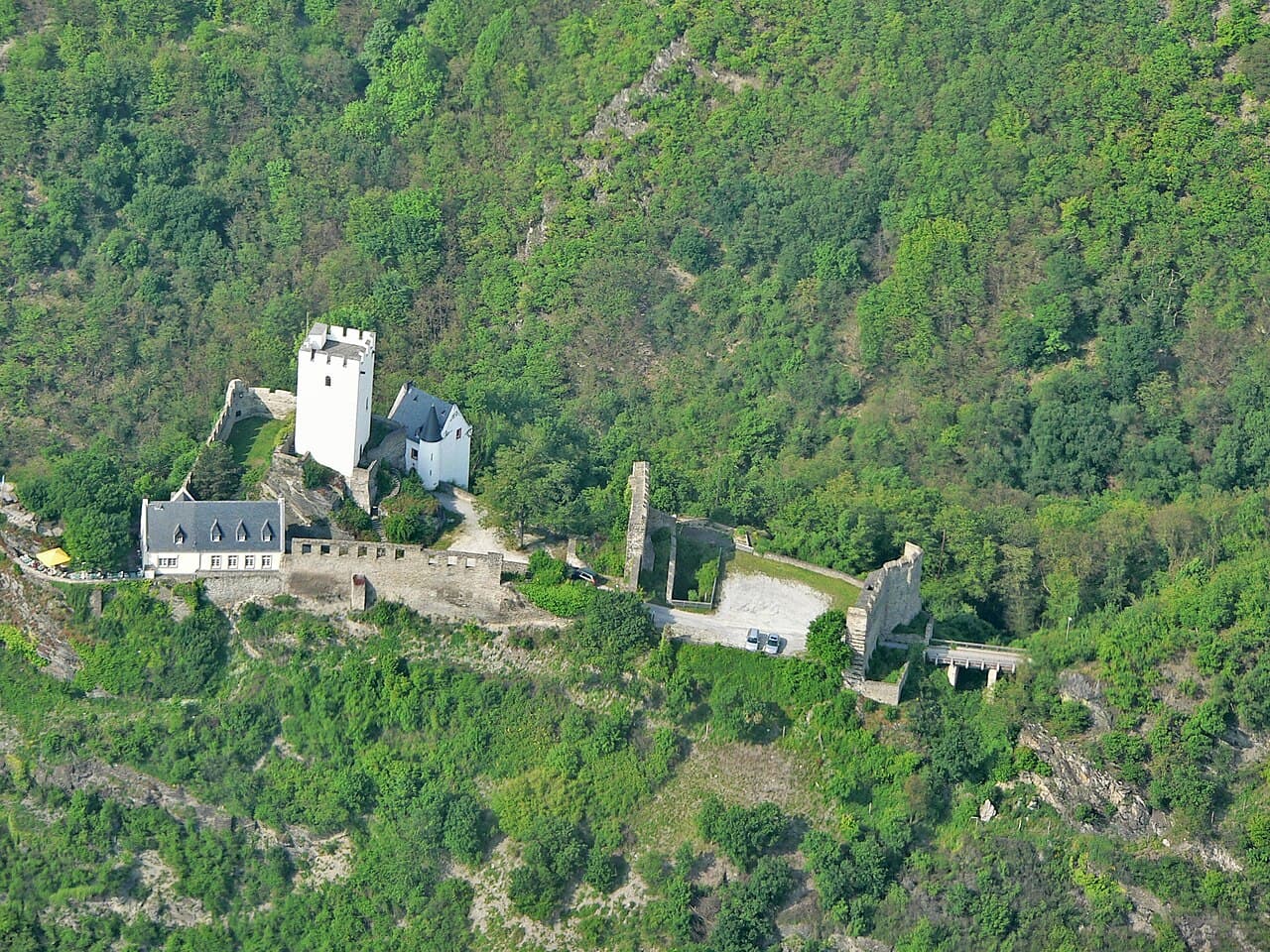
The outer shield wall, also known locally as the "Streitmauer" or dispute wall, stands approximately 30 to 35 meters ahead of the main stronghold. It follows the natural spur of the hill, enclosing what was once an outer courtyard. This wall includes narrow passageways and two spiral staircases, facilitating movement between defensive levels. A unique feature near the gate is a tower-like bluff, an architectural bluff designed to intimidate attackers with its open rear and structural integration into the main wall rather than functioning as a standalone tower.
Archaeological evidence reveals that the forecourt inside the outer shield wall once contained half-timbered residential buildings, now lost. Beam holes and chimney remains found in the shield walls testify to these former structures, though insufficient information has prevented their reconstruction. The 1970s restoration efforts successfully raised the outer shield wall to its original height and added battlements, reinforcing the castle’s medieval character.
The bergfried and residential buildings
The bergfried is the castle’s most prominent surviving structure, a tall square tower resting on a steep slate rock base. After restoration, it stands about 14.7 meters high and is coated with white plaster reminiscent of medieval finishes. Plans to open the bergfried’s interior as a permanent exhibition space will further highlight its historical significance.
Adjacent to the bergfried on the eastern side lies the Frauenhaus, the main residential building or palas, reconstructed in 1970 in a simple Romanesque style. It features a gabled roof and a round tower on one flank, reflecting the castle’s original architectural language. The Frauenhaus now accommodates chambers used for contemporary functions while preserving the medieval ambiance. Behind it, a small enclosed courtyard displays agricultural artifacts, including a ladder wagon from around 1918 linked to Johannes Eschelbach, a former mayor of nearby Filsen.
On the western side facing the Rhine, a Gothic-style restaurant built in 1972 connects to the castle. This modern addition includes a terrace offering panoramic views of the Rhine valley and is noted for serving regional wines sourced from vineyards on the left bank, as the steep slopes below Sterrenberg are unsuitable for viticulture.
Decline and modern preservation efforts
From the late 14th century, Sterrenberg’s strategic importance waned with the rise of Burg Maus, a newer fortress near Wellmich that became Trier’s main stronghold on the right Rhine bank. By 1456, Sterrenberg was described as dilapidated, and by 1568 it was uninhabited. Despite this decline, the Electorate of Trier retained ownership until the dissolution of the Holy Roman Empire in 1806. Subsequently, the castle passed to the Duchy of Nassau, and later to Prussia in 1866. Since 1946, it has been under the jurisdiction of the state of Rhineland-Palatinate.
In the 20th century, significant conservation and restoration efforts were undertaken. Between 1970 and 1977, the Frauenhaus was rebuilt in a manner faithful to its original Romanesque style, and the bergfried’s battlements and exterior were restored to approximate their medieval appearance. These efforts included the addition of crenellations and white plaster finishing. The castle’s integration into the UNESCO World Heritage Site of the Upper Middle Rhine Valley since 2002 underscores its cultural and historical importance. It is also protected under international heritage agreements such as the Hague Convention.
Cultural significance and visitor experience
Today, Sterrenberg Castle stands as a partially restored monument offering visitors a tangible connection to the medieval history of the Rhine region. Its layered fortifications, restored residential buildings, and the imposing bergfried provide rich insights into medieval military architecture and noble life. The castle’s location affords spectacular views of the Rhine valley, enhancing its appeal as a cultural and tourist destination.
The adjoining Gothic-style restaurant complements the historical atmosphere with regional cuisine and wines, making Sterrenberg a popular stop for travelers exploring the Rhine castles. Interpretive displays and planned exhibitions within the bergfried aim to deepen visitors’ understanding of the castle’s complex history and architectural evolution.
As a heritage site, Sterrenberg contributes to the broader narrative of medieval fortifications along the Rhine and exemplifies the strategic importance of castles in controlling river traffic and regional power dynamics. Its preservation reflects ongoing efforts to maintain Germany’s rich architectural legacy and promote cultural tourism in the Rhineland-Palatinate region.
Frequently asked questions (FAQ)
- When was Sterrenberg Castle originally built?
- Sterrenberg Castle was originally constructed in the 11th century, with its earliest possible mention dating to 1034.
- What architectural style characterizes Sterrenberg Castle?
- The castle primarily features Romanesque architectural elements, especially evident in the restored Frauenhaus and bergfried.
- Is Sterrenberg Castle open to visitors year-round?
- Yes, Sterrenberg Castle is open daily from 10:00 to 17:00, allowing visitors to explore its historic structures and enjoy panoramic views.
- What is the significance of the bergfried at Sterrenberg Castle?
- The bergfried is the central keep of the castle, dating from the early medieval period, and serves as a key defensive and symbolic structure.
- Are there any modern facilities at Sterrenberg Castle?
- Yes, a Gothic-style restaurant built in 1972 offers regional cuisine and wines, enhancing the visitor experience.
- How is Sterrenberg Castle protected as a heritage site?
- Sterrenberg Castle is part of the UNESCO World Heritage Site Upper Middle Rhine Valley and is protected under international heritage agreements like the Hague Convention.
Photo gallery

Information
Opening hours
10:00-17:00, daily
Ticket prices
€5 adult, €3 child
Current owner
State of Rhineland-Palatinate
Website
Visit websiteSources & official resources
Verify the information above using these authoritative references.
Loading map...
Visitor reviews
No reviews yet. Been here? Write the first review and help other travelers!
Write the first reviewVisited this castle? Share your experience
Your review helps other travelers and adds first-hand knowledge to our encyclopedia.