Liebenstein Castle
Liebenstein Castle, located above the village of Kamp-Bornhofen in the Rhineland-Palatinate region of Germany, is a prominent example of a high medieval hill castle with a complex history and architectural evolution. Constructed in the 13th century, it originally served as a fortified residence for feudal lords, strategically positioned on a granite cone overlooking the Rhine River. This location provided both defensive advantages and control over river traffic, a vital medieval economic and military artery.
Historical background and ownership
The castle was likely built in close conjunction with the nearby Sterrenberg Castle, both initially under the ownership of the Bolanden family, later known as the Sponheim-Dannenfels lineage. The earliest documentary references date back to the early 12th century, with the hill fort mentioned as early as 1125. By the late 13th century, the castle became a focal point in familial disputes and territorial conflicts.
Between 1284 and 1290, significant expansions were undertaken by Albrecht von Löwenstein through his marriage to Luccardis von Bolanden, reflecting internal power struggles with Werner VI von Bolanden, the lord of Sterrenberg Castle. This rivalry led to the castle's development as a Ganerbenburg — a unique medieval arrangement where multiple co-heirs shared ownership and residence within the same fortress, each maintaining independent living quarters and defensive structures.
In the 1290s, ownership shifted when Heinrich I von Sponheim-Bolanden pledged halves of Liebenstein to knights Siegfried and Ludwig von Sterrenberg, who subsequently adopted the name "von Liebenstein." Unlike Sterrenberg Castle, which became part of the Electorate of Trier, Liebenstein remained a shared family estate. This division and cohabitation of the two castles gave rise to the enduring legend of the "Feindliche Brüder" or "Hostile Brothers," symbolizing the rivalry between the two strongholds.
Architectural development and features
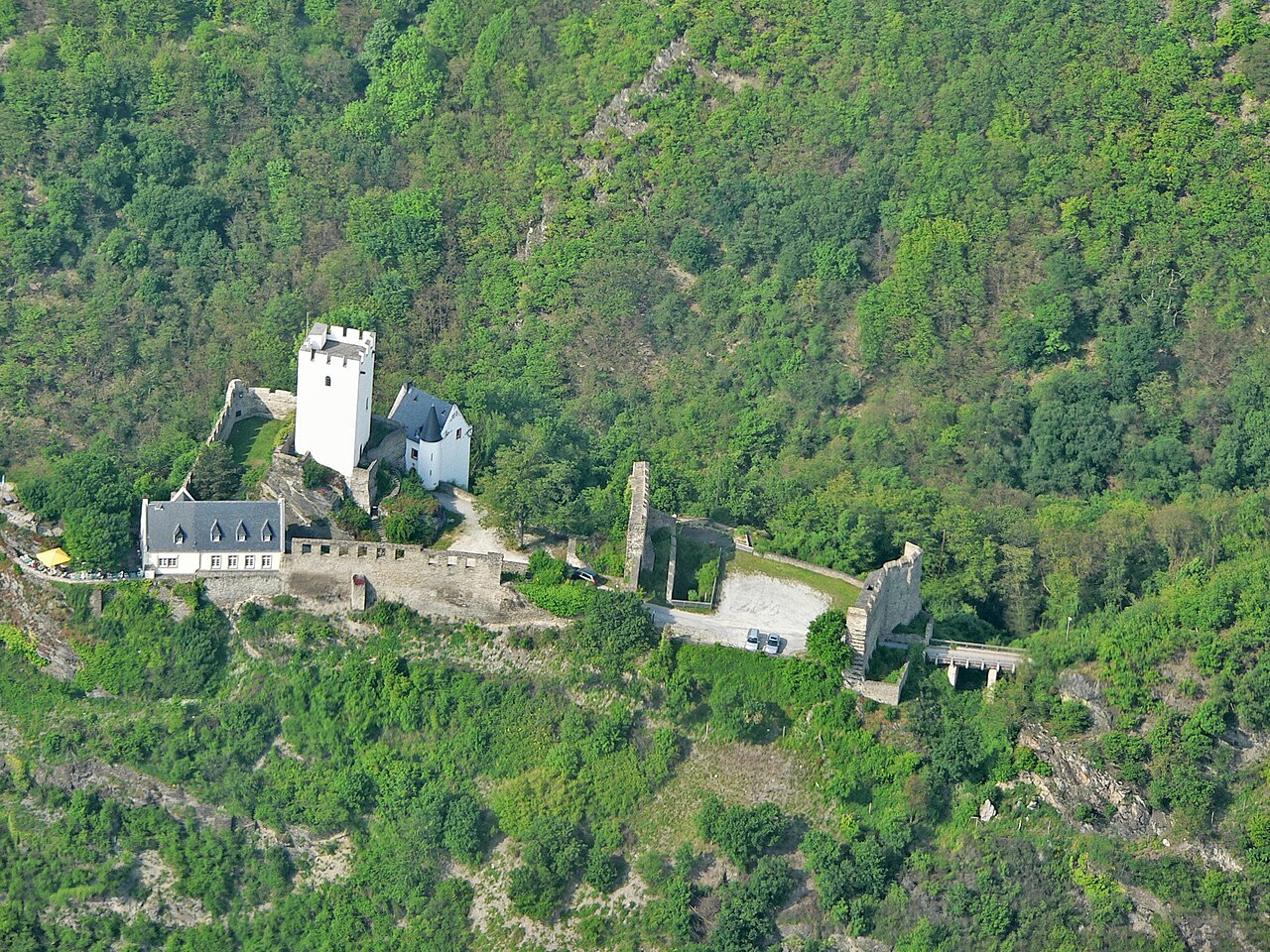
The castle underwent several phases of construction and fortification from the 13th through the 15th centuries. Around 1363, a gate tower was added to enhance security, followed by the erection of a second defensive tower circa 1380. The main residential tower, or bergfried, was constructed during the 14th or 15th century, standing approximately 17 meters tall with an almost square base and comprising seven floors. This tower served as the primary living quarters and a refuge during attacks.
Liebenstein's layout reflects its status as a Ganerbenburg, with up to ten distinct family branches inhabiting the castle simultaneously, each erecting separate towers and living spaces. The castle's curtain walls enclose a courtyard built on a natural slate rock outcrop, which once supported the main bergfried. Defensive features include a fore moat protecting the southern approach and a substantial curtain wall delineating the castle's perimeter.
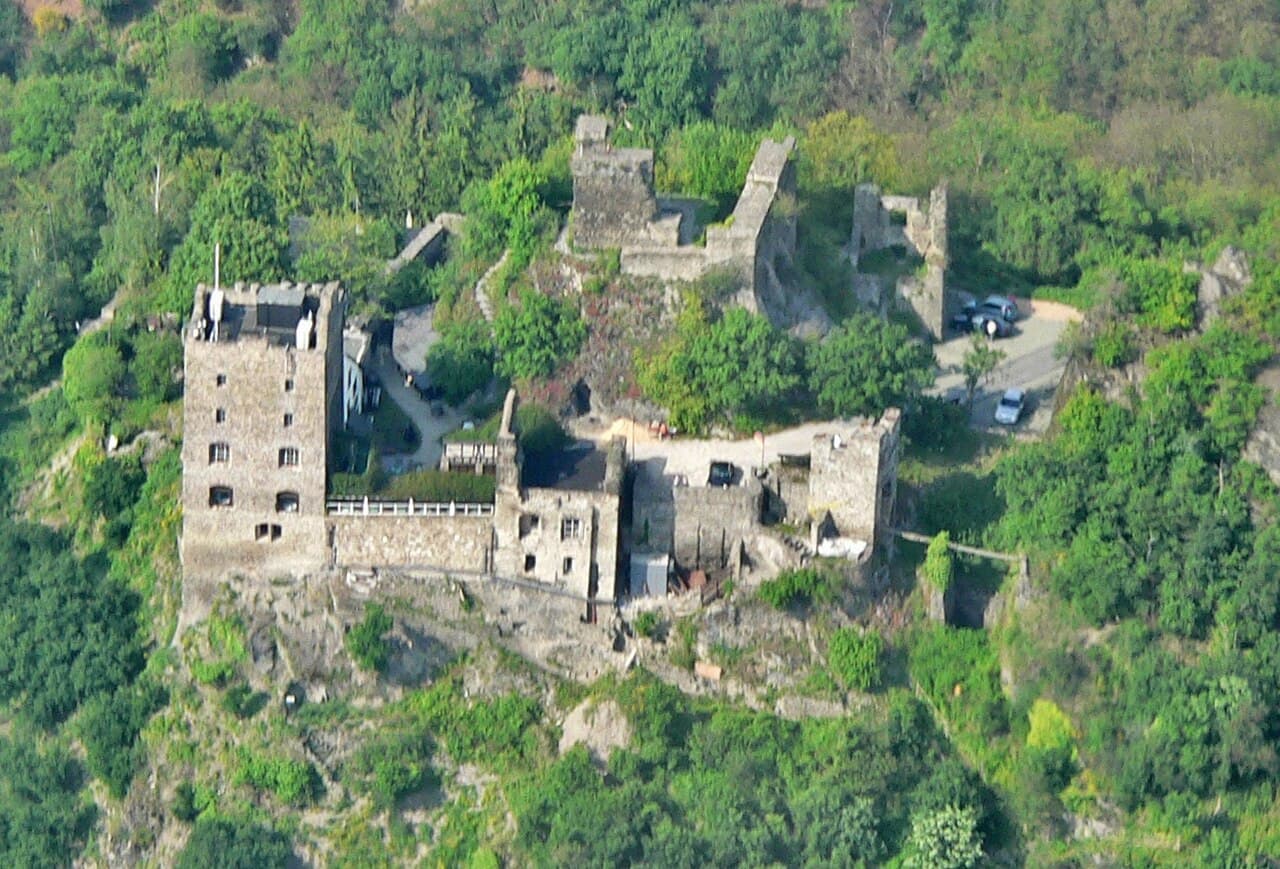
On the western side, remnants of a defensive tower overlook the Rhine, constructed with robust medieval stonework for surveillance and protection. To the east, ruins of a smaller residential tower stand on privately owned land, illustrating the fragmented nature of the castle's occupation. North of the main wall lie remains of a later-period artillery emplacement, indicating adaptations to evolving military technologies.
The castle also features a 17th or 18th-century gabled house attached to the bergfried, evidencing continued use and modification beyond the medieval period. This building now includes a castle garden and a terrace offering panoramic views of the Rhine Valley.
Decline, restoration, and current use
Liebenstein Castle was abandoned as a residence by 1529, falling into gradual disrepair. Throughout the 17th and 18th centuries, it changed hands multiple times, including ownership by Gerhard von Waldenburg, chancellor of the Electorate of Mainz, and later the Preuschen family, who established fideicommissary estates to preserve the property within the family line.
After centuries of neglect, the castle underwent a major restoration beginning in 1977, led by Rudolf Freiherr von Preuschen von und zu Liebenstein. These efforts stabilized the ruins and partially rebuilt walls, preserving the castle's historical fabric. Today, Liebenstein Castle functions as a hotel and restaurant, allowing visitors to experience its medieval ambiance alongside modern hospitality.
Since 2002, the castle has been part of the Upper Middle Rhine Valley UNESCO World Heritage Site, recognizing its cultural and historical significance within this renowned landscape.
Visitor experience and architectural significance
Visitors approach Liebenstein Castle via a steep, narrow road from the south, emphasizing its original defensive isolation. The castle's ruins offer a tangible glimpse into the medieval practice of shared noble residences through its Ganerbenburg structure. The surviving bergfried, curtain walls, and remnants of various towers illustrate the layered history of construction and adaptation over several centuries.
The castle's position on a granite hilltop provides commanding views of the Rhine River and surrounding valley, a testament to its strategic importance. The presence of multiple residential towers and separated living quarters reflects the complex social and familial arrangements of medieval nobility.
Liebenstein Castle stands as a significant example of high medieval hill castle architecture in the Rhineland, showcasing the evolution of fortifications and noble residences in response to political and military pressures. Its restoration and incorporation into a UNESCO site ensure the preservation of this heritage for future generations.
Frequently asked questions (FAQ)
- How do I get to Liebenstein Castle?
- Liebenstein Castle is accessible via a steep, narrow road from the south of Kamp-Bornhofen. Parking near the entrance is limited, so visitors should plan accordingly.
- What is the historical significance of Liebenstein Castle?
- Liebenstein Castle is a notable example of a high medieval Ganerbenburg, illustrating the unique practice of shared noble residences and family rivalries in the Rhineland region.
- Can I visit the interior of Liebenstein Castle?
- Yes, the castle operates as a hotel and restaurant, allowing visitors to experience parts of the restored structures and enjoy views of the Rhine Valley.
- When was Liebenstein Castle built?
- Liebenstein Castle was built in the 13th century and underwent expansions in the 14th and 15th centuries.
- Is Liebenstein Castle part of a UNESCO World Heritage Site?
- Yes, since 2002, Liebenstein Castle has been included in the Upper Middle Rhine Valley UNESCO World Heritage Site, recognizing its cultural and historical value.
Photo gallery

Information
Website
Visit websiteSources & official resources
Verify the information above using these authoritative references.
Loading map...
Visitor reviews
No reviews yet. Been here? Write the first review and help other travelers!
Write the first reviewVisited this castle? Share your experience
Your review helps other travelers and adds first-hand knowledge to our encyclopedia.