Stellerburg
The Stellerburg is a significant early medieval hill castle located in the municipality of Weddingstedt in northern Germany. Constructed by the Saxons before the expansion of Charlemagne's empire in the late 8th century, it represents the northernmost example of Saxon defensive architecture. This fortress was strategically positioned on a raised area resembling an island, surrounded by natural barriers such as moorlands and marshy, frequently flooded lands, which enhanced its defensive capabilities.
Historical context and strategic importance
The Stellerburg was built during a period marked by frequent conflicts and raids, particularly from Viking incursions along the northern coasts. Its placement guarded a crucial trade route and served as a military stronghold to protect the Saxon territories from external threats. The fortification's role as a defensive installation was vital in maintaining the security and autonomy of the region during the turbulent early medieval period.
Local tradition, as recorded by early chroniclers such as Neocorus and later by Karl Müllenhoff, tells of a count who ruled the region of Dithmarschen from the Stellerburg. According to legend, the local inhabitants revolted against this noble ruler, destroyed the fortress, and reclaimed their independence. This event is said to be corroborated by a royal decree that prohibited any further noble residence in the area, marking a significant moment of local resistance and self-determination in the region's history.
Architectural features and archaeological findings
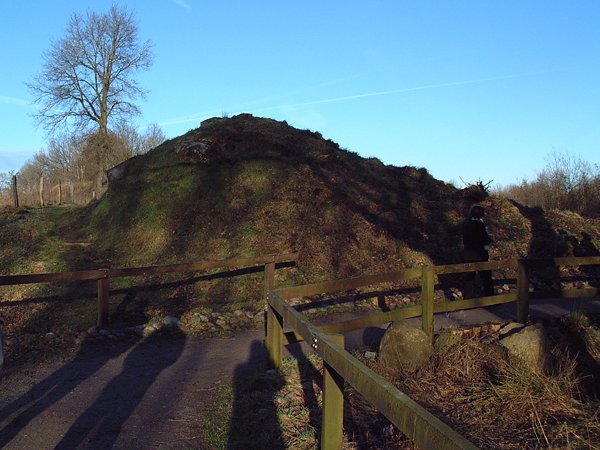
The remains of the Stellerburg reveal a ring-shaped defensive enclosure with walls that still stand between four and six meters high. The fortification was constructed using a combination of wood, earth, and stone, materials typical of Saxon military architecture, providing a sturdy perimeter against attacks. The fort's design took full advantage of the natural landscape, integrating man-made defenses with the surrounding moorlands and marshes.
Excavations conducted in the early 1930s uncovered a wooden plank walkway inside the enclosure, indicating how the occupants moved within the walls. Archaeologists also discovered the foundations of about twenty small wooden houses, suggesting that the site contained a modest settlement or garrison area. The limited number of small artifacts found implies that the fortress was not continuously inhabited but was likely used intermittently, probably during periods of heightened threat or military activity.
Defensive landscape and natural barriers
The Stellerburg's location was carefully chosen to maximize natural defenses. To the east lay extensive moorlands, while to the west, marshy lands that frequently flooded created a natural moat-like barrier. These features made direct assaults difficult and enhanced the effectiveness of the fort's constructed defenses. The combination of natural and artificial fortifications made the Stellerburg a formidable stronghold in the Saxon defensive network.
Cultural significance and legacy
The Stellerburg stands as a testament to the Saxons' efforts to defend their lands against external threats during the early medieval era. Its story, preserved through local legend and historical records, highlights a period of regional autonomy and resistance against noble domination. The royal decree forbidding noble residence in Dithmarschen after the uprising reflects the unique political and social dynamics of the area.
Today, the archaeological remains of the Stellerburg provide valuable insights into early medieval fortification techniques and Saxon settlement patterns. The site offers a tangible connection to the past, illustrating the strategic importance of hill castles in northern Germany during a time of frequent conflict and cultural change.
Visiting the site and preservation
While the Stellerburg is primarily an archaeological site with partially preserved walls, it remains accessible to visitors interested in early medieval history and Saxon architecture. The visible remnants of the defensive walls and the surrounding natural landscape allow visitors to appreciate the site's historical context and strategic significance. Preservation efforts focus on maintaining the integrity of the remaining structures and the surrounding environment to ensure that this important cultural heritage site endures for future generations.
Frequently asked questions (FAQ)
- When was the Stellerburg built?
- The Stellerburg was constructed during the early medieval period, before the late 8th century, by the Saxons.
- What is the architectural style of Stellerburg?
- Stellerburg reflects early medieval Saxon fortification techniques using a combination of wood, earth, and stone, rather than a later formal architectural style.
- Can visitors see the remains of the Stellerburg today?
- Yes, visitors can view the partially preserved ring-shaped defensive walls and foundations of wooden houses at the site.
- Why was the Stellerburg strategically important?
- Its location guarded a key trade route and protected the region from Viking raids, benefiting from natural barriers like moorlands and marshes.
- Is the Stellerburg continuously inhabited?
- Archaeological evidence suggests it was used intermittently, likely during times of threat, rather than as a permanent settlement.
Information
Loading map...
Visitor reviews
No reviews yet. Been here? Write the first review and help other travelers!
Write the first reviewVisited this castle? Share your experience
Your review helps other travelers and adds first-hand knowledge to our encyclopedia.