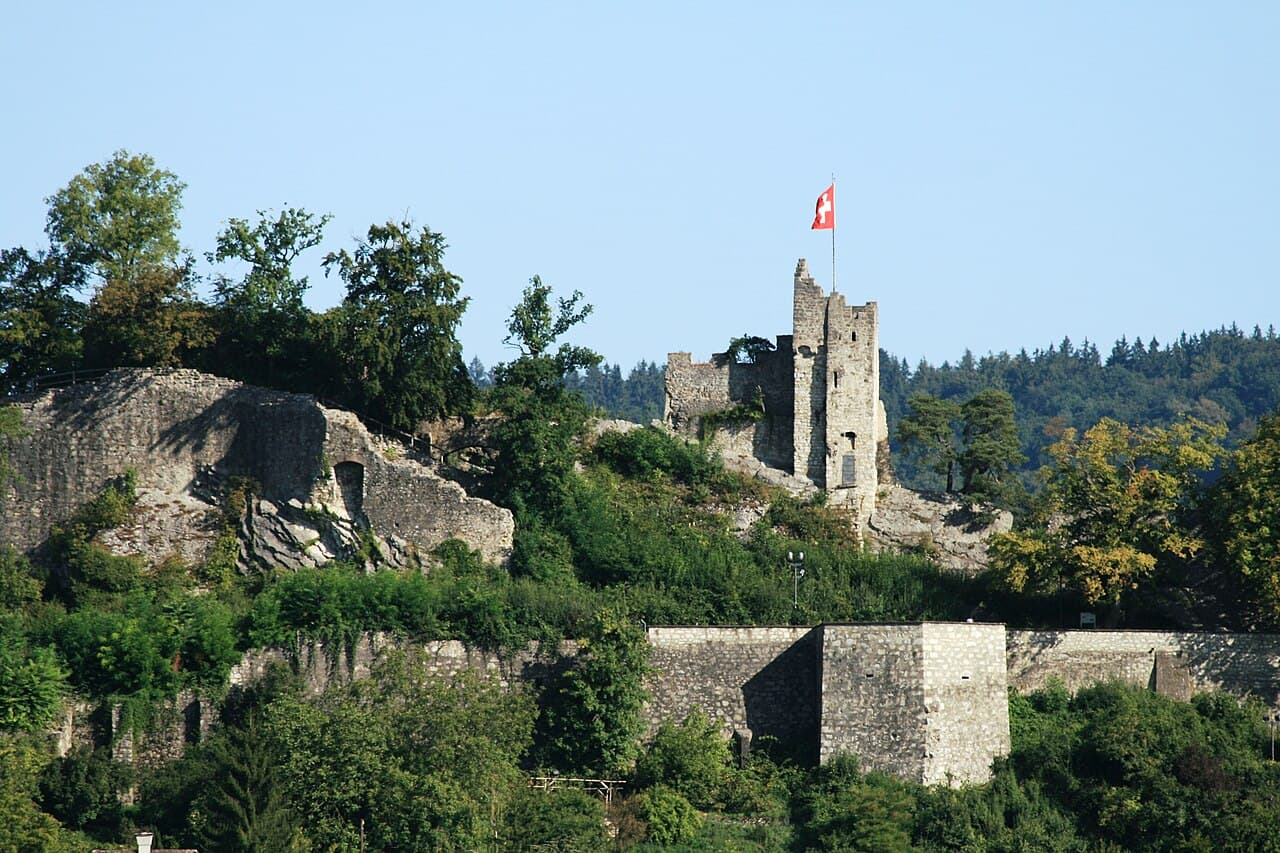
Stein Castle
Stein Castle, known in German as Schloss Stein or Ruine Stein, is a prominent early medieval castle ruin perched on a rocky promontory overlooking the Baden gorge in the canton of Aargau, Switzerland. Constructed before the year 1000 AD, it stands as a significant historical monument reflecting the power struggles and noble lineages of medieval Switzerland. The castle's strategic position provided commanding views of the surrounding landscape, crucial for defense and control of the region.
Early construction and strategic importance
The initial construction of Stein Castle dates back to the 10th century, during a period when fortifications were essential for territorial control amid the fragmented political landscape of early medieval Europe. The castle was built on solid rock, which contributed to its defensive strength and longevity. Its location above the Baden gorge not only offered natural protection but also oversight of key trade routes and local settlements.
Lords and lineage: from lenzburg to habsburg
By the late 11th century, the castle came under the ownership of the influential Lenzburg family, a noble house with significant holdings in the region. Early in the 12th century, a cadet branch of the family residing at Stein adopted the title Counts of Baden, establishing a distinct noble line closely tied to the castle itself. This lineage marked the castle as a seat of regional power and governance.
In 1172, the castle passed to the Kyburg family, another prominent noble house in medieval Switzerland. The Kyburgs were known for their extensive territorial ambitions and influence. Their tenure lasted until the family line ended in 1263, after which the castle was inherited by the Habsburgs in 1264. The Habsburg acquisition marked a significant shift, as the castle became an administrative center for Further Austria (Vorderösterreich), representing Habsburg interests in the region.
Administrative role and military history
Under Habsburg control, Stein Castle served as the seat of a bailiff who managed the local administration. The castle housed important archives, underscoring its role as a center of governance and record-keeping for the Austrian territories in Switzerland. This administrative function made the castle a target during regional conflicts.
In 1415, during a period of Swiss expansion and consolidation, the castle was besieged and destroyed by forces of the Swiss Confederation. This event was part of the wider conflict that saw the Swiss asserting independence from Habsburg rule. The destruction significantly damaged the castle's structure, reducing it to ruins.
Reconstruction and eventual demolition
Despite its destruction, the castle was partially rebuilt between 1658 and 1670. This reconstruction sought to restore some of the castle's defensive and administrative functions. However, this revival was short-lived; in 1712, the castle was deliberately demolished amid the turmoil of the Second War of Villmergen, a conflict that involved religious and political factions within Switzerland.
Since its demolition, Stein Castle has remained in a state of ruin. The remains serve as an important archaeological site, offering insights into medieval fortification techniques and regional history.
Architectural features and archaeological significance
The castle's ruins reveal typical features of early medieval fortifications, including remnants of thick stone walls, defensive battlements, and the foundations of towers and living quarters. The rocky outcrop on which it stands provided a natural defensive advantage, complemented by man-made fortifications.
Archaeological investigations have uncovered artifacts and structural details that illuminate the castle's evolution through the early medieval to the late medieval periods. These findings contribute to understanding the shifting political landscape of medieval Switzerland and the role of noble families in territorial governance.
Heritage status and modern-day significance
Stein Castle is recognized as a Swiss heritage site of national significance. Its ruins attract historians, archaeologists, and visitors interested in medieval history and architecture. The site offers panoramic views of the surrounding area and serves as a tangible connection to the region's feudal past.
Visitors to Baden can explore the ruins and appreciate the castle's historical context within the broader narrative of Swiss independence and noble lineage. Interpretive signage and guided tours provide additional context for the castle's complex history and architectural features.
Frequently asked questions (FAQ)
- What is the historical significance of Stein Castle?
- Stein Castle, located in Baden, Switzerland, dates back to the late 13th century and played a crucial role in the region's defense. It served as a stronghold for the local nobility and has witnessed many historical events, making it a key site for understanding the medieval history of Switzerland.
- How do I get to Stein Castle?
- Stein Castle is easily accessible from the center of Baden by public transport or car. The nearest train station is Baden, from which you can take a short bus ride or enjoy a scenic walk to the castle.
- What are the opening hours of Stein Castle?
- Stein Castle is open to visitors from 10 AM to 5 PM, Tuesday through Sunday. It is closed on Mondays, so plan your visit accordingly to ensure you can explore this historical site.
- Can I take guided tours of Stein Castle?
- Yes, guided tours are available at Stein Castle, providing you with in-depth knowledge about its history and architecture. These tours are led by knowledgeable guides who can answer your questions and share fascinating stories about the castle.
- Is it possible to visit Stein Castle with children?
- Absolutely! Stein Castle is family-friendly and offers engaging activities for children. The castle grounds provide plenty of space for exploration, and children will enjoy the adventure of discovering the castle's history.
- When is the best time to visit Stein Castle?
- The best time to visit Stein Castle is during the spring and early autumn months when the weather is pleasant for outdoor exploration. Additionally, these seasons often see fewer tourists, allowing for a more peaceful experience.
- What are the ticket prices for Stein Castle?
- Ticket prices for Stein Castle are quite reasonable, with adult tickets priced at CHF 10 and discounts available for children and seniors. Family tickets and group rates are also offered, making it an affordable destination for all.
- Are there any nearby attractions to Stein Castle?
- Yes, visitors can explore other attractions near Stein Castle, such as the historic old town of Baden, known for its thermal baths and charming architecture. Additionally, the beautiful surrounding nature offers many hiking trails and scenic views worth discovering.
- Is Stein Castle accessible for people with disabilities?
- Stein Castle strives to be accessible for all visitors, with some areas equipped for those with mobility challenges. However, due to its historical nature, certain parts of the castle may have limited accessibility, so it's advisable to check in advance for specific needs.
Photo gallery

Information
Loading map...
Visitor reviews
No reviews yet. Been here? Write the first review and help other travelers!
Write the first reviewVisited this castle? Share your experience
Your review helps other travelers and adds first-hand knowledge to our encyclopedia.


