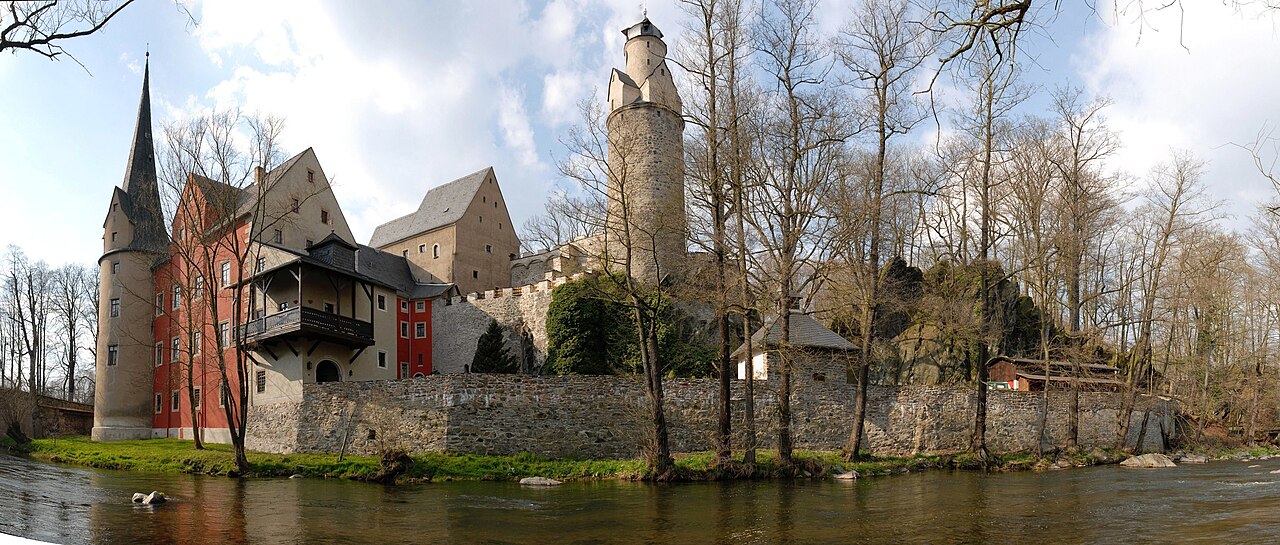
Stein Castle
Stein Castle, located in the municipality of Hartenstein in the German state of Saxony, is a remarkable example of a high medieval hill castle with a rich history spanning over eight centuries. Situated on a rocky spur overlooking the Zwickauer Mulde river, the castle's strategic position was key to controlling an important river crossing and the surrounding territory. Its origins trace back to the early 13th century, with construction likely beginning around 1200, making it one of the region's oldest fortified sites.
The castle complex is divided into the upper ward (Oberburg) and lower ward (Niederburg), each reflecting different phases of architectural development and historical use. The upper ward contains the oldest core of the castle, including a distinctive round bergfried (fortified tower) rising approximately 50 meters, built in the late Romanesque style using local stone. This bergfried features a high entrance designed for defense and was heightened in the 16th century with Renaissance ornamental elements and an 18th-century Baroque dome, illustrating the castle's architectural evolution over time.
Attached to the bergfried is the palas, the main residential building, notable for its great hall and a sturdy round bastion that once guarded the gate to the lower ward. The palas retains original features such as a spiral staircase made from roughly hewn fir wood and a heavy oak door with late Gothic or early Renaissance carvings. Beneath the bergfried once stood a Gothic chapel dating from around 1400, characterized by window tracery and pointed-arch windows, though it was destroyed in the 19th century.
Historical significance and ownership
The first documentary mention of Stein Castle dates to 1135, with more detailed records from 1233 naming Heidenreich of Grünhain, a minor noble, as its owner. The castle's early role was likely as an outer defensive position for the nearby Hartenstein Castle. Over the centuries, Stein Castle changed hands among various noble families, including the Toerring family in the 13th century and later the Schönburg family from 1406 onwards, who retained it until 1945.
Stein Castle is closely linked to the legendary figure of Kunz von Kaufungen, who in 1455 famously kidnapped the sons of Elector Frederick the Gentle, Princes Ernest and Albert, in an event known as the Saxon Princes' Kidnapping. This dramatic episode is a highlight of the castle's turbulent medieval history. The castle also endured a siege during the Great Peasants' Revolt of 1525, when local serfs attempted to capture it, only to be defeated and harshly punished.
In the early 18th century, the castle became the administrative center of the newly independent Barony of Stein, marking its transition from a purely military fortress to a lordly residence. A devastating fire in 1732 destroyed much of the lower ward, which was subsequently rebuilt and renovated in the 19th century, reflecting changing architectural tastes and residential needs.
Architectural features and fortifications
Stein Castle's fortifications include robust defensive walls, water-filled moats, and earthen ramparts that enhanced its natural protection provided by the river. The castle's position on a rocky outcrop made it a formidable hill castle, with additional defenses such as a pointed round tower in the southwest corner of the lower ward, dating from the 14th century. This tower, approximately 32 meters tall, originally featured battlements and a steep conical roof.
The castle complex also included an outer bailey housing practical buildings like a hunter's house and a bone mill, connected to the main castle by a bridge. Historically, a network of wooden and stone bridges crossed the Mulde river near the castle, some covered, with a toll charged until 1924. A modern steel arch bridge was destroyed during World War II and replaced by a concrete bridge in 1950.
The bergfried and palas
The bergfried is a key architectural feature, serving as a lookout and last refuge during sieges. Its high entrance and thick walls demonstrate medieval defensive design. The palas, adjoining the bergfried, was the residential heart of the castle, with spacious halls for living and entertaining, reflecting the castle's role as a noble residence beyond its military function.
Chapel and other structures
The now-lost Gothic chapel beneath the bergfried was an important religious space, indicative of the castle's self-sufficiency and the spiritual needs of its inhabitants. The lower ward's festival hall, featuring a late Gothic ribbed vault, remains a venue for cultural events today, showcasing the castle's adaptation to modern uses.
Modern history and current use
Following the confiscation of the estate in 1945 due to socialist land reforms in East Germany, Stein Castle was repurposed to house a castle and local history museum from 1954. The surrounding estate also saw various uses, including a convalescent home. After German reunification, the castle was repurchased in 1996 by Prince Alfred of Schönburg-Hartenstein, who undertook extensive restoration to preserve its historical and architectural heritage.
Today, Stein Castle remains partially accessible to the public. The upper ward functions primarily as a museum presenting the region's feudal past, cultural heritage, and exhibits related to notable figures such as the poet Paul Fleming. The lower ward continues to serve administrative and residential purposes, including hosting forestry offices and private residences of the princely family.
Stein Castle is also notable as Germany's most important cave castle, with archaeological remains nearby including a medieval defensive earthwork known as "Ur-Stein," featuring a large round mound and ditches, protected as an archaeological monument since 1958.
Notable legends and cultural significance
The legend of the robber knight Hainz von Stein dem Wilden, purported to have lived at the castle in the early 13th century, adds a romantic dimension to Stein Castle's history. The story was first recorded in the 18th century and contributes to the castle's allure as a site of medieval mystery and intrigue.
The castle's association with the Saxon Princes' Kidnapping and its role during the Great Peasants' Revolt highlight its importance in Saxony's political and social history. Its preservation and museum function today ensure that Stein Castle remains a vital cultural landmark, offering insight into medieval fortification, noble life, and regional heritage.
Frequently asked questions (FAQ)
- How do I visit Stein Castle and what are the opening hours?
- Stein Castle is partially accessible to the public, with the upper ward housing a museum open seasonally. Visitors should check the official website or local tourist information for current opening hours and guided tour availability.
- What is the historical significance of Stein Castle?
- Stein Castle is historically significant as a high medieval hill castle with connections to notable events such as the Saxon Princes' Kidnapping in 1455 and the Great Peasants' Revolt of 1525. It also served as a noble residence for the Schönburg family for centuries.
- Can I see the medieval architecture at Stein Castle?
- Yes, visitors can observe well-preserved elements such as the late Romanesque bergfried, the palas with Gothic and Renaissance features, and the 14th-century pointed round tower in the lower ward. The castle's fortifications and layout reflect typical medieval defensive design.
- Is Stein Castle accessible for people with mobility issues?
- Due to its medieval construction on a rocky hill and historic structures, accessibility may be limited in some areas. Visitors with mobility concerns should contact the museum in advance to inquire about accommodations.
- What are nearby attractions to visit along with Stein Castle?
- Nearby attractions include the town of Hartenstein with its historic sites, the Zwickauer Mulde river valley offering scenic nature walks, and other castles and cultural landmarks in Saxony. Visitors often combine castle visits with exploring regional heritage.
Information
Sources & official resources
Verify the information above using these authoritative references.
Loading map...
Visitor reviews
No reviews yet. Been here? Write the first review and help other travelers!
Write the first reviewVisited this castle? Share your experience
Your review helps other travelers and adds first-hand knowledge to our encyclopedia.