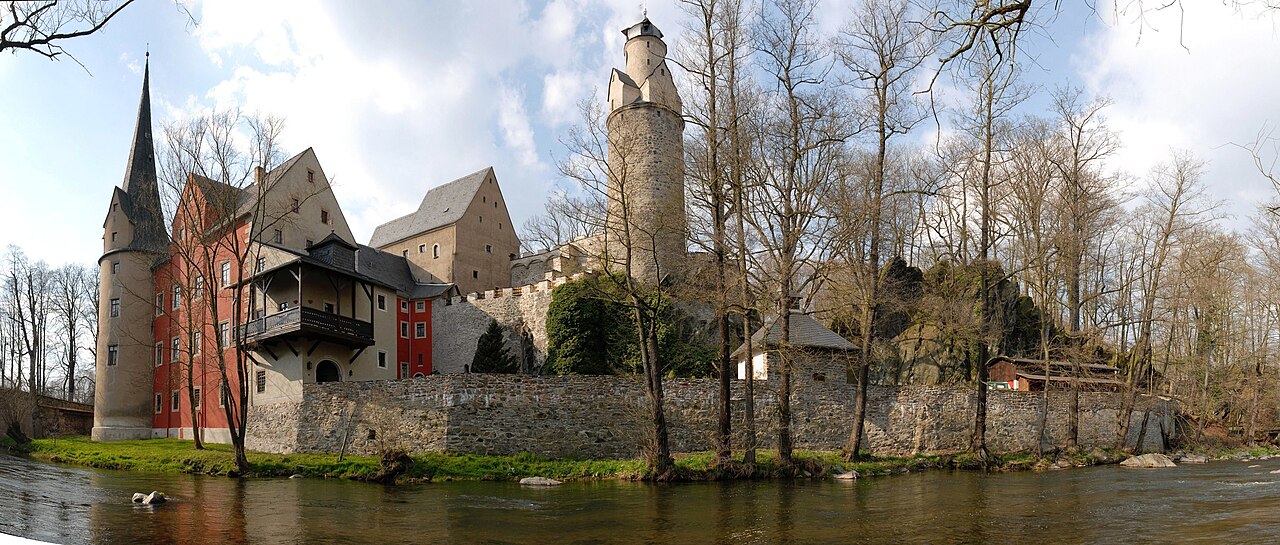
Hartenstein Castle
Hartenstein Castle, often referred to as the "Pearl of the Ore Mountains", is a historically significant fortress located in Hartenstein, Saxony, Germany. Its origins trace back to the 12th century, placing its foundation firmly in the High Medieval period. The castle's strategic position and architectural evolution reflect the complex feudal history and noble lineages of the region.
The early history and ownership of Hartenstein Castle
The earliest known proprietor of the castle was Meinher I von Werben, who held the title of Burgrave of Meißen in 1173. This association situates the castle within the broader political landscape of medieval Saxony. By the early 15th century, specifically from 1406, the county of Hartenstein, including the castle and its surrounding villages and forests, was pledged to the Schönburg family. This transfer marked the beginning of a long-standing influence of the Schönburgs in the region.
The settlement of ownership disputes
A notable event in the castle's history occurred in 1439 when Veit II von Schönburg married Anna von Plauen from the Reuss family. This marriage effectively resolved protracted conflicts over the ownership of the county of Hartenstein, which included both Hartenstein Castle and Stein Castle. The union symbolized a political alliance that stabilized the region's noble power structures.
Architectural evolution through the centuries
During the 16th century, significant transformations reshaped Hartenstein Castle under the direction of Ernst II von Schönburg. The castle was rebuilt into a more modern fortress, with a notable construction date of 1530. Above the main gate, a Schönburg coat of arms stone commemorates these renovations, marking a period of architectural renewal.
Further modifications and additions
In 1572, Hugo II von Schönburg-Waldenburg oversaw additional modifications and repairs, enhancing the castle's defensive and residential functions. A significant adaptation occurred in 1584 when the former armory located within the inner castle was converted into a chapel, reflecting the castle's evolving role as a noble residence with religious functions.
The construction of a new castle tower in 1606 further altered the castle's silhouette, adding to its defensive capabilities and architectural complexity.
19th and 20th-century transformations and destruction
At the dawn of the 19th century, Prince Friedrich Alfred von Schönburg initiated a major rebuilding of Hartenstein Castle in the neo-Gothic style. This architectural revival was part of a broader European trend that sought to romanticize medieval forms through pointed arches, decorative battlements, and intricate stonework. However, some of these neo-Gothic modifications were partially reversed in the early 20th century before 1945.
The castle complex featured an oval floor plan and remained largely intact until the final days of World War II. On April 20, 1945, the castle suffered near-total destruction due to American bombing. This devastation was linked to the presence of SS units hiding in the nearby Hartenstein Forest, which made the castle a military target.
Post-war use and preservation efforts
Following the war, the surviving buildings in the outer courtyard were repurposed for residential use. The castle ruins themselves found a new role as an open-air stage, hosting cultural events amid the historic remains. Since 2002, the association Schlossruine Hartenstein e.V. has been dedicated to preserving and partially reconstructing the castle, aiming to safeguard its historical and architectural legacy.
Notable historical events linked to Hartenstein Castle
The Altenburg prince robbery and the castle's role
One of the castle's most dramatic historical episodes is connected to the prince robbery in Altenburg on the night of July 8, 1455. A group of kidnappers led by knights Wilhelm von Mosen and Wilhelm von Schönfeld allegedly handed over the young Prince Ernst of Elector Saxony to Friedrich XX von Schönburg at Hartenstein Castle on July 11, 1455. Friedrich XX, who was Lord von Waldenburg and co-owner of Glauchau since 1446, escorted the prince to Chemnitz to reunite him with his father, Elector Friedrich the Meek (1428–1464).
Alternative accounts suggest the handover occurred at Stein Castle near Hartenstein, with the prince only brought to Hartenstein Castle afterward. This event underscores the castle's strategic importance in regional power dynamics during the 15th century.
Architectural features and layout
Hartenstein Castle's architecture evolved from a medieval fortress to a Renaissance residence and later a neo-Gothic revivalist structure. The castle originally had an oval floor plan, a layout that provided effective defense and efficient use of space. The main gate with its coat of arms stone remains a key architectural highlight, symbolizing the Schönburg family's heritage.
The castle tower built in 1606 stands as a testament to the castle's military function, offering a vantage point for surveillance and defense. The transformation of the former armory into a chapel illustrates the integration of religious life within the castle walls.
Defensive structures and residential elements
The castle was surrounded by fortified walls and included an outer courtyard that housed auxiliary buildings. These structures supported the castle's role as both a defensive stronghold and a noble residence. The evolution of the castle's architecture reflects changing military technologies and residential needs over several centuries.
Hartenstein Castle today
Today, Hartenstein Castle stands as a partially preserved ruin with ongoing efforts to restore and maintain its historical structures. The site serves as a cultural venue and a reminder of the region's medieval and early modern heritage. Visitors can explore the ruins and learn about the castle's layered history through interpretive displays and guided tours organized by local heritage groups.
The castle's location in the Ore Mountains region adds to its appeal, offering scenic views and a connection to Saxony's rich historical landscape.
Frequently asked questions (FAQ)
- How do I get to Hartenstein Castle?
- Hartenstein Castle is located in the picturesque town of Hartenstein, Germany. You can easily reach it by car via the A72 motorway or by taking public transportation, with nearby train stations providing access to local bus services that lead directly to the castle.
- What is the historical significance of Hartenstein Castle?
- Hartenstein Castle dates back to the 13th century and has played a pivotal role in the region's history. Originally built as a fortification, it has witnessed numerous historical events and changes in ownership, reflecting the rich heritage of the area.
- When was Hartenstein Castle last renovated?
- Hartenstein Castle underwent significant renovations in the late 20th century to preserve its structure and historical features. These efforts have made the castle accessible to visitors while maintaining its authentic medieval charm.
- Can I take guided tours of Hartenstein Castle?
- Yes, guided tours of Hartenstein Castle are available, providing visitors with in-depth insights into its history and architecture. Tours typically run on weekends and public holidays, so it's best to check the schedule in advance to ensure availability.
- Why is Hartenstein Castle a popular tourist destination?
- Hartenstein Castle attracts visitors due to its stunning architecture, beautiful surroundings, and rich history. The castle's strategic location offers panoramic views of the Erzgebirge mountains, making it a perfect spot for both history enthusiasts and nature lovers.
- Is it possible to host events at Hartenstein Castle?
- Yes, Hartenstein Castle offers facilities for hosting various events, including weddings, conferences, and private gatherings. The picturesque setting and historic ambiance make it a unique venue for special occasions.
- What are the opening hours for Hartenstein Castle?
- Hartenstein Castle is typically open to visitors from April to October, with varying hours throughout the week. It's advisable to check the official website for the most current opening times, especially during holidays.
- What are the ticket prices for visiting Hartenstein Castle?
- Ticket prices for Hartenstein Castle are quite reasonable, with discounts available for students and seniors. Children under a certain age can enter for free, making it an affordable family outing.
- What nearby attractions can I visit while at Hartenstein Castle?
- While visiting Hartenstein Castle, you can explore nearby attractions such as the charming town of Hartenstein, the scenic hiking trails in the Erzgebirge, and other historical sites in the region. These attractions offer a well-rounded experience for visitors looking to immerse themselves in local culture and nature.
Information
Loading map...
Visitor reviews
No reviews yet. Been here? Write the first review and help other travelers!
Write the first reviewVisited this castle? Share your experience
Your review helps other travelers and adds first-hand knowledge to our encyclopedia.