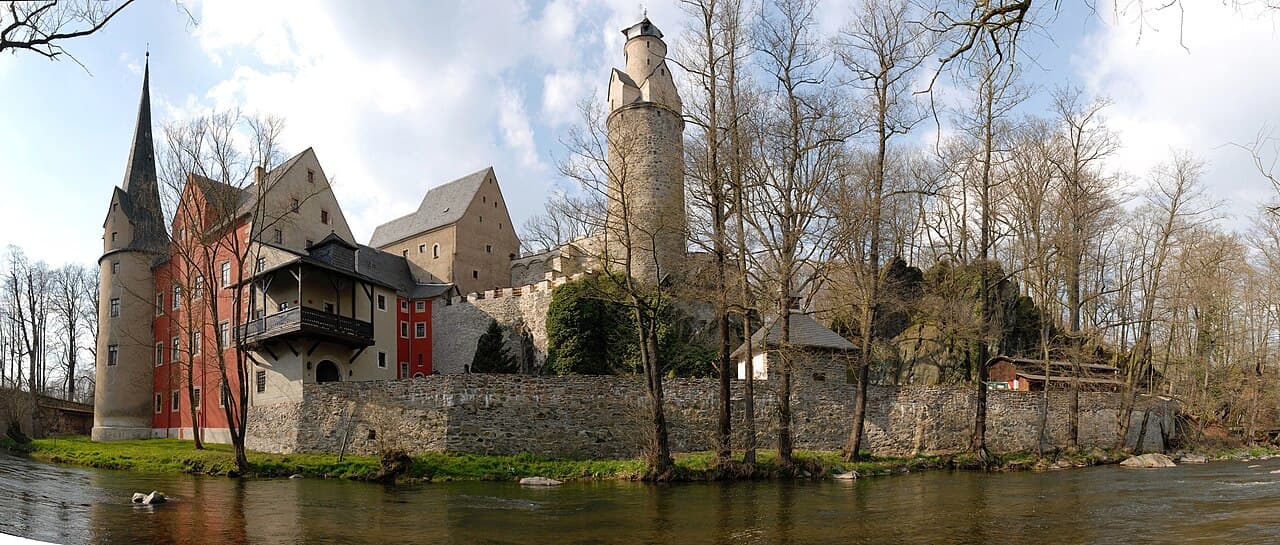
Stein Castle (Saxony) — Germany castle

Stein Castle (Saxony)

Stein Castle in Saxony: medieval hill castle on the Zwickauer Mulde
High Medieval (11th–13th c.)
Well Preserved

Stein Castle (German: Burg Stein or Burg und Schloss Stein) is a prominent high medieval hill castle situated in the village of Stein, within the municipality of Hartenstein, southeast of Zwickau in the German state of Saxony. Built in the 12th century, this castle occupies a strategic position on the rocky banks of the Zwickauer Mulde river, utilizing the natural landscape for defense and control over the surrounding region.

Historical background and significance

The origins of Stein Castle date back to the high medieval period, a time when the region was marked by feudal fragmentation and the construction of numerous fortifications to assert territorial control. The castle was likely established by local nobility to oversee trade routes and protect the area from rival lords. Its location on a rocky promontory offered a commanding view of the valley and the river, which was essential for monitoring movement and potential threats.

Throughout its history, Stein Castle has witnessed various phases of ownership and architectural development, reflecting the changing political and military landscape of Saxony. It served not only as a defensive stronghold but also as a residence for noble families and a center of local administration.

Architectural features and layout

Defensive structures

Stein Castle exemplifies typical hill castle architecture of the high medieval era. Its construction incorporates the natural rocky terrain to enhance its fortifications. The castle is built on a steep rock outcrop overlooking the Zwickauer Mulde, which forms a natural moat on one side, limiting access and providing a defensive advantage.

The castle complex includes a keep or donjon, which served as the last line of defense and the residence of the lord. Surrounding the keep are curtain walls with battlements and defensive towers positioned to cover all approaches. The entrance was likely protected by a gatehouse and possibly a drawbridge, typical of castles from this period.

Residential and functional buildings

Within the walls, the castle contained various buildings such as the great hall, living quarters, a chapel, storage rooms, and workshops. These structures were arranged to maximize defense while providing the necessary amenities for daily life and governance.

Strategic location and environment

Stein Castle's placement on the rocky banks of the Zwickauer Mulde gave it a natural defensive advantage and control over river traffic. The surrounding terrain is characterized by steep slopes and dense forests, which further complicated any attacking force's approach. Its elevated position allowed for early warning of enemy movements and facilitated communication with other nearby fortifications.

Preservation and current status

Today, Stein Castle is well preserved and remains a significant cultural monument in Saxony. It attracts visitors interested in medieval architecture and history. The castle has undergone restoration efforts to maintain its structural integrity and to preserve its historical character. It stands as a testament to the medieval fortification techniques and the region's feudal past.

Visitors can explore the castle grounds, including the defensive walls, towers, and internal buildings, gaining insight into the medieval way of life. Its scenic location also offers picturesque views of the Zwickauer Mulde valley.

Visiting information and accessibility

Stein Castle is accessible to the public, with guided tours available during certain times of the year. The castle's location near Hartenstein makes it reachable by car and local transport. Visitors should check opening hours and ticket prices in advance, as these may vary seasonally.

Architectural style and influences

Stein Castle's architecture reflects the Romanesque and early Gothic styles typical of the 12th century, characterized by robust stone construction, rounded arches, and simple yet effective defensive features. Over the centuries, modifications and additions may have introduced elements from later architectural movements, but the core medieval character remains dominant.

Frequently asked questions (FAQ)

How do I get to Stein Castle?
Stein Castle is located in Saxony, Germany, and is easily accessible by car or public transportation. The nearest major city is Dresden, which is about 30 kilometers away, and there are local bus services that can take you close to the castle.
What is the historical significance of Stein Castle?
Stein Castle dates back to the late 15th century and played a crucial role in the regional politics of Saxony. It served as a stronghold and residence for various noble families, reflecting the architectural and cultural evolution of the period.
When was Stein Castle built?
Construction of Stein Castle began in 1494 and was completed in the early 16th century. Over the centuries, it has undergone several renovations, preserving its historical charm while adapting to modern needs.
Can I take guided tours of Stein Castle?
Yes, guided tours are available for visitors, offering insights into the castle's rich history and architectural features. These tours typically last about an hour and are available in multiple languages, making it accessible for international guests.
Why is Stein Castle considered an architectural gem?
Stein Castle is renowned for its unique blend of Gothic and Renaissance architectural styles, which showcase intricate details and craftsmanship. The castle's towers, walls, and interiors reflect the grandeur of its era, making it a fascinating study for architecture enthusiasts.
Is it possible to visit Stein Castle year-round?
Yes, Stein Castle is open to visitors throughout the year, although hours may vary by season. It's advisable to check the official website for specific opening hours and any seasonal events before planning your visit.
What are the ticket prices for visiting Stein Castle?
Ticket prices for Stein Castle are quite affordable, with discounts available for students, seniors, and families. A general admission ticket typically ranges from €5 to €10, but check the official site for the most current pricing and any special offers.
What is the best time to visit Stein Castle?
The best time to visit Stein Castle is during the spring and early fall when the weather is pleasant and the gardens are in bloom. Summer months can be busy with tourists, while winter offers a serene atmosphere, albeit with colder temperatures.
Are there any nearby attractions to Stein Castle?
Absolutely! Nearby attractions include the picturesque town of Pirna, known for its historic architecture, and the stunning Saxon Switzerland National Park, perfect for outdoor enthusiasts. Both destinations can easily complement your visit to Stein Castle.

Photo gallery

Stein Castle (Saxony)
Click to view

Photo by Caulobacter subvibrioides•CC BY-SA 3.0

1 photo • Click any image to view in full screen

Information

Hill Castle

Loading map...

Visitor reviews

No reviews yet. Been here? Write the first review and help other travelers!

Write the first review

Visited this castle? Share your experience

Your review helps other travelers and adds first-hand knowledge to our encyclopedia.

Write a review

(5/5)

0/2000 characters

Your review will be visible after admin approval

Nearby castles

1.3 km

Stein Castle

Hartenstein, Germany

Stein Castle, located in the municipality of Hartenstein in the German state of Saxony, is a remarkable example of a high medieval hill castle with a rich history spanning over eight centuries. Situated on a rocky spur overlooking the Zwickauer Mulde river, the castle's strategic position was key to controlling an important river crossing and the surrounding territory. Its origins trace back to the early 13th century, with construction likely beginning around 1200, making it one of the region's oldest fortified sites. The castle complex is divided into the upper ward (Oberburg) and lower ward (Niederburg), each reflecting different phases of architectural development and historical use. The upper ward contains the oldest core of the castle, including a distinctive round bergfried (fortified tower) rising approximately 50 meters, built in the late Romanesque style using local stone. This bergfried features a high entrance designed for defense and was heightened in the 16th century with Renaissance ornamental elements and an 18th-century Baroque dome, illustrating the castle's architectural evolution over time. Attached to the bergfried is the palas, the main residential building, notable for its great hall and a sturdy round bastion that once guarded the gate to the lower ward. The palas retains original features such as a spiral staircase made from roughly hewn fir wood and a heavy oak door with late Gothic or early Renaissance carvings. Beneath the bergfried once stood a Gothic chapel dating from around 1400, characterized by window tracery and pointed-arch windows, though it was destroyed in the 19th century. Historical significance and ownership The first documentary mention of Stein Castle dates to 1135, with more detailed records from 1233 naming Heidenreich of Grünhain, a minor noble, as its owner. The castle's early role was likely as an outer defensive position for the nearby Hartenstein Castle. Over the centuries, Stein Castle changed hands among various noble families, including the Toerring family in the 13th century and later the Schönburg family from 1406 onwards, who retained it until 1945. Stein Castle is closely linked to the legendary figure of Kunz von Kaufungen, who in 1455 famously kidnapped the sons of Elector Frederick the Gentle, Princes Ernest and Albert, in an event known as the Saxon Princes' Kidnapping. This dramatic episode is a highlight of the castle's turbulent medieval history. The castle also endured a siege during the Great Peasants' Revolt of 1525, when local serfs attempted to capture it, only to be defeated and harshly punished. In the early 18th century, the castle became the administrative center of the newly independent Barony of Stein, marking its transition from a purely military fortress to a lordly residence. A devastating fire in 1732 destroyed much of the lower ward, which was subsequently rebuilt and renovated in the 19th century, reflecting changing architectural tastes and residential needs. Architectural features and fortifications Stein Castle's fortifications include robust defensive walls, water-filled moats, and earthen ramparts that enhanced its natural protection provided by the river. The castle's position on a rocky outcrop made it a formidable hill castle, with additional defenses such as a pointed round tower in the southwest corner of the lower ward, dating from the 14th century. This tower, approximately 32 meters tall, originally featured battlements and a steep conical roof. The castle complex also included an outer bailey housing practical buildings like a hunter's house and a bone mill, connected to the main castle by a bridge. Historically, a network of wooden and stone bridges crossed the Mulde river near the castle, some covered, with a toll charged until 1924. A modern steel arch bridge was destroyed during World War II and replaced by a concrete bridge in 1950. The bergfried and palas The bergfried is a key architectural feature, serving as a lookout and last refuge during sieges. Its high entrance and thick walls demonstrate medieval defensive design. The palas, adjoining the bergfried, was the residential heart of the castle, with spacious halls for living and entertaining, reflecting the castle's role as a noble residence beyond its military function. Chapel and other structures The now-lost Gothic chapel beneath the bergfried was an important religious space, indicative of the castle's self-sufficiency and the spiritual needs of its inhabitants. The lower ward's festival hall, featuring a late Gothic ribbed vault, remains a venue for cultural events today, showcasing the castle's adaptation to modern uses. Modern history and current use Following the confiscation of the estate in 1945 due to socialist land reforms in East Germany, Stein Castle was repurposed to house a castle and local history museum from 1954. The surrounding estate also saw various uses, including a convalescent home. After German reunification, the castle was repurchased in 1996 by Prince Alfred of Schönburg-Hartenstein, who undertook extensive restoration to preserve its historical and architectural heritage. Today, Stein Castle remains partially accessible to the public. The upper ward functions primarily as a museum presenting the region's feudal past, cultural heritage, and exhibits related to notable figures such as the poet Paul Fleming. The lower ward continues to serve administrative and residential purposes, including hosting forestry offices and private residences of the princely family. Stein Castle is also notable as Germany's most important cave castle, with archaeological remains nearby including a medieval defensive earthwork known as "Ur-Stein," featuring a large round mound and ditches, protected as an archaeological monument since 1958. Notable legends and cultural significance The legend of the robber knight Hainz von Stein dem Wilden, purported to have lived at the castle in the early 13th century, adds a romantic dimension to Stein Castle's history. The story was first recorded in the 18th century and contributes to the castle's allure as a site of medieval mystery and intrigue. The castle's association with the Saxon Princes' Kidnapping and its role during the Great Peasants' Revolt highlight its importance in Saxony's political and social history. Its preservation and museum function today ensure that Stein Castle remains a vital cultural landmark, offering insight into medieval fortification, noble life, and regional heritage.

High Medieval (11th–13th c.)
Details
1.5 km

Hartenstein Castle

Hartenstein, Germany

Hartenstein Castle, often referred to as the "Pearl of the Ore Mountains", is a historically significant fortress located in Hartenstein, Saxony, Germany. Its origins trace back to the 12th century, placing its foundation firmly in the High Medieval period. The castle's strategic position and architectural evolution reflect the complex feudal history and noble lineages of the region. The early history and ownership of Hartenstein Castle The earliest known proprietor of the castle was Meinher I von Werben, who held the title of Burgrave of Meißen in 1173. This association situates the castle within the broader political landscape of medieval Saxony. By the early 15th century, specifically from 1406, the county of Hartenstein, including the castle and its surrounding villages and forests, was pledged to the Schönburg family. This transfer marked the beginning of a long-standing influence of the Schönburgs in the region. The settlement of ownership disputes A notable event in the castle's history occurred in 1439 when Veit II von Schönburg married Anna von Plauen from the Reuss family. This marriage effectively resolved protracted conflicts over the ownership of the county of Hartenstein, which included both Hartenstein Castle and Stein Castle. The union symbolized a political alliance that stabilized the region's noble power structures. Architectural evolution through the centuries During the 16th century, significant transformations reshaped Hartenstein Castle under the direction of Ernst II von Schönburg. The castle was rebuilt into a more modern fortress, with a notable construction date of 1530. Above the main gate, a Schönburg coat of arms stone commemorates these renovations, marking a period of architectural renewal. Further modifications and additions In 1572, Hugo II von Schönburg-Waldenburg oversaw additional modifications and repairs, enhancing the castle's defensive and residential functions. A significant adaptation occurred in 1584 when the former armory located within the inner castle was converted into a chapel, reflecting the castle's evolving role as a noble residence with religious functions. The construction of a new castle tower in 1606 further altered the castle's silhouette, adding to its defensive capabilities and architectural complexity. 19th and 20th-century transformations and destruction At the dawn of the 19th century, Prince Friedrich Alfred von Schönburg initiated a major rebuilding of Hartenstein Castle in the neo-Gothic style. This architectural revival was part of a broader European trend that sought to romanticize medieval forms through pointed arches, decorative battlements, and intricate stonework. However, some of these neo-Gothic modifications were partially reversed in the early 20th century before 1945. The castle complex featured an oval floor plan and remained largely intact until the final days of World War II. On April 20, 1945, the castle suffered near-total destruction due to American bombing. This devastation was linked to the presence of SS units hiding in the nearby Hartenstein Forest, which made the castle a military target. Post-war use and preservation efforts Following the war, the surviving buildings in the outer courtyard were repurposed for residential use. The castle ruins themselves found a new role as an open-air stage, hosting cultural events amid the historic remains. Since 2002, the association Schlossruine Hartenstein e.V. has been dedicated to preserving and partially reconstructing the castle, aiming to safeguard its historical and architectural legacy. Notable historical events linked to Hartenstein Castle The Altenburg prince robbery and the castle's role One of the castle's most dramatic historical episodes is connected to the prince robbery in Altenburg on the night of July 8, 1455. A group of kidnappers led by knights Wilhelm von Mosen and Wilhelm von Schönfeld allegedly handed over the young Prince Ernst of Elector Saxony to Friedrich XX von Schönburg at Hartenstein Castle on July 11, 1455. Friedrich XX, who was Lord von Waldenburg and co-owner of Glauchau since 1446, escorted the prince to Chemnitz to reunite him with his father, Elector Friedrich the Meek (1428–1464). Alternative accounts suggest the handover occurred at Stein Castle near Hartenstein, with the prince only brought to Hartenstein Castle afterward. This event underscores the castle's strategic importance in regional power dynamics during the 15th century. Architectural features and layout Hartenstein Castle's architecture evolved from a medieval fortress to a Renaissance residence and later a neo-Gothic revivalist structure. The castle originally had an oval floor plan, a layout that provided effective defense and efficient use of space. The main gate with its coat of arms stone remains a key architectural highlight, symbolizing the Schönburg family's heritage. The castle tower built in 1606 stands as a testament to the castle's military function, offering a vantage point for surveillance and defense. The transformation of the former armory into a chapel illustrates the integration of religious life within the castle walls. Defensive structures and residential elements The castle was surrounded by fortified walls and included an outer courtyard that housed auxiliary buildings. These structures supported the castle's role as both a defensive stronghold and a noble residence. The evolution of the castle's architecture reflects changing military technologies and residential needs over several centuries. Hartenstein Castle today Today, Hartenstein Castle stands as a partially preserved ruin with ongoing efforts to restore and maintain its historical structures. The site serves as a cultural venue and a reminder of the region's medieval and early modern heritage. Visitors can explore the ruins and learn about the castle's layered history through interpretive displays and guided tours organized by local heritage groups. The castle's location in the Ore Mountains region adds to its appeal, offering scenic views and a connection to Saxony's rich historical landscape.

High Medieval (11th–13th c.)
Details
2.2 km

Isenburg Castle Ruins

Hartenstein, Germany

Isenburg Castle ruins are perched high above the valley of the Zwickauer Mulde near Hartenstein, Germany. This high medieval spur castle dates back to the 12th century, as confirmed by archaeological finds, though its detailed history remains largely undocumented. The castle's strategic location on a rocky spur provided natural defense advantages, typical of medieval fortifications designed to control important river valleys and trade routes. The origins and historical context of Isenburg Castle Isenburg was constructed during the high medieval period, a time when numerous castles were built across the German lands to assert territorial control and protect against rival nobles and external threats. While no contemporary written records survive to detail the castle's founders or its role, archaeological evidence and later oral traditions provide clues about its significance. The castle was likely established by a local noble family seeking to dominate the surrounding region and control passage along the Zwickauer Mulde river. The castle's name, Isenburg, is believed to derive from the German word for iron (eisen), reflecting either the strength of its fortifications or its association with robber barons, as local oral tradition suggests. The first known written reference to the castle dates to 1738, long after its destruction, when it was described as a "robber castle" or "robber baron stronghold" (Raubritterburg), indicating its reputation in regional folklore. Architectural features and layout of the spur castle Isenburg was a classic example of a spur castle, built on a narrow ridge or spur of a hill, which provided natural defenses on multiple sides. The castle's remains show typical medieval defensive elements, including stone curtain walls that once enclosed the inner ward, remnants of a gatehouse, and traces of towers that would have provided vantage points for surveillance and defense. The castle's position above the valley allowed defenders to monitor and control traffic along the river and surrounding roads. The terrain limited the size of the castle, which was likely compact but efficiently designed for defense. The use of local stone in construction contributed to the castle's durability, though much of the masonry was later dismantled. Destruction and subsequent use of the ruins Isenburg Castle was destroyed by the 14th century under circumstances that remain unclear due to the absence of contemporary records. Theories range from military siege to deliberate demolition during regional conflicts or feuds common in the medieval period. After its destruction, the castle was never rebuilt as a noble residence or fortress. Despite its ruinous state, the castle's remnants served a practical purpose for local inhabitants. From the 15th to 17th centuries, villagers used the ruins as a refuge during times of unrest, such as peasant uprisings or military incursions. This adaptive reuse highlights the continuing strategic value of the site even after its original function had ended. In the mid-18th century, around 1750, much of the remaining stonework was quarried to provide building materials for the construction of the stone church in Wildbach. This recycling of castle masonry was common in the region, contributing to the gradual disappearance of many medieval fortresses. Visiting Isenburg Castle ruins today The ruins of Isenburg Castle are accessible primarily by foot, offering visitors a scenic and historically rich hiking experience. The recommended route begins at Hartenstein railway station, approximately a 30-minute walk from the site. Just 200 meters from the station lies Stein Castle, another historic site, before the path crosses the Zwickauer Mulde river near Schloss Wolfsbrunn. From there, the trail leads through the Poppenwald forest, running upstream alongside the river. Visitors encounter a steep climb known locally as "Sanfter Heinrich" ("Gentle Henry"), after which the path forks. Taking the right fork leads past the Wildbach Church on an easy forest trail, with signs directing hikers to the ruins about 700 meters further on. The left fork offers a more adventurous route called the "Raubrittersteig" or "Robber Baron Climb," a narrow and romantic path along the riverbank. This trail is celebrated for its natural beauty and historical atmosphere, making it one of the most attractive walks in the Mulde Valley. Isenburg's place in regional heritage and folklore Though Isenburg Castle's historical record is sparse, its legacy endures through local legend and cultural memory. The castle's reputation as a "robber baron" stronghold reflects the turbulent medieval period in Saxony, when many castles were centers of feuding and banditry. This folklore adds a layer of intrigue to the ruins and attracts visitors interested in medieval history and mystery. Today, the ruins are protected as a cultural monument, offering insight into medieval castle construction and the dynamics of territorial control in the high medieval era. The site also provides educational opportunities for archaeology and history enthusiasts, with ongoing interest in uncovering more about the castle's origins and role.

High Medieval (11th–13th c.)
Details

