Stara Lubowla
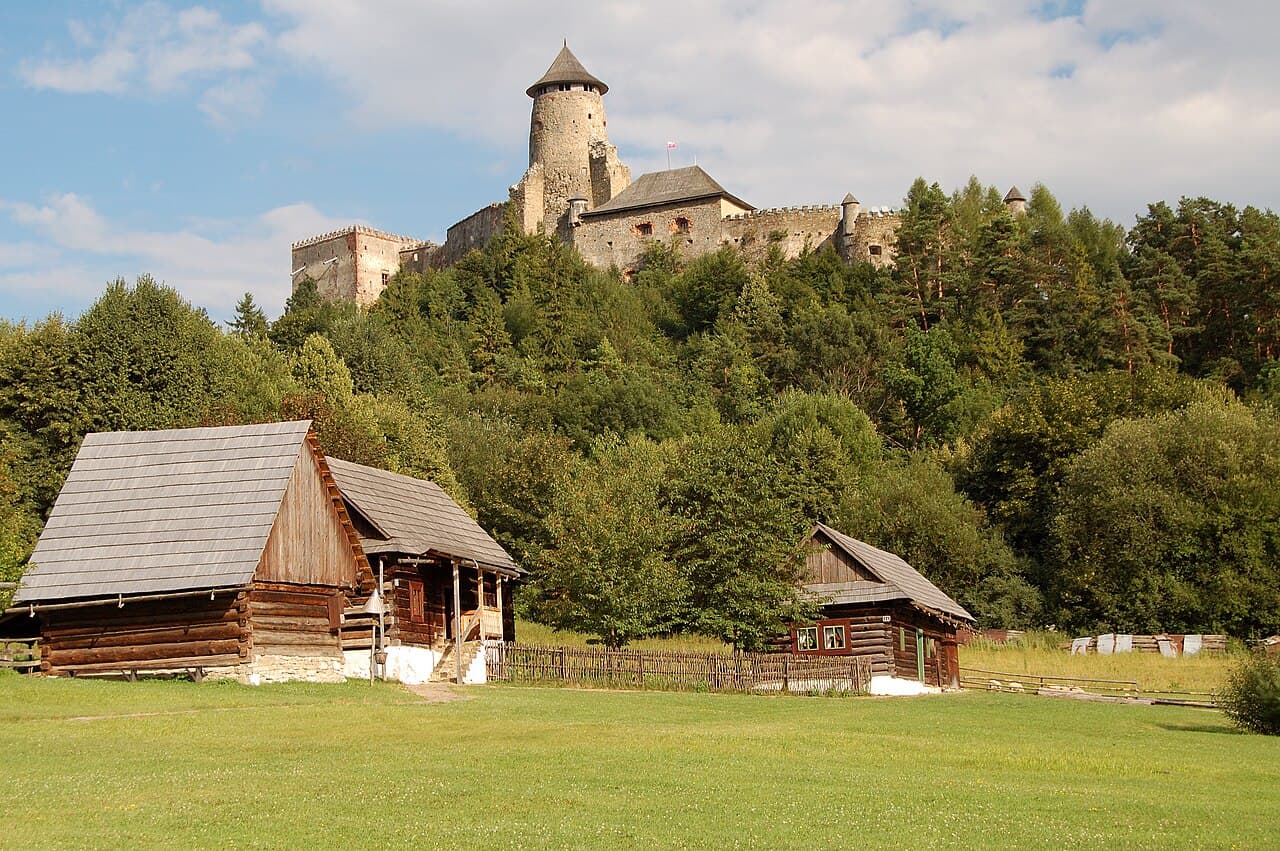
Ľubovňa Castle, located in the town of Stará Ľubovňa in present-day Slovakia, is a remarkable example of a late-medieval bastioned fortress with a rich history spanning over seven centuries. Perched strategically atop a limestone hill rising 548 meters above sea level, the castle was originally constructed to guard the northern borders of the Kingdom of Hungary and to protect vital trade routes leading to the Kingdom of Poland. Its commanding position overlooking the valley of the Poprad River made it a crucial military and administrative center throughout the medieval and early modern periods.
The castle's origins date back to the early 14th century, with the most probable founding year around 1311. It is traditionally attributed to the Hungarian magnate Omodej Aba, who served as the župan (county head) of Spiš and played a significant role in the region's defense. The initial fortress consisted of a massive circular tower approximately 12.45 meters in diameter, with walls nearly 3 meters thick, accompanied by an early Gothic palace. These structures were built from locally quarried limestone at the summit of the hill, surrounded by a defensive wall and a dry moat carved into the rock on the southern side. The main entrance was through a small gate tower reinforced with a defensive pit known as a "wolf's pit."
Historical significance and political role
Ľubovňa Castle played a pivotal role in the turbulent history of Central Europe, especially in the context of Hungarian-Polish relations. After the death of Omodej Aba, the castle became a focal point of conflict between his widow and King Charles Robert of Hungary, leading to a royal siege in 1312. The castle was then granted to loyal supporters of the king, including the Drugeth family, before reverting to royal ownership under King Louis I in the mid-14th century.
Its proximity to the Polish-Hungarian border made Ľubovňa a frequent site for diplomatic meetings and negotiations between monarchs. Notably, in 1412, the castle was the venue for a historic agreement between King Sigismund of Hungary and King Władysław Jagiełło of Poland. This treaty resulted in the pledge of the castle and thirteen nearby Spiš towns to Poland as collateral for a substantial loan of 37,000 Prague groschen. This arrangement lasted for 360 years, during which the castle served as the administrative center for the Polish trustees overseeing the Spiš region.
The castle during the renaissance and baroque periods
The castle underwent significant transformations in the 16th and 17th centuries, reflecting changing military technologies and architectural styles. After a devastating fire in 1553, the fortress was rebuilt in the Renaissance style, incorporating new defensive features such as bastions and artillery towers to withstand cannon fire. The upper castle was divided into two parts: the original Gothic structures and a newly constructed Renaissance palace with five stories on the front and three on the rock-facing side, notable for its thick, windowless walls on the eastern and northern sides.
The lower castle was fortified with a defensive wall pierced by numerous embrasures and included a two-level bastion with sixteen firing slits. Additional buildings such as a kitchen, smithy, and a deep well (150 meters) were integrated within the complex. In the 17th century, the powerful Polish-Lithuanian Lubomirski family acquired the castle and further enhanced its fortifications in the Baroque style. They added a new gate with a drawbridge, an eastern bastion replacing older defenses, and a western bastion crowned with a shield-shaped attic. The Baroque period also saw the construction of a palace wing with an integrated chapel and quarters for troops, reflecting the castle's continued military importance.
The castle as a royal treasury and military stronghold
One of the castle's most notable historical roles was its function as a secure repository for the Polish crown jewels during the Swedish invasion of Poland (the Deluge) from 1655 to 1661. Under the stewardship of starost Jerzy Sebastian Lubomirski, the fortress safeguarded these precious symbols of monarchy, underscoring its strategic and symbolic importance.
Throughout the 17th and early 18th centuries, Ľubovňa Castle was involved in the dynastic struggles for the Polish throne, including occupation by forces loyal to Augustus II the Strong and counteractions by supporters of Stanisław Leszczyński. The castle remained a center of military and administrative activity until the late 18th century, when the First Partition of Poland in 1772 ended Polish administration of the Spiš region.
Decline and modern history
Following the partitions, the castle gradually lost its strategic importance and fell into disrepair. It was sold to private owners in the 19th century, including György Felix Raisz and later the Zamoyski family, who maintained the property until World War II. After the war, the castle was nationalized and became a museum in 1966, with ongoing restoration efforts aimed at preserving its architectural and historical legacy.
Architectural features and current condition
Ľubovňa Castle is a complex of terraced courtyards descending the hillside, showcasing an evolution of architectural styles from Gothic to Renaissance and Baroque. The upper castle retains the massive circular bergfried tower and ruins of the Gothic palace, alongside a Renaissance palace built on the site of the former kitchen. The lower castle includes a Renaissance bastion with casemates, a late Gothic gate, a Baroque palace, a chapel, and a deep castle well.
The castle's defensive system is notable for its combination of medieval curtain walls, Renaissance bastions designed to resist artillery, and Baroque fortifications with drawbridges and bastions. The gate complex consists of a Baroque bastion, a Renaissance gate tower known as the Boner Gate, and a Renaissance roundel bastion.
Today, the castle serves as a museum presenting archaeological finds, period furnishings, and exhibits related to its history and the families who owned it. The surrounding area includes a protected avenue of chestnut trees and a centuries-old small-leaved lime tree, adding to the site's cultural and natural heritage. Nearby, an open-air folk architecture museum offers visitors insight into the traditional regional lifestyle.
Visitor experience and accessibility
Visitors to Ľubovňa Castle can explore its extensive grounds, including the towers, courtyards, and museum exhibitions. The castle offers panoramic views of the surrounding landscape from its upper terraces. Access is possible on foot from the town center or by vehicle to a nearby parking area. The site is a popular cultural attraction in the Spiš region, drawing tourists interested in medieval history, architecture, and Central European heritage.
Frequently asked questions (FAQ)
- How do I get to Ľubovňa Castle?
- Ľubovňa Castle is located in the town of Stará Ľubovňa, Slovakia. Visitors can reach the castle by walking from the town center or by car, with parking available near the castle grounds.
- What is the historical significance of Ľubovňa Castle?
- Ľubovňa Castle was a key border fortress protecting trade routes between Hungary and Poland. It also served as the administrative center for Polish trustees of the Spiš region for over 350 years and safeguarded the Polish crown jewels during the 17th century.
- Can I explore the interior of the castle?
- Yes, the castle operates as a museum with accessible interiors including the Gothic tower, Renaissance palace, and exhibitions of archaeological finds and historical artifacts.
- When is the best time to visit Ľubovňa Castle?
- The best time to visit Ľubovňa Castle is during the warmer months from late spring to early autumn when the weather is favorable for exploring the outdoor courtyards and panoramic views.
- Are there guided tours available at Ľubovňa Castle?
- Guided tours are often available, providing detailed historical and architectural insights. Visitors should check the official museum website or local tourist information for current tour schedules.
Photo gallery

Information
Sources & official resources
Verify the information above using these authoritative references.
Loading map...
Visitor reviews
No reviews yet. Been here? Write the first review and help other travelers!
Write the first reviewVisited this castle? Share your experience
Your review helps other travelers and adds first-hand knowledge to our encyclopedia.