Stara Kamienica
Stara Kamienica castle stands as a significant historical monument nestled in the village of Stara Kamienica, Poland. This site represents the remnants of a renaissance bastioned fortress that once served as a residence for one of Silesia's most prominent noble families, the Schaffgotsch lineage. Though now in ruins, the castle's history stretches back to the medieval period, reflecting centuries of architectural evolution, noble ownership, and regional conflicts.
The medieval origins and early ownership
The earliest claims regarding the castle's origins are tied to a document allegedly dated 1242, which stated that Duke Bolesław Rogatka granted the castle and land to a knight named Siboto Scof, the progenitor of the Schaffgotsch family. However, this document is now recognized as a falsification from the late 16th or early 17th century, created to enhance the prestige of the Schaffgotsch family by extending their ancestral roots. Reliable historical records confirm that the Schaff family only came into possession of Stara Kamienica in the second half of the 14th century. The first known owner from the family was Gotsche Schoff, mentioned in 1370.
By the late 15th century, the estate was divided through inheritance, and the Kamienica property, along with the nearby Chojnik castle, became the possession of Ernest Schoff. Archaeological research has confirmed the existence of a 15th-century residence at the site, though only modest remains survive. This early structure was likely a regular fortified complex surrounded by a moat, typical of medieval defensive architecture.
Renaissance transformation and architectural features
Following the death of Ernest Schoff in 1525 without heirs, the estate passed to other relatives. In the mid-16th century, Caspar II Schoff undertook a significant reconstruction, replacing the medieval castle with a new renaissance-style residence. An inscription dated 1562 above the entrance attests to this construction phase. The castle was built on a mound elevated approximately 3 meters above the surrounding moat, with a rectangular plan measuring roughly 50 by 30 meters.
The design included three three-story wings with cellars and a curtain wall on the northern side. A prominent feature was the five-story square tower attached to the western wing, serving both defensive and residential purposes. The entrance was located on the eastern side, accessed via a drawbridge crossing the moat and leading through an economic bailey. The southern wing was the most representative part of the castle, featuring a cloistered gallery overlooking the courtyard, a hallmark of renaissance architecture emphasizing symmetry and elegance.
Communication within the side wings was facilitated by cylindrical staircases positioned at their northern ends, showcasing advanced design for that era. This layout reflects the transition from purely defensive medieval castles to more comfortable and stylistically refined noble residences of the Renaissance period.
Destruction, rebuilding, and decline
On August 20, 1616, the castle suffered a devastating fire that destroyed most of the structure, sparing only the stables and barns. The then-owner, Hans Ulrich von Schaffgotsch, promptly initiated reconstruction efforts, which were completed by 1630. The rebuilding not only restored the castle but also expanded its living spaces and modernized the surrounding manor farm.
However, the castle's fortunes declined soon after. In 1634, Hans Ulrich was accused of high treason and involvement in an anti-imperial conspiracy. He was executed in 1635, and his properties, including Stara Kamienica, were confiscated. The castle changed hands several times thereafter. In 1641, it was sold to the Hungarian general Count von Palffy, and later in 1679 to Count von Żerotin. By 1756, the estate was owned by Georg Friedrich Smith, a merchant from Jelenia Góra.
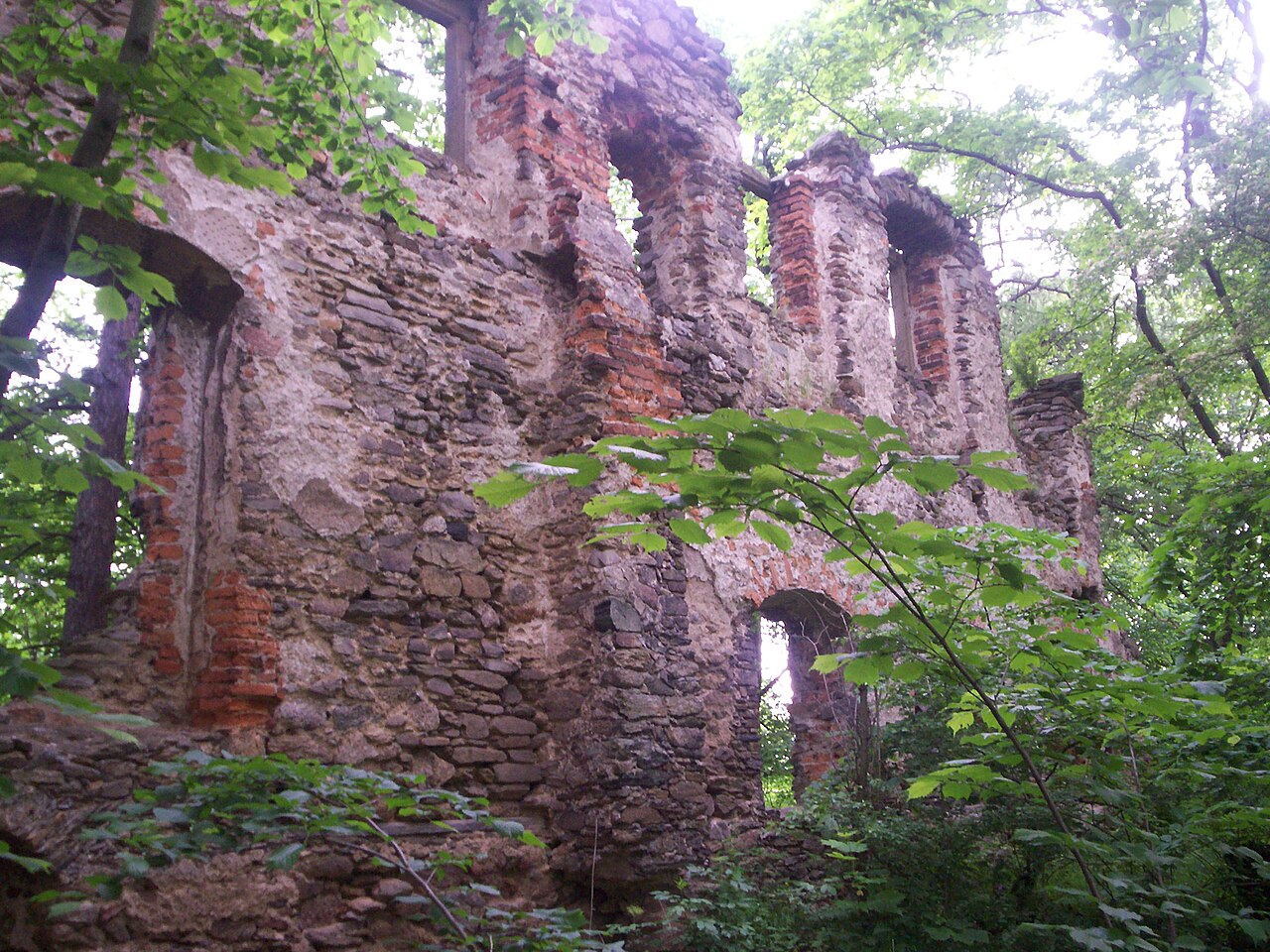
Tragically, in 1758, another fire severely damaged the castle, and unlike before, it was never rebuilt. The ruins gradually deteriorated, and the castle became a source of building stone, accelerating its decline. In the 19th century, much of the castle was dismantled. Additionally, the renaissance manor buildings were demolished in the 1930s, further erasing the site's historical fabric.
Surviving elements and modern preservation efforts
Today, visitors to Stara Kamienica can explore the ruins of the tower, the vaulted cellars which are partially buried, and a single-span stone bridge spanning the moat. These remnants offer a glimpse into the castle's former grandeur and architectural complexity.
In 2017, conservation work began to stabilize and protect the ruins. Efforts included the reconstruction of the tower and bridge, clearing debris from the cellars, and cleaning the moat. The castle is preserved as a "permanent ruin" and is accessible to the public, serving as an important cultural and historical site that illustrates the legacy of one of Silesia's most distinguished knightly families.
Architectural significance and cultural heritage
Stara Kamienica castle exemplifies the architectural transition from medieval fortifications to renaissance noble residences. Its bastioned design and rectangular layout reflect the influence of contemporary European military architecture adapted to local conditions. The integration of defensive elements like the moat, curtain walls, and the imposing tower with renaissance features such as cloisters and elegant staircases demonstrates the dual purpose of security and comfort.
The castle's history is intertwined with the fortunes of the Schaffgotsch family, whose prominence shaped much of the region's cultural and political landscape. As a ruin, it remains a testament to the turbulent history of Silesia, marked by wars, fires, and shifting ownerships, yet still preserving the memory of noble residence and architectural innovation.
Frequently asked questions (FAQ)
- When was Stara Kamienica castle originally built?
- The original medieval castle dates back to at least the 15th century, with the renaissance reconstruction completed in 1562.
- What architectural style characterizes Stara Kamienica castle?
- The castle is primarily known for its renaissance architectural style with bastioned fortress elements.
- Can visitors explore the ruins of Stara Kamienica castle?
- Yes, the castle ruins, including the tower, vaulted cellars, and stone bridge, are accessible to the public and have been stabilized for safety.
- What caused the destruction of Stara Kamienica castle?
- The castle was destroyed by fires in 1616 and again in 1758, after which it was never rebuilt.
- Who were the historical owners of Stara Kamienica castle?
- Notable owners include the Schaffgotsch family, Count von Palffy, Count von Żerotin, and merchant Georg Friedrich Smith.
Information
Loading map...
Visitor reviews
No reviews yet. Been here? Write the first review and help other travelers!
Write the first reviewVisited this castle? Share your experience
Your review helps other travelers and adds first-hand knowledge to our encyclopedia.