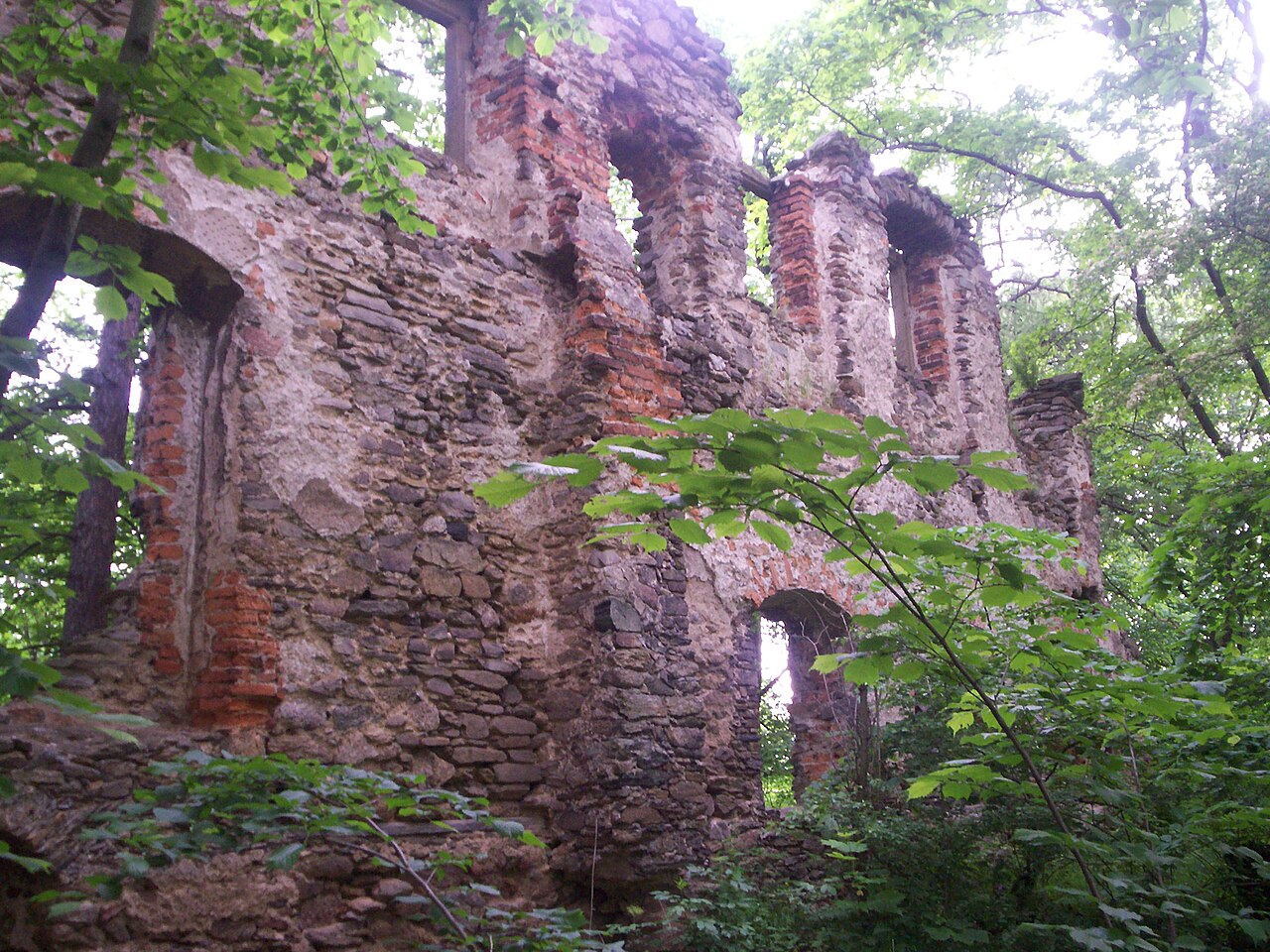
Siedlęcin
Siedlęcin Castle is a remarkable example of a medieval defensive tower located in the village of Siedlęcin, Poland. Its origins date back to the 13th century, with the first historical mention of the settlement appearing in 1300. At that time, the castle was part of the duchy of Jawor and was a princely possession. The castle’s most prominent feature is its imposing stone tower, which stands as one of the largest and best-preserved of its kind in Poland.
The tower was constructed on a small hill near a river crossing of the Bóbr River, which provided natural protection on its western side. To the north, a marshy valley with a stream flowing into the Bóbr further shielded the structure. The castle’s location was strategically important, situated on the trade route between Jelenia Góra and Lwówek Śląski.
Architectural features and construction details
The tower was built of stone on a rectangular plan measuring approximately 20.2 by 15 meters. It comprises four above-ground floors and a basement. The walls at the base are exceptionally thick, reaching up to 3 meters, tapering as they rise. The top of the tower features a defensive platform or gallery protected by battlements. Surrounding the tower was a water-filled moat and a defensive wall set about 2.5 meters away. On the south side, the wall curves outward, creating a small courtyard. Archaeological research has revealed a small gate tower in the southern section of the defensive wall, accessed by a bridge.
The entrance to the tower is through a pointed arch portal at courtyard level. Two pairs of grooves remain visible, which were used to secure wooden beams for locking the door, illustrating the castle’s defensive capabilities.
Interior layout and decoration
The basement and ground floor served primarily economic functions, while the upper three floors were residential. The second floor was the most prestigious, containing a large chamber adorned with medieval frescoes of secular themes. These frescoes are painted with natural pigments on dry plaster and are the oldest known secular wall paintings in Poland. This chamber also features two trefoil windows set in niches with stone benches, emphasizing its importance.
The residential rooms were equipped with fireplaces and latrine bays, ensuring comfort and security for the duke during his stays. This combination of defensive strength and domestic comfort highlights the tower’s dual function as a fortress and noble residence.
Historical context and ownership
In 1312, the duchy of Jawor came under the rule of Henryk I the Younger, the younger son of Bolko I. Henryk’s wife, Agnieszka, was the daughter of King Wenceslaus II of Bohemia, linking the castle to prominent regional dynasties. Dendrochronological studies of the original ceiling beams precisely date the timber felling to 1313-1314, confirming Henryk I as the tower’s founder.
After Henryk’s death, ownership passed to his nephew, Bolko II the Small, duke of Świdnica. In 1369, Bolko’s widow, Duchess Agnieszka, sold the tower to the knight Jan von Redern. The von Redern family maintained possession until the mid-15th century, after which the castle changed hands multiple times.
In 1575, a fire severely damaged the upper floors. Reconstruction introduced a four-sided roof, replacing the original battlements and creating an attic space used for storage. The defensive walls were heightened with windows inserted into the former battlements. During this period, a residential building was added adjacent to the gate tower, and in the following century, a kitchen building was constructed between this residential structure and the tower’s southeast corner.
Later history and preservation
In the mid-17th century, the castle became the property of the von Schaffgotsch family, who held it until 1945. They undertook significant renovations, including the construction of a large rectangular residential building on the site of the former gate tower and defensive wall, featuring a hallway leading to the inner courtyard.
After World War II, the castle belonged to a state agricultural enterprise (PGR). In 2001, it was acquired by the "Zamek Chudów" Foundation, which carried out necessary conservation and restoration work. Today, the castle is open to visitors and stands as a testament to medieval architecture and history.
Significance of the frescoes
The secular frescoes on the second floor are the castle’s most exceptional feature. Discovered in the late 19th century beneath layers of plaster, these paintings depict scenes uncommon in medieval art, offering valuable insights into the cultural life of the period. Their preservation makes Siedlęcin Castle unique among Polish medieval monuments.
These frescoes, executed with natural pigments on dry plaster, are the oldest surviving secular wall paintings in Poland, enhancing the castle’s cultural and historical importance. They contribute greatly to the castle's appeal as a heritage site and attract scholars and tourists alike.
Frequently asked questions (FAQ)
- When was Siedlęcin Castle built?
- Siedlęcin Castle was constructed in the 13th century, with dendrochronological evidence dating the timber used in the tower to 1313-1314.
- What makes the frescoes in Siedlęcin Castle unique?
- The castle features the oldest known secular medieval frescoes in Poland, painted with natural pigments on dry plaster, discovered on the second floor.
- Is Siedlęcin Castle open to visitors?
- Yes, after restoration by the "Zamek Chudów" Foundation, Siedlęcin Castle is open to the public for tours and educational visits.
- What architectural style characterizes Siedlęcin Castle?
- Siedlęcin Castle is a prime example of a high medieval hill castle featuring a fortified residential tower with Gothic architectural elements.
- How was the castle defended?
- The castle was defended by thick stone walls, a water-filled moat, a defensive wall with a gate tower, and battlements atop the tower's platform.
Information
Current owner
"Zamek Chudów" Foundation
Loading map...
Visitor reviews
No reviews yet. Been here? Write the first review and help other travelers!
Write the first reviewVisited this castle? Share your experience
Your review helps other travelers and adds first-hand knowledge to our encyclopedia.