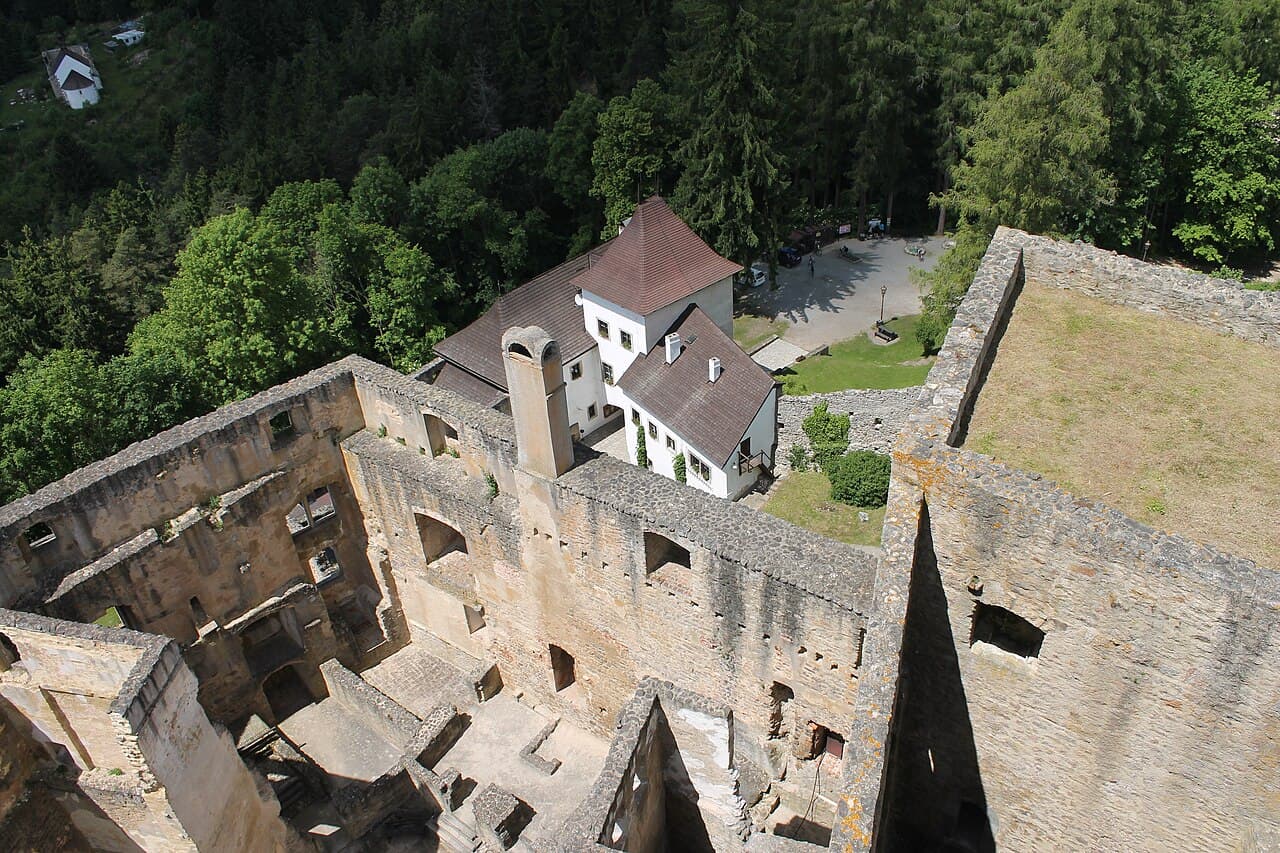
Landštejn Castle
Landštejn Castle stands as a remarkable example of a medieval hill castle strategically positioned near the border between Czechia and Austria. Its origins trace back to the early 13th century, making it a significant fortress in the region's medieval landscape. The castle's construction was likely commissioned by King Přemysl Otakar I to secure important trade routes and defend the border against Austrian expansion, particularly countering the nearby Zöbingen family stronghold.
The earliest documentary mention of Landštejn dates to 1231, when Hartlieb of Landštejn was recorded as castellan, confirming the castle's role as a defensive and administrative center. Initially part of the Margraviate of Moravia, it came under direct Bohemian control after 1222. The castle soon became the seat of the noble Vítkovci family, who took the title Lords of Landštejn. Prominent figures such as Sezema (1261–1282) and Vilém I (d. 1356) were instrumental in regional politics and the protection of trade routes. After Vilém I's death, the castle reverted to royal ownership.
In 1381, King Wenceslaus IV granted Landštejn to the Krajířové z Krajku family, under whose stewardship the castle underwent significant expansion and renovation. This period introduced late Gothic and Renaissance architectural elements, reflecting evolving styles and military needs. The castle's strategic importance persisted during the Hussite Wars, notably enduring a siege in 1420 led by the Hussite commander Jan Žižka. Archaeological evidence reveals intense combat and fire damage from this siege.
Ownership of Landštejn shifted among various noble families through the 16th and 17th centuries, including the Stephan von Eyczing, David Neumayer, the Mohrovs of Lichtenegg, the Khuen of Belasy, the Černín family, and finally the Herbersteins until 1816. The castle suffered structural damage, including a lightning strike in the mid-17th century that affected a Romanesque tower, and a devastating fire in 1771 that led to its abandonment and partial dismantling for building materials.
Following World War II, the castle ruins were confiscated from the Sternbach family in 1945. Neglect caused further deterioration until volunteer-led clearing efforts began in the 1960s. Large-scale restoration commenced in 1972, with reopening to the public by 1990. Today, Landštejn is protected as a cultural monument managed by the National Heritage Institute.
Architectural features and layout
The original pentagonal layout of Landštejn Castle is enclosed by a robust defensive stone wall punctuated by square towers at the northern and eastern corners. The eastern tower functioned as a bergfried, a tall, typically uninhabited defensive tower overseeing the main southeast entrance. The northern tower served residential purposes and housed a small Romanesque chapel with an apse, integrated into its thick walls. This chapel was accessible from the castle's main palace situated between the two towers. The palace retains an outer wall featuring corbels that once supported a wooden gallery for internal communication.
A smaller building occupied the southern corner of the castle grounds, though its original function remains uncertain. Defensive expansions in the 14th century included an outer bailey (parkán) and a forecourt to bolster protection against increasing military threats. A new residential tower was erected outside the southeast wall, and the original main gate was replaced by a new entrance in the southwest wall.
The Krajíř family significantly enhanced the castle by rebuilding the old palace and adding wings around the courtyard, refurbishing living quarters in the Renaissance style. Some interior walls were decorated with sgraffito, a plaster technique creating layered artistic designs. Fortifications were reinforced with polygonal bastions in the northern and eastern outer bailey, while the southwest side featured three open semicircular bastions topped with battlements for mounting defensive weapons, exemplifying advanced late medieval military architecture.
Access to the forecourt was secured through two tower gates, complemented by an encompassing moat and an earthen rampart for layered defense. Around 1520, a new defensive wall with a shooting gallery was constructed, featuring two semicircular open bastions and a polygonal earth bastion on the southeast side. These additions reflected evolving military design aimed at resisting artillery attacks.
Below the castle core lies an extensive network of cellars, currently closed for reconstruction. The original well near the western wall was replaced with a deeper 27-meter well within the courtyard, ensuring water supply during sieges. In 1495, a new chapel dedicated to Saint George was built in the eastern palace wing, adding to the castle's religious significance.
Historical significance and military role
Landštejn Castle played a crucial role in controlling borderlands and trade routes between Bohemia and Austria. Its position allowed oversight of key transit corridors, making it a focal point in regional conflicts and power struggles. The castle's repeated sieges and ownership changes reflect its strategic importance through the High and Late Middle Ages.
The siege by Jan Žižka during the Hussite Wars underscores the castle's military resilience and the intensity of religious and political upheavals in 15th-century Bohemia. Despite suffering damage, the castle remained a symbol of noble power and defense.
Restoration and current status
After centuries of decline following the 18th-century fire and abandonment, Landštejn Castle faced further decay in the 20th century. Post-World War II confiscation and neglect left the ruins vulnerable until community and governmental efforts initiated preservation. Restoration beginning in the 1970s focused on stabilizing structures and making the site accessible to visitors.
Today, visitors can explore the preserved Romanesque chapel, climb the large rectangular tower known as Velká věž via a wooden staircase, and enjoy panoramic views extending to the Lower Austrian Alps on clear days. The castle remains an important cultural monument, offering insights into medieval architecture, military history, and noble life in Czech borderlands.
Visitor information and accessibility
Landštejn Castle is open to the public with guided tours available, providing detailed historical context and architectural insights. The site is managed by the National Heritage Institute, ensuring ongoing preservation and educational outreach. Visitors are advised to check seasonal opening hours and ticket prices before planning their visit.
The castle's hilltop location involves some steep walking paths, so appropriate footwear and moderate physical fitness are recommended. The site is suitable for history enthusiasts, architecture scholars, and tourists interested in medieval fortifications and Bohemian heritage.
Nearby attractions
The surrounding region offers additional cultural and natural attractions, including the historic town of Jindřichův Hradec and the scenic landscapes of the Bohemian Forest. These sites complement a visit to Landštejn Castle, enriching the experience of Czechia's rich medieval past and natural beauty.
Frequently asked questions (FAQ)
- How do I get to Landštejn Castle?
- Landštejn Castle is located near the municipality of Staré Město pod Landštejnem in South Bohemia, Czechia. Visitors can reach the castle by car or local bus services from nearby towns such as Jindřichův Hradec. Parking is available near the site.
- What are the opening hours and ticket prices?
- The castle is typically open from spring through autumn, with hours generally from 9:00 to 17:00 daily. Ticket prices vary, with discounts for children, seniors, and groups. It is advisable to check the official website for current information before visiting.
- What architectural styles are visible at Landštejn Castle?
- Landštejn Castle showcases a mixture of <strong>Romanesque</strong>, <strong>Gothic</strong>, and <strong>Renaissance</strong> architectural styles. Visitors can observe the original Romanesque chapel, late Gothic fortifications, and Renaissance residential wings with sgraffito decoration.
- Is Landštejn Castle accessible for visitors with mobility issues?
- Due to its hilltop location and medieval structure, Landštejn Castle has limited accessibility for visitors with mobility impairments. Some areas involve steep paths and stairs. Visitors are encouraged to contact the site in advance to inquire about specific accommodations.
- When is the best time to visit Landštejn Castle?
- The best time to visit Landštejn Castle is during the late spring to early autumn months when the weather is mild and the castle is fully open to the public. This period also offers the best visibility from the towers and pleasant conditions for exploring the grounds.
Photo gallery

Information
Sources & official resources
Verify the information above using these authoritative references.
Loading map...
Visitor reviews
No reviews yet. Been here? Write the first review and help other travelers!
Write the first reviewVisited this castle? Share your experience
Your review helps other travelers and adds first-hand knowledge to our encyclopedia.


