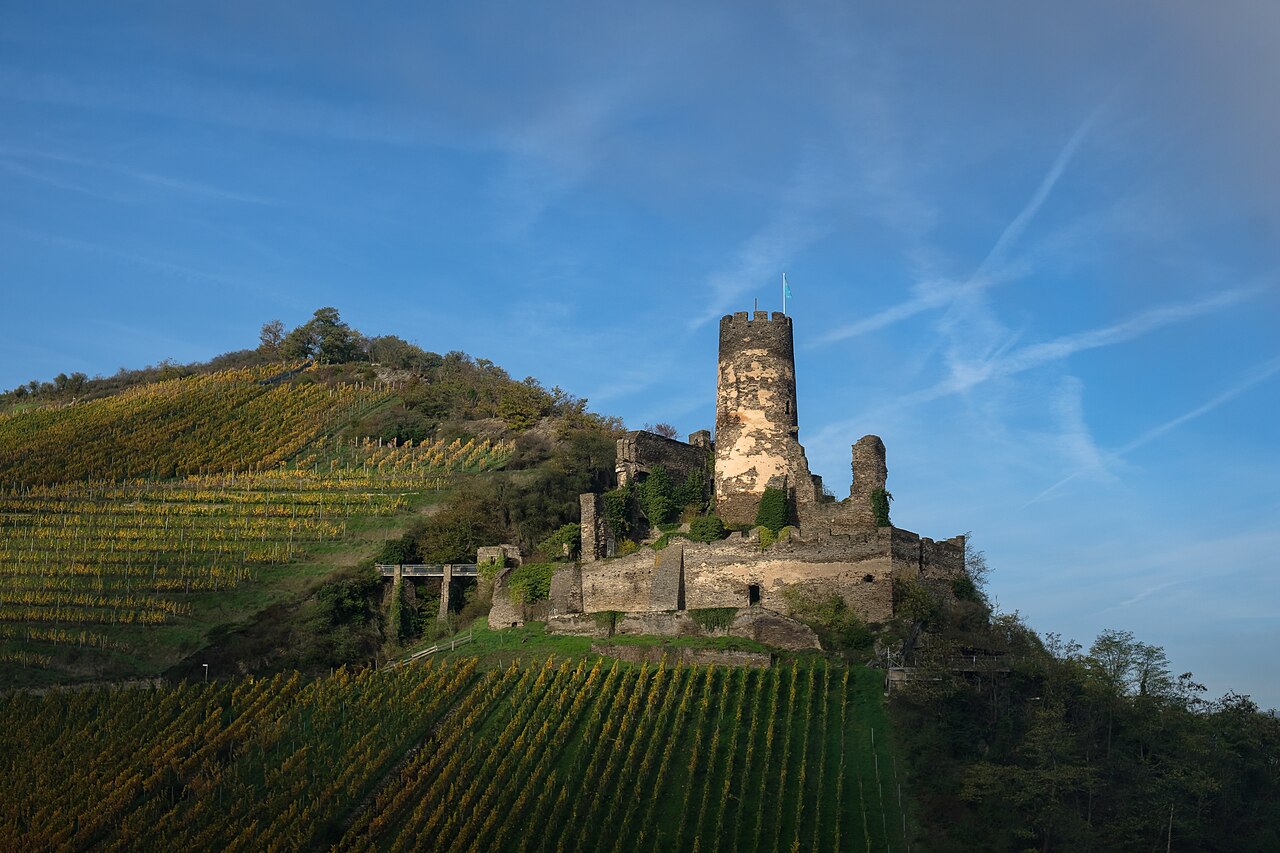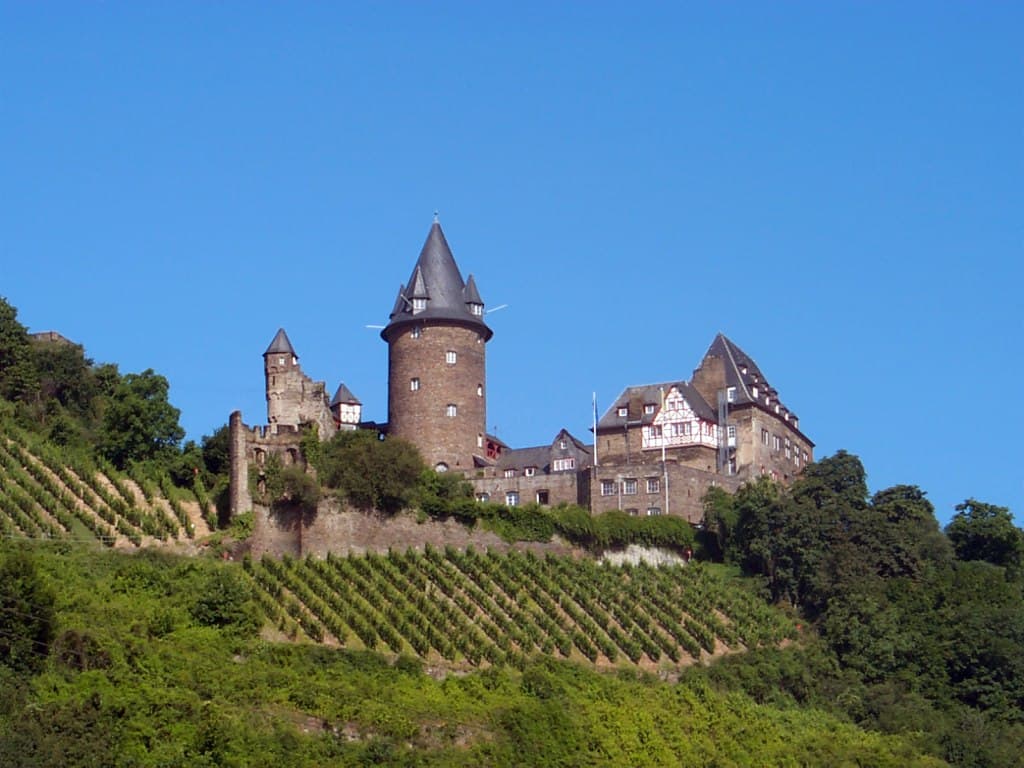
Stahleck Castle
Stahleck Castle stands prominently on a rocky crag about 160 meters above sea level, overlooking the majestic Rhine River near the town of Bacharach in Germany's Upper Middle Rhine Valley. This 12th-century hill castle is a remarkable example of medieval fortification, combining strategic location with architectural ingenuity. Its name, meaning "impregnable castle on a crag," underscores its formidable defensive position and enduring historical significance.
Constructed originally on the orders of the Archbishop of Cologne, Stahleck Castle was designed to serve as a southern outpost and administrative center for the archbishop's territories along the Rhine. The castle's commanding vantage point allowed control over the vital river trade routes and the nearby town of Bacharach, which was a key center in the medieval wine trade. The castle also functioned as a toll station, collecting fees from passing vessels navigating the Rhine.
Early history and political significance
The exact founding date of Stahleck Castle remains uncertain, but archaeological and documentary evidence confirm occupation since at least 1095. It is first mentioned in written records in 1135, associated with Goswin von Hochstadt. The castle quickly became a contested site, with nearly a decade of conflict over its rights until 1148. By 1156, following the death of Hermann of Stahleck, his stepbrother Konrad von Hohenstaufen assumed the title of Count Palatine of Bacharach, establishing Stahleck as the seat of power for the Palatinate on the Rhine.
Stahleck Castle was assigned by Emperor Frederick Barbarossa to his brother Konrad in 1190, cementing its status as a significant imperial stronghold. The castle's role expanded as it became the residence of the Counts Palatine, influential rulers who shaped the politics of the Holy Roman Empire. The castle witnessed important historical events, including the election of Ludwig IV as King of Germany in 1314 and the wedding of Emperor Charles IV in 1349.
Architectural features and layout
Stahleck Castle's layout is characteristic of Hohenstaufen-period castles, with a nearly rectangular plan measuring approximately 55 by 24 meters. The castle is perched on a rocky spur, providing natural defense on several sides. Its fortifications include a complex system of gates and walls designed to repel attackers.
Defensive structures
The castle features three main entrances: a double gate from the Rhine valley leading to a narrow outer ward known as a zwinger, a primary gate at the west corner accessed via a drawbridge from the southwestern outer bailey, and a small door in the southern zwinger near a round tower. The shield wall on the west side is notably thick, measuring 2.6 meters, and includes polygonal turrets and embrasures adapted for early firearms, reflecting the castle's evolution in response to changing military technology.
The bergfried and palas
At the heart of the castle stands a round Romanesque bergfried (keep) with walls two meters thick and a diameter of 7.5 meters. This tower rises 16 meters high, topped with a cone-shaped roof adorned with four small turreted dormer windows. The bergfried was built on solid bedrock and served as a last refuge during sieges.
The palas, or main residential building, is a two-story structure made of crushed stone with an interior lining of local Rhenish Schwemmstein sandstone. It sits at the eastern end of the castle above a vaulted cellar dating back to the time of Conrad of Hohenstaufen. The palas is crowned by a 10-meter-high hipped roof covered with slate and features three rows of dormer windows facing both the courtyard and the Rhine. Adjacent to the palas is a kitchen building with a timber-framed upper floor overlooking the river, now used as the residence for hostel managers.
Water defenses and moat
One of the castle's most distinctive features is its water-filled rock-cut moat known as the Halsgraben, measuring approximately 18 by 13 meters. This moat functions as a cistern, holding around 500 cubic meters of water, fed by three hillside springs since the early 20th century. A stone bridge with an embrasured turret spans the moat, providing access to the main gate and the zwinger.
Historical conflicts and destruction
Throughout its history, Stahleck Castle was a focal point in regional conflicts. During the Thirty Years' War in 1644, the castle provided refuge to French troops fleeing from Bacharach after a Catholic counterattack. The fortress was subsequently fired upon but not occupied. Restoration efforts were undertaken in 1666 by Count Palatine Carl Ludwig.
However, the castle's fortunes declined dramatically during the War of the Palatine Succession. In 1689, French troops under King Louis XIV deliberately destroyed Stahleck Castle by explosion, leaving it in ruins for over two centuries.
Restoration and modern use
After centuries of neglect, the ruins of Stahleck Castle were purchased by the Crown Prince of Prussia in 1828. The Rhenish Association for Monument Preservation began stabilization and restoration work in 1909-1910. Architect Ernst Stahl led a significant reconstruction project starting in 1925, guided by archaeological evidence and a detailed 1646 engraving by Matthäus Merian.
The restoration faithfully recreated the castle's medieval appearance, including the rebuilding of the bergfried and palas. During the Nazi era, the castle was repurposed for youth indoctrination, military hospital use, and re-education camps. Plans to complete the bergfried as the "Rudolf Hess Tower" were halted by the outbreak of World War II.
From 1965 to 1967, further renovations were carried out to complete the keep and add a large south terrace. Today, Stahleck Castle serves as a popular youth hostel, welcoming visitors from around the world. Its courtyard remains accessible to the public, offering stunning panoramic views of the Rhine valley and the historic town of Bacharach.
Cultural heritage and significance
Stahleck Castle is part of the Upper Middle Rhine Valley UNESCO World Heritage Site since 2002, recognized for its outstanding cultural landscape and historic architecture. The castle is also protected under the Hague Convention since 1989 due to its historical importance and preservation efforts.
Archaeological excavations have uncovered foundations of medieval buildings, including fragments of a chapel dedicated to Saint Paul, early Gothic vaults, and a window. A post-medieval artillery platform carved into the rock above the castle reflects adaptations to gunpowder warfare in the 17th century.
Inside the castle, the great hall accommodates about 100 people and features eleven stained-glass windows by Richard Gassen, depicting historical scenes and coats of arms. Although original furnishings and Art Deco elements no longer survive, the hall remains a significant space reflecting the castle's layered history.
Stahleck Castle today stands as a testament to medieval fortification, historical resilience, and adaptive reuse. Its combination of Romanesque and Gothic architectural elements, strategic location, and rich history make it a prominent landmark in the Rhine valley and a cherished cultural treasure.
Frequently asked questions (FAQ)
- How do I visit Stahleck Castle and what are the opening hours?
- Visitors can explore the castle courtyard daily from 10:00 to 18:00. The interior is generally not open to the public as it functions as a youth hostel, but guided tours may be available by arrangement.
- What is the historical significance of Stahleck Castle?
- Stahleck Castle was a key political and military site from the 12th century, serving as the seat of the Counts Palatine and witnessing important events such as royal elections and imperial weddings.
- Can I stay overnight at Stahleck Castle?
- Yes, the castle operates as a youth hostel offering accommodation to travelers. Booking in advance is recommended, especially during peak tourist seasons.
- What architectural styles are represented in Stahleck Castle?
- The castle features primarily Romanesque architecture with Gothic elements, reflecting its construction and modifications from the 12th century through later periods.
- Is Stahleck Castle accessible for visitors with mobility issues?
- Due to its hilltop location and historic structure, accessibility is limited. Visitors with mobility issues should contact the hostel in advance to discuss accommodations.
- Why is Stahleck Castle part of the UNESCO World Heritage Site?
- It is included in the Upper Middle Rhine Valley UNESCO World Heritage Site for its outstanding medieval architecture, strategic location, and cultural landscape significance.
Photo gallery

Public domain
Information
Opening hours
10:00-18:00, daily
Ticket prices
Free to visit courtyard; hostel fees apply for accommodation
Current owner
Rhenish Association for Monument Preservation
Website
Visit websiteSources & official resources
Verify the information above using these authoritative references.
Loading map...
Visitor reviews
No reviews yet. Been here? Write the first review and help other travelers!
Write the first reviewVisited this castle? Share your experience
Your review helps other travelers and adds first-hand knowledge to our encyclopedia.