Burg Stahleck
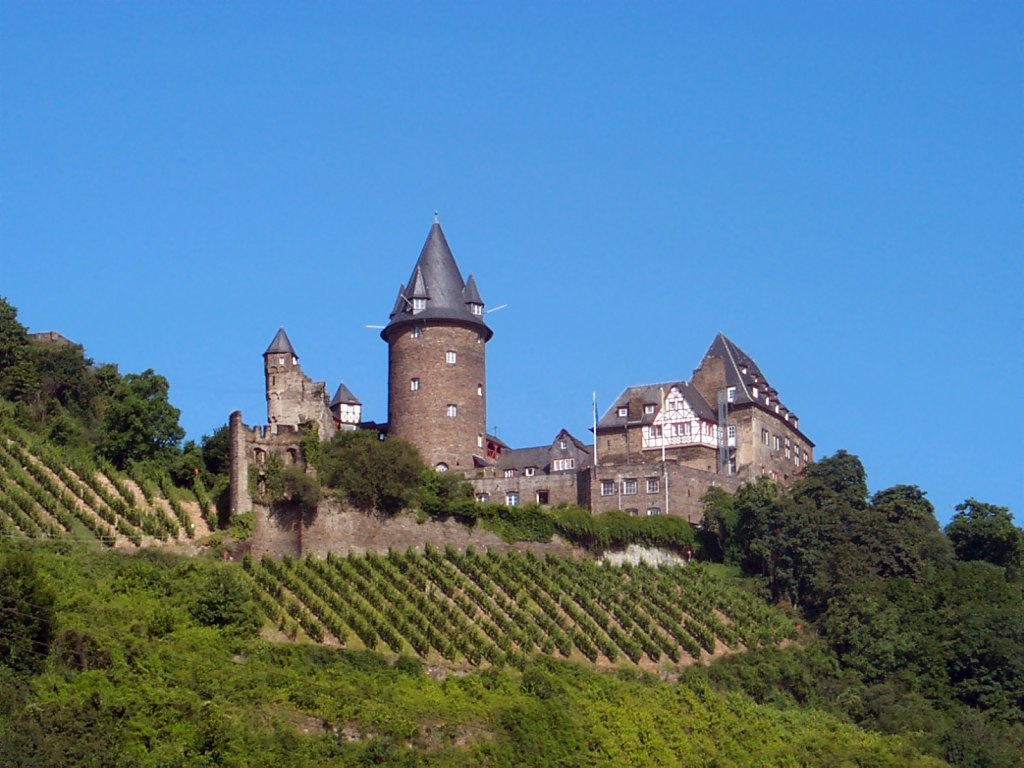
Burg Stahleck is a prominent hill castle perched on the heights overlooking the Rhine River near the town of Bacharach in the Rhineland-Palatinate region of Germany. Its commanding position above the river made it a vital strategic fortress controlling the Rhine trade routes and regional power during the medieval and early modern periods. Though the exact date of its foundation remains uncertain, historical evidence confirms that Stahleck Castle was inhabited as early as 1095, making it one of the enduring medieval fortresses along the Rhine.
Early history and origins
The castle is first documented in 1135 under the ownership of Goswin von Hoechstadt, and it was originally known by names such as Stabekkum or Sthaleckthum. During the mid-12th century, the castle became embroiled in regional power struggles. By 1148, nearly a decade of conflict over its control culminated in the victory of Hermann, brother-in-law to King Konrad III. Hermann was granted the Palatine County and its possessions, marking the castle's importance in the governance of the Palatinate region.
Palatine significance and medieval ownership
After Hermann von Stahleck's death in 1156, his stepbrother Konrad von Hohenstaufen assumed the role of Palatine over Bacharach am Rhein. The nearby village of Bacharach, situated on the Burgberg hill, grew in prominence as the central residence of the Palatinate on the Rhine. Initially under the control of the bishops of Cologne, the castle was transferred in 1190 by Emperor Frederick Barbarossa to his brother Konrad, further cementing its status as a key imperial stronghold.
The castle also played a role in notable dynastic events, including the secret marriage in 1194 between the son of Henry the Lion and the daughter of Count Palatine Konrad, highlighting its significance as a noble residence and political center.
Transition to wittelsbach control and strategic role
In 1214, Stahleck Castle became a fief under the powerful Wittelsbach family through Ludwig of Bavaria. This acquisition gave the Wittelsbachs two important bases on the Rhine, including Stahleck and Pfalz castles, reinforcing their influence over the region. Subsequently, Stahleck served as the seat of the Palatinate burgraves and officials, overseeing the administration and defense of the territory.
Throughout the medieval period, the castle's strategic location made it a crucial fortress for controlling the Rhine current and protecting trade and territorial interests.
Conflicts and damage in the early modern period
During the Thirty Years' War, in mid-October 1644, the castle witnessed significant military action. When Catholic forces comprising 250 mounted troops and 450 Kurköln infantry expelled the French from Bacharach, the French retreated to Stahleck Castle. Subsequently, Colonel von Nievernheimb, commander of Ehrenbreitstein, ordered a heavy bombardment of the castle for a day. Despite the intense assault, the castle was not occupied, but it sustained considerable damage.
Restoration and later history
Following the devastation of the Thirty Years' War, the castle remained in a damaged state until 1666, when Elector Palatine Carl Ludwig undertook a significant rebuilding effort. This restoration helped preserve the castle's structure and maintain its role as a regional landmark.
Architectural features and preservation
Burg Stahleck exemplifies a hill castle with typical medieval defensive features adapted to its elevated position. Its architecture includes robust curtain walls, fortified towers, and a commanding keep that provided both defense and residence for the ruling nobility. The castle's layout reflects its dual function as a military stronghold and a noble residence.
Today, the castle is well preserved and serves as a symbol of the region's rich medieval heritage. It remains a popular destination for visitors interested in castle architecture, Rhine history, and German medieval culture.
Cultural significance and tourism
Located near the picturesque town of Bacharach, Burg Stahleck attracts tourists for its stunning views of the Rhine valley and its historical ambiance. The castle often hosts cultural events and offers accommodations, enhancing its role as a living monument that connects modern visitors with the medieval past.
Its enduring presence on the Rhine heights makes it an essential part of the Rhineland-Palatinate's cultural landscape and a testament to the region's strategic importance through centuries.
Frequently asked questions (FAQ)
- How do I get to Burg Stahleck?
- Burg Stahleck is located in Bacharach, Germany, and can be reached by car or public transportation. If traveling by train, the nearest station is Bacharach, which is about a 15-minute walk to the castle. There are also local bus services that connect to the area.
- What is the historical significance of Burg Stahleck?
- Burg Stahleck dates back to the 12th century and played a crucial role in the defense of the Rhine River. It was strategically positioned to control trade routes and protect the surrounding territories. Today, it stands as a testament to medieval architecture and history.
- When was Burg Stahleck built?
- Burg Stahleck was constructed around 1050 AD, making it one of the older castles in the region. The castle has undergone various renovations and restorations throughout the centuries, reflecting the architectural styles of its time. Its long history is part of what makes it a popular destination for visitors.
- Can I visit Burg Stahleck year-round?
- Yes, Burg Stahleck is open to visitors throughout the year, although hours may vary by season. It is advisable to check the official website for specific opening times, especially during the winter months. Visiting during the warmer months offers a chance to enjoy the beautiful views and surrounding gardens.
- Why is Burg Stahleck popular among tourists?
- Burg Stahleck is popular for its stunning panoramic views of the Rhine Valley and its well-preserved medieval architecture. The castle also hosts events and exhibitions that attract history enthusiasts and families alike. Its picturesque location and historical significance make it a must-visit site in the Rhine region.
- Is it possible to stay overnight at Burg Stahleck?
- Yes, Burg Stahleck offers accommodations for guests who wish to experience the castle overnight. Staying at the castle allows visitors to enjoy the unique atmosphere and stunning views during different times of the day. Reservations are recommended, especially during peak tourist seasons.
- What are the ticket prices for visiting Burg Stahleck?
- Ticket prices for Burg Stahleck are generally affordable, with discounts available for students and seniors. Children under a certain age may enter for free, making it a family-friendly destination. Check the official website for the latest pricing and any special offers.
- What are the best times to visit Burg Stahleck?
- The best times to visit Burg Stahleck are during the spring and fall when the weather is mild and the scenery is particularly beautiful. Summer can be crowded but offers vibrant views and activities. Winter visits can be magical, especially if there is snow, but be prepared for colder temperatures.
- Are there any nearby attractions to explore?
- Yes, Bacharach is surrounded by several attractions including the picturesque town center, the Rhine River, and numerous hiking trails. The nearby town of Rüdesheim is also worth a visit, known for its wine culture and scenic vistas. Exploring the surrounding area can enhance your experience at Burg Stahleck.
Information
Loading map...
Visitor reviews
No reviews yet. Been here? Write the first review and help other travelers!
Write the first reviewVisited this castle? Share your experience
Your review helps other travelers and adds first-hand knowledge to our encyclopedia.