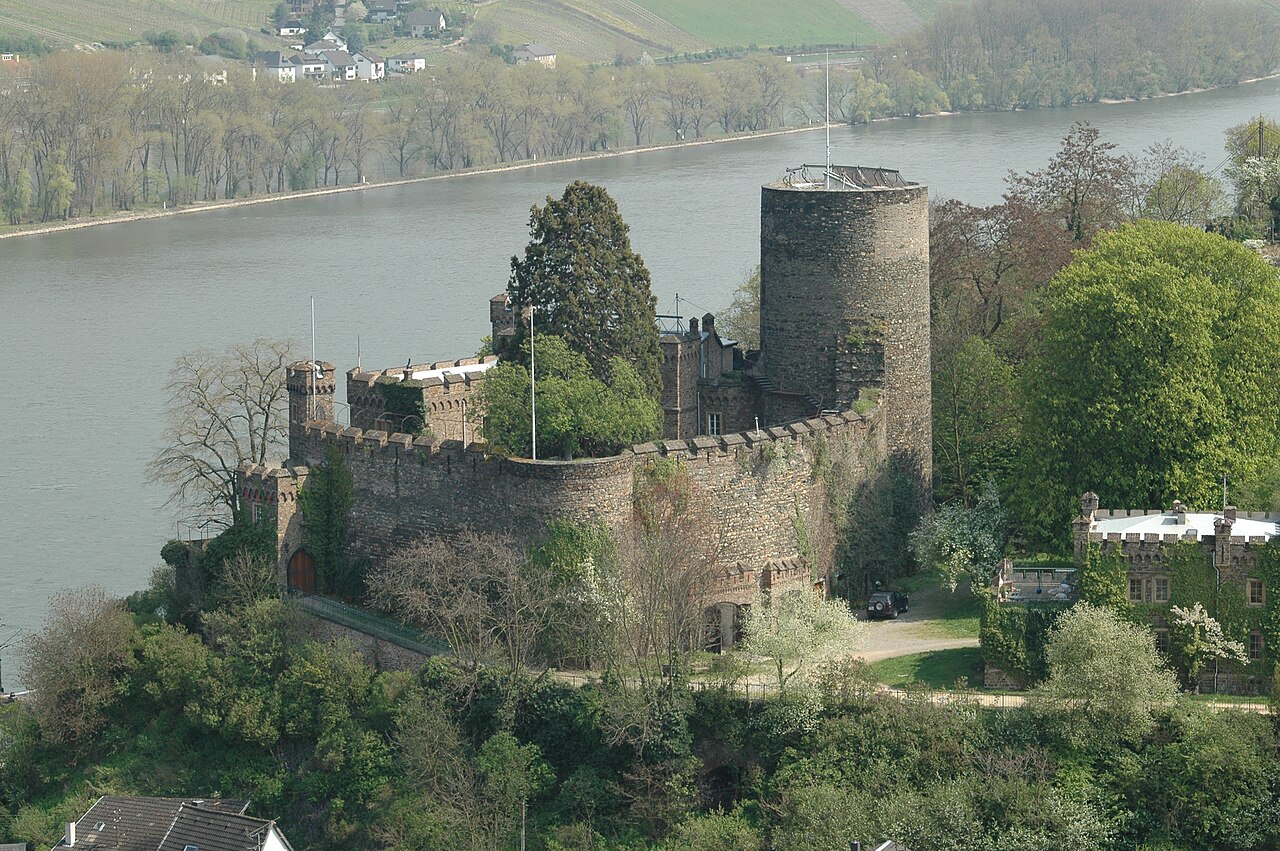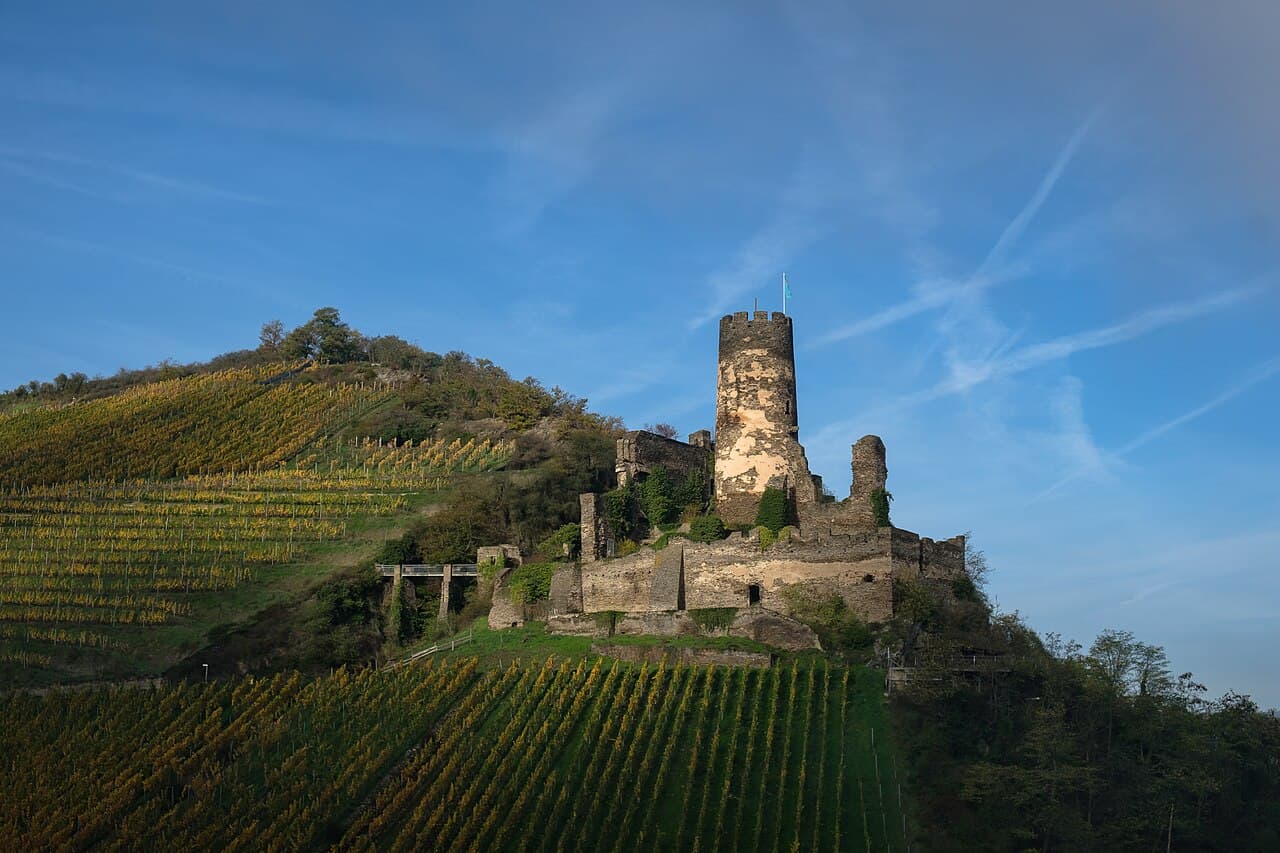
Furstenberg Castle
Fürstenberg Castle is a remarkable high medieval hilltop fortress located in the Rhineland-Palatinate region of Germany. Perched approximately 152 meters above sea level, it overlooks the village of Rheindiebach and commands expansive views of the Rhine River valley. Founded in 1219 by Archbishop Engelbert I of Cologne, the castle was strategically built to protect the archbishopric's electoral lands in the Viertäler region and to enforce toll collection along the vital Rhine trade route. Its location and design reflect the military and administrative priorities of the Holy Roman Empire during the high medieval period.
Historical significance and ownership
Fürstenberg Castle's history is deeply intertwined with the complex territorial politics of medieval Germany. Initially constructed by the Archbishopric of Cologne, it served as a border fortress against the County of Arnsberg and other regional powers. The castle first appears in written records in 1295, alongside the earliest mention of Hermann von Fürstenberg, a Burgmann whose family would later gain prominence as the Barons von Fürstenberg. This lineage originated from the Binolen family of Hönnetal but adopted the castle's name as their own.
The castle endured multiple sieges and reconstructions due to its strategic importance. It was destroyed in 1303/04 by Count Everd of the Mark during a feud with Archbishop Wigbold, rebuilt by Archbishop Henry between 1307 and 1309, and destroyed again in 1311 by Count Engelbert II of the Mark. Archbishop Henry restored it once more in 1313, but it faced final destruction in 1343/44 by allied forces of the Counts of Arnsberg and the Mark. Following the transfer of the County of Arnsberg to the Electorate of Cologne in 1368, Fürstenberg Castle lost much of its military significance, with the nearby city of Neheim assuming the protective role against neighboring threats.
Architectural features and defensive design
Built primarily from local slate rubble stone, Fürstenberg Castle is a classic example of a hill castle adapted to its mountainous terrain. The fortress features a deep and wide neck ditch on its uphill side, originally spanned by a drawbridge, now replaced by a fixed bridge flanked by a gatehouse that served as the main entrance in later centuries.
The castle's most prominent feature is its bergfried, a massive main tower standing 26 meters tall with a circular base measuring 10 meters in diameter and walls four meters thick. This tower originally had no windows and was accessible only via a door located about 12 meters above ground level, a defensive design typical of medieval keeps. The ground floor likely functioned as storage or a dungeon. Modifications before the 20th century introduced a ground-level entrance for easier access.
East of the bergfried lie the remains of the palas, the residential and administrative building, which was originally three stories high and partially timber-framed. Surviving masonry reaches up to the second floor, showcasing the castle's dual role as a military stronghold and noble residence. The northwest side contains an outer ward or zwinger, where traces of small timber-framed buildings suggest quarters for servants and livestock.
Around 1500, the castle's western defensive wall was reinforced with a three-quarter tower designed to accommodate firearms, reflecting advancements in military technology. The eastern side is enclosed by a ring wall with a crenellated battlement and wall walk, portions of which remain visible today.
Plaster and decorative elements
Fürstenberg Castle is notable for preserving original plaster from multiple construction phases dating back to the 13th century, a rare feature in Rhine Valley castles. The initial plaster layer was a coarse off-white mixture embedding particles up to two centimeters in size. Later repairs, likely following siege damage, included a richly colored re-plastering of the bergfried with red, yellow, gray, and blue-gray pigments on a white base. This decorative scheme featured incised designs resembling large heraldic shields, similar to motifs found at Burg Balduinstein, associated with Archbishop Baldwin of Trier in the 14th century. A subsequent phase applied a muted yellow-white lime plaster, still visible in parts of the ruins.
Military history and conflicts
Fürstenberg Castle's military history spans several centuries and reflects the turbulent nature of the region. It was involved in numerous conflicts, including sieges by King Ludwig the Bavarian in 1321 and Archbishop Baldwin of Trier in 1325. In the early modern period, the castle was contested during the Thirty Years’ War, captured by Spanish troops under Ambrosio Spinola in 1620 and by Swedish forces led by King Gustavus Adolphus in 1632.
The castle's military function ended during the Palatine War of Succession when French forces destroyed it in 1689. Unlike many contemporaneous castles, Fürstenberg was not rebuilt in the 19th century, leading to its current status as a ruin.
Later history and preservation efforts
In the 19th century, Fürstenberg Castle attracted the interest of nobility despite its ruined state. In 1845, Prince Frederick of the Netherlands purchased the site and gifted it to his wife Louise, who commissioned architect C. de Jong in 1849 to design a neo-Gothic reconstruction. These plans were never realized, and the castle remained a ruin.
Ownership later passed to their daughter Marie of Wied, who sold the property in 1910 to the Wasum family from Bacharach. In 1993, Gernot Stelter acquired the castle and initiated preservation work in collaboration with the Rhineland-Palatinate State Office for Monument Preservation. Recent efforts have included restoration of the massive curtain walls and uncovering original plasterwork, enhancing the site's historical authenticity and visitor experience.
Site layout and visitor experience
The castle's layout takes full advantage of its hilltop position, with defensive structures oriented to maximize protection against uphill attacks. Visitors today can explore the remains of the bergfried, palas, zwinger, and curtain walls, gaining insight into medieval fortress design and living conditions.
A terraced viewing platform below the northeast side offers panoramic views over the Rhine River, including sights of the nearby town of Bacharach, the ruins of Nollig and Lorch castles, and the scenic Rheingau vineyard landscape. This vantage point highlights the castle's historical role in overseeing and controlling the vital Rhine trade corridor.
Frequently asked questions (FAQ)
- When was Fürstenberg Castle built and by whom?
- Fürstenberg Castle was built in 1219 by Archbishop Engelbert I of Cologne to protect his electoral lands and enforce toll collection along the Rhine River.
- What are the main architectural features of Fürstenberg Castle?
- The castle features a massive bergfried tower, a palas residential building, a zwinger outer ward, a deep neck ditch, a gatehouse, and a ring wall with crenellated battlements.
- What historical conflicts affected Fürstenberg Castle?
- Fürstenberg Castle was involved in multiple sieges and destructions during the 14th century, the Thirty Years’ War, and was ultimately destroyed in 1689 during the Palatine War of Succession.
- Is Fürstenberg Castle accessible to visitors today?
- Yes, visitors can explore the ruins and enjoy panoramic views of the Rhine River valley from the castle’s terraced viewing platform.
- Has Fürstenberg Castle been restored or preserved?
- The castle remains a ruin but has undergone preservation efforts, including restoration of curtain walls and uncovering original plasterwork to enhance historical authenticity.
Photo gallery

Information
Website
Visit websiteSources & official resources
Verify the information above using these authoritative references.
Loading map...
Visitor reviews
No reviews yet. Been here? Write the first review and help other travelers!
Write the first reviewVisited this castle? Share your experience
Your review helps other travelers and adds first-hand knowledge to our encyclopedia.