Stafford Castle
Stafford Castle stands as a remarkable testament to over 900 years of English history, showcasing the evolution of castle architecture from the early Norman period through the medieval era and into the Gothic Revival of the 19th century. Located just west of Stafford town in Staffordshire, England, this historic site occupies more than 26 acres, including its iconic motte and bailey earthworks, a 14th-century stone keep, extensive courtyards, woodland, and a reconstructed medieval herb garden. The castle's ruins and grounds offer visitors a rich insight into the military, social, and architectural developments spanning the Norman Conquest to the post-medieval period.
Originally established as a wooden fortification in the 1070s by Robert de Toeni (later Robert of Stafford), under the orders of William the Conqueror, Stafford Castle was strategically positioned to dominate the local landscape and assert Norman control over the Anglo-Saxon population. The castle began as a classic motte and bailey design, featuring a raised earth mound (the motte) and enclosed baileys, with timber structures atop glacial deposits reshaped for defense. Over the centuries, Stafford Castle witnessed numerous phases of construction, destruction, and restoration that reflect the shifting tides of English history.
Early origins and Anglo-Saxon context
The site of Stafford Castle has roots reaching back to the early 10th century, when the Saxon ruler Æthelflæd, Lady of the Mercians, is recorded to have established a wooden fortress and a defended settlement around 913 AD. While the exact location of this early fortification remains uncertain, it laid the foundation for the later Norman castle. The Anglo-Saxon period was marked by conflict, including the failed rebellion led by Eadric the Wild against Norman rule, culminating in the Battle of Stafford in 1069.
Norman construction and medieval development
The motte and bailey design
Following the Norman Conquest of 1066, Robert de Stafford was granted extensive lands and tasked with establishing Norman authority in the region. The initial castle was a wooden motte and bailey fortification, incorporating two baileys and a surrounding village. The motte was artificially raised from glacial deposits, surrounded by deep ditches and ramparts that extended into adjacent woodland, which historically served as grazing land. This design was typical of early Norman military architecture, emphasizing rapid construction and defensive advantage.
Stone keep construction in the 14th century
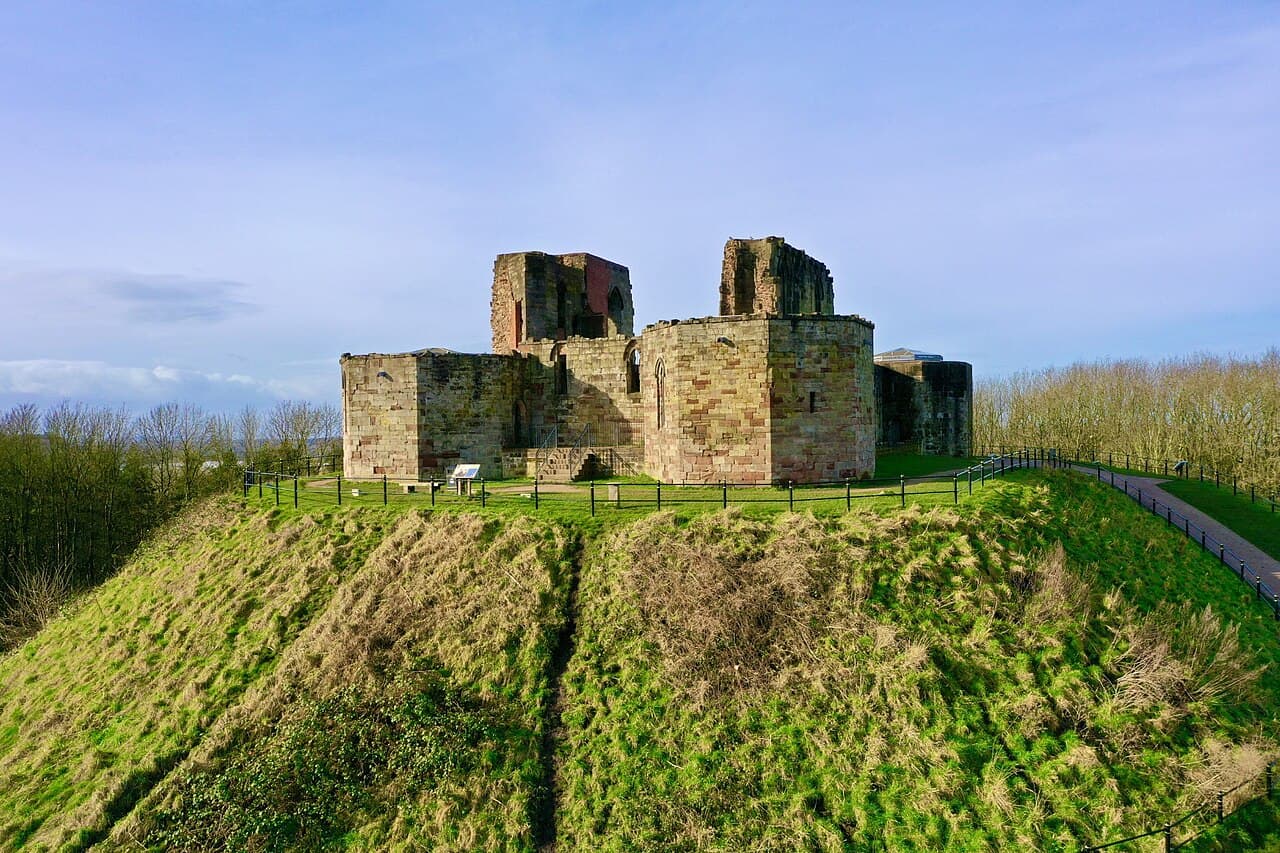
In 1347, Ralph de Stafford, a prominent military commander and later the first Earl of Stafford, commissioned the construction of a substantial stone keep atop the motte. This rectangular keep originally featured a tower at each corner, built from stone repurposed from earlier structures. A fifth tower was later added on the north wall, which faces west, enhancing the keep's defensive capabilities. This transition from timber to stone symbolized the castle's growing importance and the increased wealth and status of the Stafford family.
The castle in the late medieval period
The castle reached its zenith under Humphrey Stafford, who was created the Duke of Buckingham in 1444. Stafford Castle served as the family seat for the Dukes of Buckingham, who were influential figures in English nobility. The castle's strategic and symbolic significance was underscored during the turbulent Wars of the Roses and subsequent Tudor period, with family members experiencing both favor and downfall at the royal court.
Decline and destruction during the English Civil War
By the early 17th century, Stafford Castle had begun to fall into disrepair. The English Civil War (1642–1651) marked a turning point, as the castle was held by Lady Isabel Stafford for the Royalists. In 1643, Parliamentarian forces besieged the castle, resulting in damage from fires and military action. After surrender, the Parliamentarian Committee of Stafford ordered the castle's partial demolition to prevent its further military use. This deliberate slighting left the castle largely ruined, with only fragments of walls and earthworks remaining visible above ground.
Restoration and Gothic Revival transformation
During the late 18th century, the castle's buried foundations were rediscovered beneath a low surviving wall. Sir William Jerningham initiated a restoration project in the early 19th century, rebuilding parts of the castle in the Gothic Revival style. This work incorporated much of the original medieval stone and transformed the keep into a residential building rather than a mere ornamental folly. The restoration was never fully completed due to financial constraints and changing family fortunes, but the keep remained occupied into the 20th century.
20th-century decline and archaeological rediscovery
Following World War II, the removal of surrounding woodland exposed the castle to harsh weather, accelerating structural deterioration. Significant masonry collapses occurred by 1949, leading to the abandonment of the keep. Ownership transferred to local authorities in 1961, who undertook safety measures including reducing the height of unstable towers. Archaeological excavations began in 1978, uncovering complex layers of occupation and revealing features such as medieval herb gardens. These investigations culminated in the establishment of a heritage trail and a museum in 1992, which houses a detailed scale model of the Norman castle and artifacts from the site.
Architectural features and site layout
The motte and earthworks
The castle's defining feature is its motte, an artificially raised mound formed from reshaped glacial deposits. Surrounding the motte are extensive earthworks including deep ditches and ramparts that once formed formidable defensive barriers. These ramparts extend into adjacent woodland, historically cleared for livestock grazing and linked to the castle's economic base. The site covers over four hectares, with the earthworks covering more than ten acres.
The stone keep
The 14th-century stone keep atop the motte is rectangular with originally four corner towers and a later-added fifth tower on the north wall. Constructed from medieval stone reused from earlier structures, the keep exemplifies the transition to permanent stone fortifications in the medieval period. The keep's walls and towers were adapted during the 19th-century Gothic Revival restoration, blending medieval defensive architecture with Victorian residential design.
Additional structures and grounds
The castle complex included an internal courtyard and an external courtyard, surrounded by defensive walls and ancillary buildings. Archaeological excavations have revealed foundations of domestic and service buildings, as well as a medieval herb garden that provides insight into the lifestyle and self-sufficiency of the castle's inhabitants. The grounds also include a visitor center and car park, facilitating public access and education.
Visitor experience and cultural significance
Today, Stafford Castle is a Grade II listed site and a prominent landmark visible from major transport routes including the M6 motorway and West Coast mainline railway. Visitors can explore the extensive heritage trail that interprets the castle's earthworks, stone remains, and archaeological findings through informative panels and illustrations. The on-site museum offers educational exhibits, including a large-scale model of the castle during the Norman period, enhancing understanding of its historical context.
The castle grounds host annual public events, notably Shakespearean plays performed outdoors, which celebrate the site's cultural heritage. The combination of archaeological research, restoration efforts, and community engagement ensures that Stafford Castle remains a vital link to England's medieval past and an enduring symbol of Norman military architecture.
Frequently asked questions (FAQ)
- How do I get to Stafford Castle?
- Stafford Castle is located in Staffordshire, easily accessible by car and public transport. If you're traveling by train, the nearest station is Stafford, which is only a short walk away from the castle grounds.
- What is the historical significance of Stafford Castle?
- Stafford Castle dates back to the 11th century and has a rich history tied to the Norman Conquest and the Wars of the Roses. It served as a strategic stronghold and has witnessed numerous historical events, making it an important site in England's medieval history.
- When was Stafford Castle built?
- Construction of Stafford Castle began in 1070, commissioned by the Normans shortly after their conquest of England. It has undergone several renovations and restorations throughout the centuries, reflecting various architectural styles.
- Can I visit Stafford Castle all year round?
- Yes, Stafford Castle is open to visitors throughout the year, although some areas may have seasonal restrictions. It's a good idea to check the official website for specific opening hours and any seasonal events that might affect access.
- Why is Stafford Castle a popular tourist attraction?
- Stafford Castle attracts visitors due to its impressive architecture, stunning views of the surrounding countryside, and rich historical context. It also hosts various events and activities, making it an engaging destination for families and history enthusiasts alike.
- Is it possible to access Stafford Castle for individuals with mobility challenges?
- Yes, Stafford Castle is committed to making the site accessible for all visitors. There are paths and facilities in place to assist those with mobility challenges, though some areas may still present natural limitations due to the castle's historical structure.
- What are the ticket prices for Stafford Castle?
- Admission prices to Stafford Castle can vary, with discounts often available for children, seniors, and families. It is advisable to check the official website for the latest ticket prices and any special offers available during your visit.
- What are the best times to visit Stafford Castle?
- The best times to visit Stafford Castle are during the spring and summer months when the weather is generally mild and pleasant. Additionally, the castle hosts various events during these seasons, providing a richer experience for visitors.
- Are there any nearby attractions to explore while visiting Stafford Castle?
- Yes, there are several nearby attractions, including the historic town of Stafford, Staffordshire Wildlife Trust, and the beautiful Shugborough Hall. These sites offer additional opportunities for exploration and enjoyment during your visit to the castle.

Information
Website
Visit websiteSources & official resources
Verify the information above using these authoritative references.
Loading map...
Visitor reviews
No reviews yet. Been here? Write the first review and help other travelers!
Write the first reviewVisited this castle? Share your experience
Your review helps other travelers and adds first-hand knowledge to our encyclopedia.