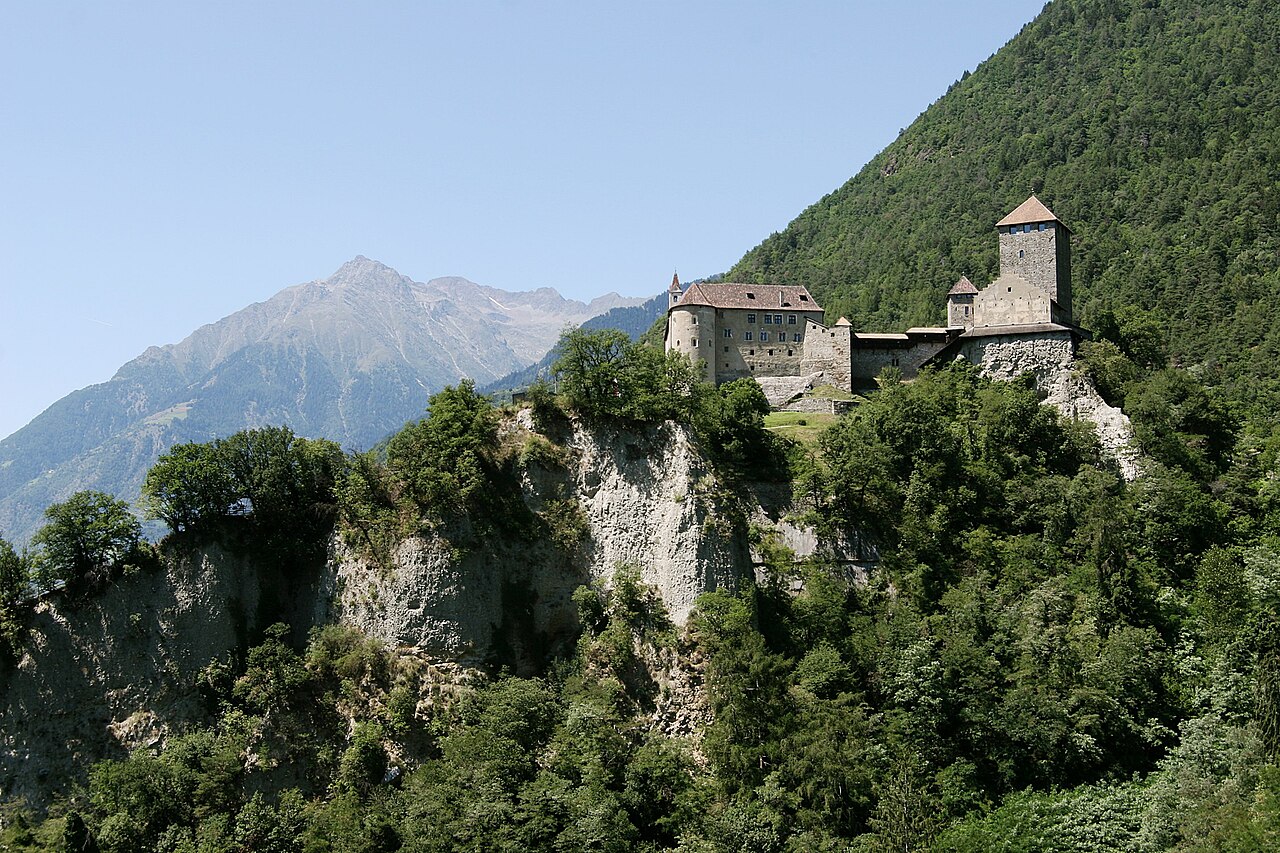
Stachlburg Castle
Stachlburg Castle stands as a remarkable example of a medieval hill castle nestled in the municipality of Partschins, Italy. Constructed originally in the mid-13th century by the noble lords of Partschins, descendants of the Tarantsberg family, it embodies centuries of regional history and architectural evolution. The castle’s oldest and most prominent feature is its central defensive tower, or bergfried, dating back to around 1250, which served as the fortress's last line of defense and remains a symbol of medieval military architecture.
Throughout its long history, Stachlburg Castle has witnessed transitions of power and adaptations reflecting changing times. In the late Middle Ages, it remained under noble control linked to the feudal structures of South Tyrol. The 16th century marked a significant turning point when Georg Stachl, a steward of nearby Castle Forst, was ennobled in 1538 and acquired the estate by 1547. The castle’s name evolved from Tarantshube, recorded in 1552, to Stachlburg by 1576, reflecting the new lordship and the castle’s integration into broader noble networks.
Ownership passed through notable families, including the Counts of Stachlburg and later the Freiherren von Schneeburg and Freiherren von Giovanelli. The last Count of Stachlburg, Johann, was a figure of historical significance who died during the Tyrolean Freedom Wars at the second Battle of Bergisel in 1809. Since 1946, the castle has been owned by the Freiherren von Kripp family, who have preserved the estate and introduced organic wine production on its grounds from 1998 onward, capitalizing on the castle’s advantageous elevation of approximately 650 meters.
Architectural features and layout
The castle complex is centered around the bergfried, a robust stone tower crowned with a distinctive pyramidal roof. This tower forms the defensive and symbolic heart of Stachlburg, showcasing medieval fortress design principles aimed at durability and protection. Adjacent to the bergfried are two principal buildings that illustrate the castle’s architectural evolution over several centuries.
The palas and residential buildings
To the west of the bergfried stands the palas, a grand residential hall constructed around 1300. This building represents the medieval period’s approach to noble living quarters, combining functionality with status display. On the eastern side, a building dating from the 15th to 16th centuries features a notable Renaissance-style stube, a heated living space designed for comfort and reflecting Renaissance domestic architecture influences.
Connecting structures and artistic elements
Circa 1600, an intermediate building with vaulted ceilings was added to connect the palas and the eastern residential structure, creating a unified living complex. This addition enhanced the castle’s residential functionality and architectural coherence. Within the eastern building lies a music hall established in 1727, distinguished by its elaborate stucco ceiling and allegorical wall paintings. These artistic features highlight the castle’s cultural refinement during the 18th century and its role as a noble residence that embraced evolving tastes and decorative arts.
Historical significance and legacy
Stachlburg Castle’s history is intertwined with the political and social fabric of South Tyrol. Its origins with the Tarantsberg family and later association with the Stachl family reflect the feudal dynamics of the region. The castle’s survival through wars, including the Tyrolean Freedom Wars, and its continued occupation by noble families underscore its resilience and importance as a symbol of aristocratic heritage.
The death of Count Johann Stachlburg in 1809 at the second Battle of Bergisel ties the castle to a pivotal moment in Tyrolean history, marking it as a site connected to the struggle for regional autonomy and freedom. The subsequent transfers of ownership through marriage alliances and noble inheritances illustrate the castle’s role within the broader network of European aristocracy.
Preservation and modern use
Today, Stachlburg Castle is well preserved and maintained as a private residence and winery. The castle’s stone and masonry construction has ensured its longevity, while careful restoration efforts have preserved its medieval and Renaissance architectural elements. The discovery of a coat of arms belonging to King Ferdinand I on an outbuilding’s facade in 2007 adds to the site’s historical richness and connects it to broader European monarchical history.
The castle grounds support organic wine production, a modern adaptation that respects the estate’s natural environment and historical context. Visitors and scholars alike can appreciate the castle’s blend of military, residential, and cultural architecture, which offers insights into the noble lifestyle and regional history of South Tyrol from the 13th century to the present.
Visiting stachlburg castle
As a private property, Stachlburg Castle is not regularly open to the public, but its exterior and surrounding landscape can be appreciated from nearby vantage points in Partschins. The castle’s location on a hillside provides picturesque views of the surrounding valleys and mountains, enhancing its appeal as a historic landmark. Special events or private tours may occasionally be arranged by the owners, providing opportunities to explore its rich heritage and architecture more closely.
Frequently asked questions (FAQ)
- How do I visit Stachlburg Castle?
- Stachlburg Castle is a private residence and winery, so it is not regularly open to the public. Visitors can view the castle from nearby public areas in Partschins. Occasionally, the owners may offer private tours or special events.
- What is the historical significance of Stachlburg Castle?
- Stachlburg Castle has a rich history dating back to the 13th century and is linked to noble families such as the Tarantsberg and Stachl. It played a role in regional history, including the Tyrolean Freedom Wars, with the last Count dying in battle in 1809.
- What architectural styles are present at Stachlburg Castle?
- The castle features a mix of architectural styles, including medieval fortress elements like the bergfried and palas, Renaissance residential features such as the stube, and 18th-century artistic decorations in the music hall.
- Is Stachlburg Castle accessible for visitors with mobility issues?
- Given that Stachlburg Castle is a historic hill castle and private residence, accessibility may be limited. Visitors should inquire in advance if private tours are available and discuss any mobility needs with the owners or tour organizers.
- When is the best time to visit the area around Stachlburg Castle?
- The region around Stachlburg Castle in South Tyrol is best visited during late spring to early autumn when the weather is pleasant, and the natural scenery is at its most vibrant. This period is ideal for enjoying outdoor views of the castle and surrounding landscape.
Information
Sources & official resources
Verify the information above using these authoritative references.
Loading map...
Visitor reviews
No reviews yet. Been here? Write the first review and help other travelers!
Write the first reviewVisited this castle? Share your experience
Your review helps other travelers and adds first-hand knowledge to our encyclopedia.