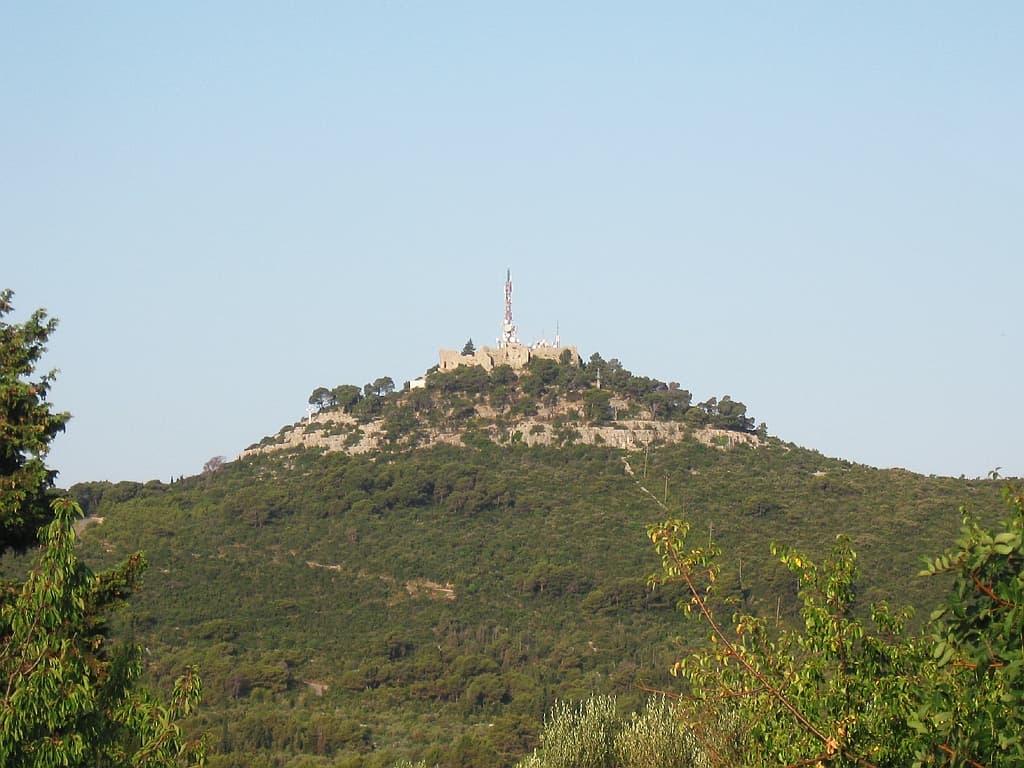
St. Michael's Castle
St. Michael's Castle, locally known as Tvrđava sveti Mihovil and often referred to as St. Michael's Fort, is a historic fortress located on the island of Ugljan, west of the town of Preko in the Zadar county of Croatia. Positioned atop a 263-meter-high hill, the second highest point on the island, the castle commands sweeping views over the Zadar archipelago, the Adriatic Sea, and the nearby Kornati National Park, making it a significant landmark both strategically and scenically.
Early fortifications and Byzantine origins
Archaeological excavations have revealed that the site of St. Michael's Castle was originally occupied by an Iron Age hill fort dating back to the 4th century BC. This early fortification highlights the strategic importance of the location, which overlooks vital maritime routes in the Adriatic. In the 6th century AD, the Byzantines constructed a fortress on this hill as part of a defensive chain designed to protect and control maritime traffic along the Dalmatian coast. The fortress served as a critical point of defense against various invasions and pirate incursions during the turbulent early medieval period.
The medieval monastery and Venetian construction
By the 11th century, a Benedictine monastery dedicated to St. Michael was established within the fortress walls, building upon a church that had been erected on the site a century earlier. This religious presence added a spiritual dimension to the fortress, integrating ecclesiastical functions with its military role.
Following the Fourth Crusade and the sack of Zadar in 1202, the Venetian Republic sought to consolidate its control over the region. In 1203, the Venetians constructed the present form of St. Michael's Castle to prevent the city's reconstruction and to protect their maritime trade interests. However, the local citizens of Zadar resisted Venetian rule fiercely, besieging and capturing the castle shortly after its completion, imprisoning the Venetian garrison and severely damaging the fortress in the process. Venetian authority was restored the following year through a peace agreement.
Conflicts and control shifts in the late medieval period
The castle and the city of Zadar experienced ongoing unrest and rebellion against Venetian domination throughout the subsequent centuries. Notably, during the 1345-1346 siege, the Venetians attempted for over a year to retake the fortress but initially failed. They succeeded in regaining control in 1347. The Treaty of Zadar in 1358 marked a significant turning point, as the Venetians relinquished control of the castle, returning it to the citizens of Zadar. The fortress underwent reconstruction following the damages inflicted during the sieges.
In 1409, Dalmatia, including St. Michael's Castle, was sold to Venice by Ladislaus of Naples, king of Croatia and Hungary, restoring Venetian control for the next four centuries. Over this period, the fortress gradually lost its military significance, transitioning into a lookout post and lighthouse, reflecting the changing nature of coastal defense in the Adriatic.
Modern era and wartime damage
Despite its declining military role, St. Michael's Castle was not spared from conflict in the 20th century. It sustained damage during World War II, notably the complete destruction of the castle church and partial damage to its walls. Later, during the Croatian War of Independence in the early 1990s, the fortress suffered further damage due to a radio-television antenna installed on the site just before the conflict.
Today, the castle remains a fascinating blend of medieval fortification and modern concrete additions, standing as a ruin that offers visitors a glimpse into centuries of Adriatic history. Its elevated position provides panoramic views, making it a popular destination for tourists and history enthusiasts alike.
Architectural features and layout
The fortress exhibits typical medieval defensive architecture, with robust stone walls adapted to the natural contours of the hilltop. The castle's design reflects its evolution from an early Byzantine fortress to a Venetian stronghold, incorporating elements such as battlements, watchtowers, and fortified gateways. Although much of the structure is in ruins, remnants of the original Benedictine monastery and the church dedicated to St. Michael can still be discerned within the complex.
The castle's strategic location on the island's second highest point allowed for effective surveillance of the surrounding sea lanes and the city of Zadar on the mainland. Its position made it an essential part of the maritime defense network controlling access to the Adriatic Sea during the medieval and Renaissance periods.
Visiting St. Michael's Castle today
Currently, St. Michael's Castle is freely accessible to the public as an open-air ruin. Visitors are drawn by its historical significance and breathtaking views of the Zadar archipelago and the Kornati National Park. The site offers a unique opportunity to explore a fortress that encapsulates layers of history from the Iron Age through the Byzantine, medieval, and Venetian periods to the modern era.
The castle is a favored destination for hikers and history buffs, who appreciate the combination of natural beauty and cultural heritage. While the fortress is in a ruinous state, the panoramic vistas and the atmospheric ruins provide a compelling experience of Dalmatia's rich past.
Frequently asked questions (FAQ)
- How do I get to St. Michael's Castle on Ugljan island?
- St. Michael's Castle is located on Ugljan island, accessible by ferry from Zadar to Preko. From Preko, visitors can hike or drive to the castle situated on the island's second highest hill.
- What is the historical significance of St. Michael's Castle?
- St. Michael's Castle has a rich history dating back to the Iron Age and Byzantine period. It played a key role in controlling maritime routes and witnessed numerous conflicts between Venetian forces and local inhabitants.
- Is St. Michael's Castle open to the public?
- Yes, the castle is freely accessible as an open-air ruin. Visitors can explore the site and enjoy panoramic views of the Adriatic Sea and surrounding islands.
- When is the best time to visit St. Michael's Castle?
- The best time to visit is during the spring and autumn months when the weather is mild and the island is less crowded. Summer offers beautiful views but can be hot and busy.
- Are there any facilities or guided tours available at the castle?
- There are no formal facilities or guided tours at St. Michael's Castle. Visitors should prepare for a self-guided visit and bring water and suitable footwear for hiking.
Photo gallery

Information
Loading map...
Visitor reviews
No reviews yet. Been here? Write the first review and help other travelers!
Write the first reviewVisited this castle? Share your experience
Your review helps other travelers and adds first-hand knowledge to our encyclopedia.



