St. Maartensdijk Castle — Netherlands castle

St. Maartensdijk Castle

St. Maartensdijk Castle: history and ruins in Zeeland, Netherlands
Sint-Maartensdijk, Zeeland, Netherlands
Late Medieval (14th–15th c.)
Ruins

St. Maartensdijk Castle was a significant medieval fortress located in the town of Sint-Maartensdijk in the province of Zeeland, Netherlands. Its origins trace back to the early 14th century, marking it as an important stronghold during the late medieval period. The castle played a notable role in the region's feudal and noble history, witnessing ownership changes among prominent families and connections to the Dutch royal lineage.

Early history and construction

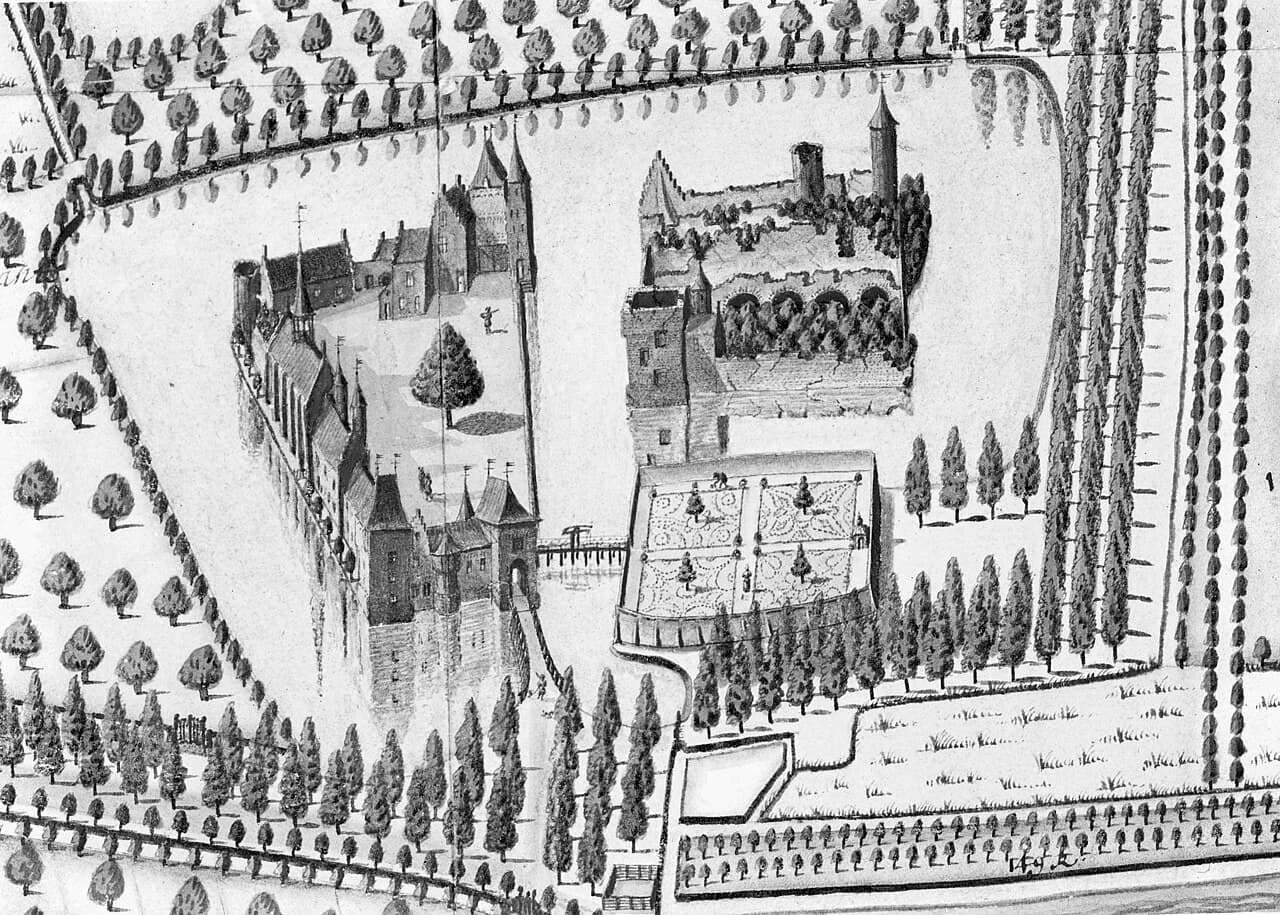
The castle's foundation is believed to date from the early 1300s, with the first documented ownership by Floris of Borselen in 1354. The Borselen family, a powerful noble house in Zeeland, significantly influenced the castle's development. In 1374, Floris's brother, Frank of Borselen, undertook substantial enlargements to the castle, enhancing its defensive and residential structures. These expansions likely included fortified walls, towers, and living quarters typical of late medieval castles in the Low Countries.

Notable historical events and ownership

One of the castle's most historically significant moments occurred in 1434 when Frank II of Borselen married Jacqueline, Countess of Holland, at St. Maartensdijk Castle. This marriage linked the castle to the broader political dynamics of the County of Holland and the surrounding regions.

Following Frank II's death in 1470, the castle passed through several female members of the Borselen family before transferring to the Van Culemborg family. Later, it came into the possession of the Van Egmont family through inheritance. The castle's ownership took on greater historical importance in 1551 when Anna van Egmont, heiress of the castle, married William I the Silent, Prince of Orange. This alliance brought St. Maartensdijk Castle into the holdings of the future Dutch royal family, linking it to the House of Orange-Nassau.

Restoration and decline

Between 1625 and 1632, Frederick Henry, Prince of Orange, undertook considerable restoration and enlargement of the castle. These works adapted the medieval fortress to more comfortable residential standards, reflecting the evolving architectural tastes and functions of noble residences in the early modern period. The restoration likely included modernization of living spaces and defensive structures to suit the needs of a princely residence rather than a purely military fortress.

Despite these improvements, the castle's maintenance declined in the decades following Frederick Henry's death. By 1695, the main castle buildings had fallen into ruin, with only the bailey—the outer courtyard—remaining in use. Over the next century, the entire complex deteriorated further until the ruins were eventually demolished around 1819.

Present condition and legacy

Today, St. Maartensdijk Castle no longer stands, with only fragments of its former moat surviving as a testament to its past. The site is now occupied by a private residence, and no visible castle structures remain accessible to the public. The castle's archaeological remains have been studied to understand its layout and historical significance within Zeeland's medieval heritage.

Although the castle itself has vanished, its historical connections to prominent noble families and the Dutch royal lineage contribute to its importance in regional history. The story of St. Maartensdijk Castle reflects the broader narrative of medieval fortifications in the Netherlands, their transformation in the early modern era, and eventual decline as military and residential needs evolved.

Frequently asked questions (FAQ)

How do I get to St. Maartensdijk Castle?
St. Maartensdijk Castle is located in Sint-Maartensdijk, Netherlands, and is accessible by car or public transport. If traveling by car, follow local road signs for Sint-Maartensdijk, and ample parking is available nearby. Public transport options include buses that connect from major towns in the region.
What is the historical significance of St. Maartensdijk Castle?
St. Maartensdijk Castle dates back to the 14th century and played a crucial role in the region's defense against invasions. It has served various purposes throughout history, including as a noble residence and a military stronghold. The castle's rich history reflects the architectural and cultural evolution of the Netherlands.
When was St. Maartensdijk Castle built?
St. Maartensdijk Castle was constructed in the 14th century, with its origins rooted in medieval architecture. Over the centuries, it has undergone several renovations that have preserved its historical integrity while adapting to modern needs. The castle remains a testament to the architectural styles of its time.
Can I take guided tours of St. Maartensdijk Castle?
Yes, guided tours of St. Maartensdijk Castle are available for visitors, providing insights into its history and architecture. Tours typically include access to the main areas of the castle and are led by knowledgeable guides. It's recommended to book in advance, especially during peak tourist seasons.
Why is St. Maartensdijk Castle a popular tourist destination?
St. Maartensdijk Castle is popular for its stunning architecture, rich history, and picturesque surroundings. Visitors are drawn to its beautiful gardens and the opportunity to explore a well-preserved medieval castle. The combination of historical significance and scenic beauty makes it an ideal destination for history buffs and casual visitors alike.
Is it possible to host events at St. Maartensdijk Castle?
Yes, St. Maartensdijk Castle offers event hosting services for weddings, corporate events, and private gatherings. The castle's unique ambiance and historic setting provide an unforgettable backdrop for any occasion. Interested parties should contact the castle management for availability and booking details.
What are the opening hours of St. Maartensdijk Castle?
St. Maartensdijk Castle is open to visitors from Tuesday to Sunday, with specific hours varying by season. Typically, the castle opens at 10 AM and closes at 5 PM, but it’s advisable to check the official website for the most current information. Special events may also affect opening hours.
Are there nearby attractions to visit while at St. Maartensdijk Castle?
Yes, visitors to St. Maartensdijk Castle can explore several nearby attractions, including scenic parks, historical sites, and local museums. The surrounding area offers beautiful walking trails and opportunities for cycling, making it a great addition to your visit. Don't miss the chance to enjoy the charm of Sint-Maartensdijk and the surrounding countryside.
What are the ticket prices for visiting St. Maartensdijk Castle?
Ticket prices for St. Maartensdijk Castle vary based on age and whether visitors opt for guided tours. Generally, adult tickets are priced at a reasonable rate, while discounts are available for children, seniors, and group bookings. It's best to check the official website for the latest pricing and any special promotions.

Photo gallery

St. Maartensdijk Castle
Click to view

Photo by Unknown authorUnknown author•CC BY-SA 4.0

1 photo • Click any image to view in full screen

Information

Archaeological Site / Ruins

Loading map...

Visitor reviews

No reviews yet. Been here? Write the first review and help other travelers!

Write the first review

Visited this castle? Share your experience

Your review helps other travelers and adds first-hand knowledge to our encyclopedia.

Write a review

(5/5)

0/2000 characters

Your review will be visible after admin approval

Nearby castles

11.8 km

Kruiningen Castle

Kruiningen, Netherlands

Kruiningen Castle was a medieval fortress located in the village of Kruiningen, in the province of Zeeland, the Netherlands. Although no physical traces remain today, historical records and depictions provide insight into its past significance as the seat of the Lords of Kruiningen and its architectural characteristics. The exact date of Kruiningen Castle's construction remains unknown, but it was first mentioned in historical documents in 1304. The earliest known lord, Wouter van Kruiningen, was recorded in 1198, suggesting the castle's origins likely date back to the late 12th or early 13th century. The castle was strategically important during the medieval period, serving as a fortified residence for the local nobility. The lords and historical context The castle was the hereditary seat of the Lords of Kruiningen. Throughout its history, it was involved in regional conflicts, including damage sustained during the power struggles between John II, Count of Holland, and Guy, Count of Flanders in the early 14th century. Financial support from William III, Count of Holland, also known as William the Good, was granted to maintain the castle after this period of unrest. During the 80 Years' War (1568–1648), the last lord, Maximilian van Kruiningen, aligned with the Spanish Crown, reflecting the complex political allegiances of the time. After his death in 1612, ownership passed to his daughter Louise and her husband Philippe de Recourt, baron of Liques, who also supported the Spanish side. This allegiance led to the castle being confiscated by the Dutch Republic. Restoration and decline Following the Peace of Münster in 1648, which ended the 80 Years' War, the States of Zeeland sold the castle to Gerard van der Nisse. At this time, Kruiningen Castle was in a dilapidated condition but underwent restoration efforts. Subsequently, the castle passed by marriage to the De Huijbert family. By the early 18th century, specifically 1702, it was inherited by Pieter Anthonie de Huijbert. Despite restoration attempts, the castle was no longer inhabited by the family and had fallen into serious disrepair. In 1721, Pieter Anthonie ordered the demolition of the crumbling structure. Since then, no visible remains of Kruiningen Castle have survived. Architectural features and layout Historical depictions indicate that Kruiningen Castle was a rectangular moated castle characterized by three square corner towers. The fourth corner was occupied by a larger main building, likely serving as the lord's residence or main hall. The moat would have provided defense against attackers, a common feature in medieval Dutch castles. The castle's design reflects typical medieval fortification principles in the Low Countries, combining residential and defensive functions. The presence of multiple towers and a moat suggests it was constructed to withstand sieges and assert noble authority in the region. Legacy and current status Today, Kruiningen Castle exists only in historical records and artistic representations. Its demolition in the early 18th century and subsequent absence of ruins mean that archaeological evidence is limited. The site behind Slotstraat 14 in Kruiningen marks where the castle once stood. The castle's history offers insight into the feudal and military dynamics of medieval Zeeland and the broader Dutch provinces. Its involvement in regional conflicts and political shifts during the 80 Years' War illustrates the complex allegiances of noble families during this turbulent period.

High Medieval (11th–13th c.)
Details
15.6 km
Fort de Roovere — Netherlands castle

Fort de Roovere

Bergen op Zoom, Netherlands

Fort de Roovere stands as a significant example of a Renaissance bastioned fortress in the Netherlands, located near Bergen op Zoom in the province of North Brabant. Constructed in 1628 as part of the Dutch Water Line (Hollandse Waterlinie), this fort played a strategic role in the military defense system devised by Maurice of Nassau during the Eighty Years' War. The fort's design reflects the military architectural principles of the Renaissance period, emphasizing earthworks and bastions to withstand artillery attacks. Strategic role and historical context The Dutch Water Line was a sophisticated network of water-based defenses intended to protect the core provinces of the Dutch Republic by flooding low-lying areas to impede enemy advances. Fort de Roovere was a key component of this system, guarding the approaches to the fortress city of Bergen op Zoom. Its location near Halsteren allowed it to control access routes and support neighboring forts such as Fort Pinssen. Throughout its history, Fort de Roovere witnessed significant military activity. In 1747, during the Austrian War of Succession (1740–1748), the fort endured a siege by French forces. This siege is well-documented and forms an important chapter in the fort's military heritage. Although the fortress of Bergen op Zoom eventually fell, the siege of Fort de Roovere was abandoned, highlighting the fort's resilience. Later, during the Napoleonic Wars, the fort again played a defensive role when English troops besieged Bergen op Zoom as they pursued French forces. While Fort de Roovere did not come under direct attack during this period, it received maintenance and upkeep to bolster its defenses. After these conflicts, the fort was gradually abandoned and fell into disrepair. Architectural features and design Fort de Roovere is characterized by its earthen construction, typical of bastioned fortresses from the Renaissance era. The fort features two prominent bastions at the front, designed to provide overlapping fields of fire and to resist cannon bombardment. The fort's dry moat and surrounding banks were originally integral to its defense, though over time these became overgrown with trees and vegetation. The fort is accessible from the 'back,' where the entrance is situated, while the front presents the imposing bastions facing outward. The earthen walls absorb artillery impact better than stone, a common feature in 17th-century fortifications adapting to gunpowder weaponry. The moses bridge: innovative access across the moat A distinctive modern addition to Fort de Roovere is the Moses Bridge, a partially submerged wooden bridge that crosses the moat. Designed to be almost invisible from a distance, the bridge creates the illusion of parting the waters, allowing visitors to cross at water level with minimal visual impact on the historic landscape. Constructed entirely of waterproofed wood, the bridge's design respects the fort's historic integrity by avoiding traditional bridge structures that would disrupt the fort's defensive appearance. This innovative solution has garnered attention for its blend of modern engineering and heritage conservation. Restoration and preservation efforts After decades of neglect, Fort de Roovere underwent significant restoration beginning in 2010, led by the organization Friends of Fort de Roovere. Restoration efforts included clearing dense undergrowth, deepening the moat to restore its original defensive function, and repairing earthworks. These measures aimed to make the fort more recognizable as a historic military structure and to preserve it for future generations. The restoration was not without controversy; local protests arose due to concerns about environmental impact and the disturbance of the natural habitat. Despite this, archaeological research has been limited, though amateur metal detectorists continue to find artifacts such as cannonballs around the site, remnants of the fort's active military past. Cultural significance and visitor experience Today, Fort de Roovere is open to the public and serves as a cultural heritage site that offers insight into the military history of the Netherlands. Visitors can explore the fort's bastions, walk across the Moses Bridge, and appreciate the integration of historic architecture with modern conservation techniques. The fort's location within the Dutch Water Line network provides context for understanding the strategic defense systems of the 17th and 18th centuries. Its well-preserved earthworks and innovative bridge make it a unique destination for history enthusiasts, architects, and tourists alike.

Renaissance (15th–17th c.)
Details
16.7 km

Fort Henricus

Oude Vlietpolderdijk, Netherlands

Fort Henricus is a notable example of a Renaissance starfort located north of Steenbergen in the province of North Brabant, Netherlands. Constructed in 1626 during the turbulent period of the Eighty Years' War, this fortification was strategically designed to protect the harbor of Steenbergen and a crucial sluice used for controlled flooding of the surrounding countryside as a defensive measure. Historical background and strategic importance The site of Fort Henricus had been of military significance since at least 1583, when a predecessor fortification was erected by the Spanish forces. This earlier fortification underscored the strategic value of controlling waterways and flood defenses in the region. The current fort was commissioned by Frederick Henry, Prince of Orange, a key leader in the Dutch fight for independence, reflecting the evolving military strategies of the time. Fort Henricus was an integral part of the West Brabant Waterline, a defensive network that used water as a natural barrier against invading forces. The fort's location enabled control over both maritime access and the sluice system that could flood the low-lying lands, a typical Dutch defensive tactic known as inundation. Architectural design and features The fort was designed as a starfort with five bastions, a style that became prominent during the Renaissance period as a response to advances in artillery. The design was the work of David van Orliens, a military engineer who employed the geometrical principles of star-shaped fortifications to maximize defensive coverage and minimize blind spots. The starfort design allowed for overlapping fields of fire from the bastions, enhancing the fort's ability to repel attackers. The fort's earthen ramparts were intended to be mounted with cannons, providing formidable artillery positions. Inside, the fort housed a garrison of approximately 450 people, including soldiers and their families, which was typical for such military installations of the era. A small church within the fort's walls served the spiritual needs of the garrison, hosting marriages and baptisms, indicating the fort's role as a semi-permanent community as well as a military stronghold. Military use and decline Fort Henricus remained militarily active through the 17th and 18th centuries, adapting to the changing political landscape of the Netherlands and Europe. In 1809, during the Napoleonic Wars, the fort was placed on standby due to fears of a British invasion, marking one of its last military mobilizations. By 1812 or 1816, the fort's military importance had diminished significantly. Subsequently, all interior structures were demolished, reflecting the obsolescence of starforts as military technology and tactics evolved. In 1827, the site was sold to a private owner and repurposed for agricultural use, marking a shift from military to civilian function. Modern restoration and current status The fort is currently owned by Natuurmonumenten, a Dutch environmental organization dedicated to the preservation of natural and historical sites. Beginning in 2008, restoration efforts have focused on rebuilding the fort's ramparts and restoring its moat, aiming to revive the fort's historical landscape and defensive features. Modern interventions include the construction of a new entrance on the northern side, replacing the original southern access point. Despite these restorations, the fort's low profile and absence of standing buildings make its outline difficult to discern at ground level, blending into the natural surroundings. Today, Fort Henricus is freely accessible to the public, serving as both a historical site and a natural reserve, illustrating the integration of cultural heritage preservation with environmental conservation. Architectural significance and legacy Fort Henricus exemplifies the Renaissance military architecture adapted to the unique Dutch landscape. Its star-shaped design reflects the era's response to the increasing use of gunpowder artillery, emphasizing angled bastions and low, thick earthen walls to absorb cannon fire. The fort's role within the West Brabant Waterline highlights the Dutch mastery of water management as a defensive tool, combining engineering and military strategy in a distinctive manner. This integration of natural and constructed defenses is a hallmark of Dutch fortifications from this period. While the fort no longer functions as a military installation, its preservation and restoration provide valuable insights into 17th-century fortification techniques and the historical context of the Eighty Years' War.

Renaissance (15th–17th c.)
Details