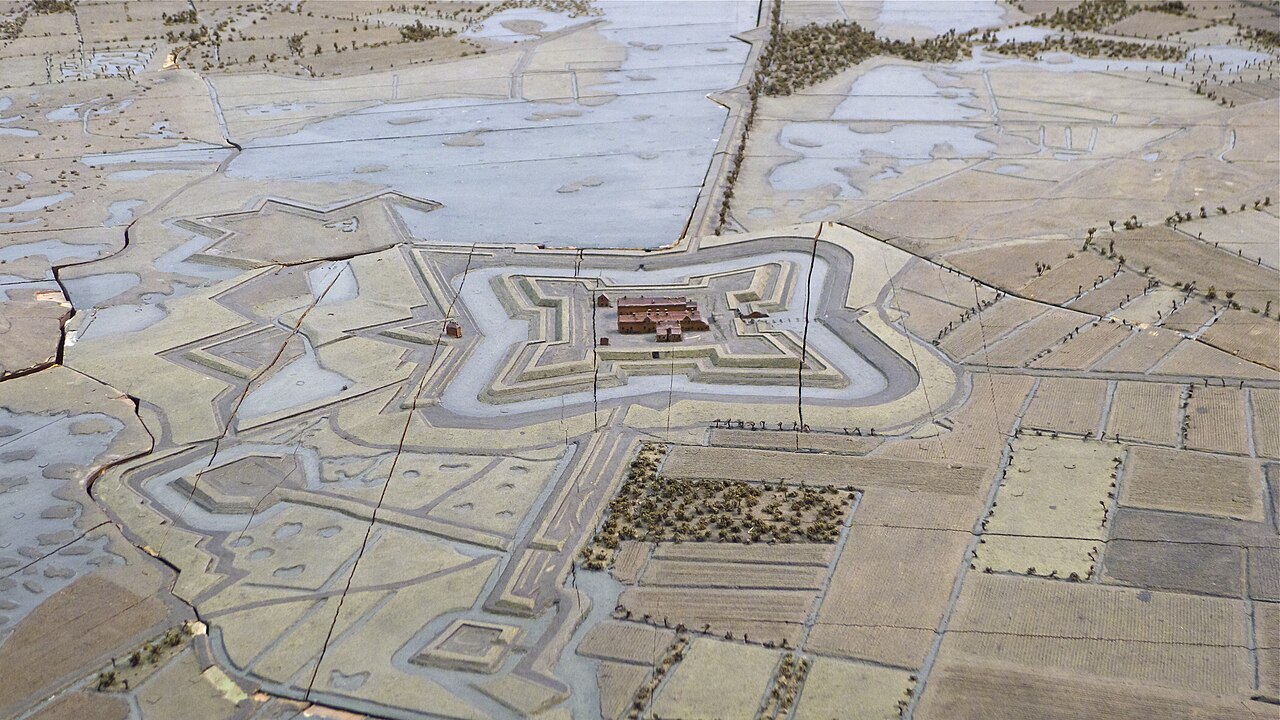
Fort Henricus
Fort Henricus is a notable example of a Renaissance starfort located north of Steenbergen in the province of North Brabant, Netherlands. Constructed in 1626 during the turbulent period of the Eighty Years' War, this fortification was strategically designed to protect the harbor of Steenbergen and a crucial sluice used for controlled flooding of the surrounding countryside as a defensive measure.
Historical background and strategic importance
The site of Fort Henricus had been of military significance since at least 1583, when a predecessor fortification was erected by the Spanish forces. This earlier fortification underscored the strategic value of controlling waterways and flood defenses in the region. The current fort was commissioned by Frederick Henry, Prince of Orange, a key leader in the Dutch fight for independence, reflecting the evolving military strategies of the time.
Fort Henricus was an integral part of the West Brabant Waterline, a defensive network that used water as a natural barrier against invading forces. The fort's location enabled control over both maritime access and the sluice system that could flood the low-lying lands, a typical Dutch defensive tactic known as inundation.
Architectural design and features
The fort was designed as a starfort with five bastions, a style that became prominent during the Renaissance period as a response to advances in artillery. The design was the work of David van Orliens, a military engineer who employed the geometrical principles of star-shaped fortifications to maximize defensive coverage and minimize blind spots.
The starfort design allowed for overlapping fields of fire from the bastions, enhancing the fort's ability to repel attackers. The fort's earthen ramparts were intended to be mounted with cannons, providing formidable artillery positions. Inside, the fort housed a garrison of approximately 450 people, including soldiers and their families, which was typical for such military installations of the era.
A small church within the fort's walls served the spiritual needs of the garrison, hosting marriages and baptisms, indicating the fort's role as a semi-permanent community as well as a military stronghold.
Military use and decline
Fort Henricus remained militarily active through the 17th and 18th centuries, adapting to the changing political landscape of the Netherlands and Europe. In 1809, during the Napoleonic Wars, the fort was placed on standby due to fears of a British invasion, marking one of its last military mobilizations.
By 1812 or 1816, the fort's military importance had diminished significantly. Subsequently, all interior structures were demolished, reflecting the obsolescence of starforts as military technology and tactics evolved. In 1827, the site was sold to a private owner and repurposed for agricultural use, marking a shift from military to civilian function.
Modern restoration and current status
The fort is currently owned by Natuurmonumenten, a Dutch environmental organization dedicated to the preservation of natural and historical sites. Beginning in 2008, restoration efforts have focused on rebuilding the fort's ramparts and restoring its moat, aiming to revive the fort's historical landscape and defensive features.
Modern interventions include the construction of a new entrance on the northern side, replacing the original southern access point. Despite these restorations, the fort's low profile and absence of standing buildings make its outline difficult to discern at ground level, blending into the natural surroundings.
Today, Fort Henricus is freely accessible to the public, serving as both a historical site and a natural reserve, illustrating the integration of cultural heritage preservation with environmental conservation.
Architectural significance and legacy
Fort Henricus exemplifies the Renaissance military architecture adapted to the unique Dutch landscape. Its star-shaped design reflects the era's response to the increasing use of gunpowder artillery, emphasizing angled bastions and low, thick earthen walls to absorb cannon fire.
The fort's role within the West Brabant Waterline highlights the Dutch mastery of water management as a defensive tool, combining engineering and military strategy in a distinctive manner. This integration of natural and constructed defenses is a hallmark of Dutch fortifications from this period.
While the fort no longer functions as a military installation, its preservation and restoration provide valuable insights into 17th-century fortification techniques and the historical context of the Eighty Years' War.
Frequently asked questions (FAQ)
- What is the historical significance of Fort Henricus?
- Fort Henricus is a notable example of 17th-century military architecture in the Netherlands, built to protect the region during various conflicts. It played a crucial role in the defense strategies of the Dutch Republic, showcasing innovative fortification techniques of its time.
- When was Fort Henricus constructed?
- Fort Henricus was constructed in 1624 as part of the defense system against potential invasions. Its establishment was part of a broader effort to enhance military readiness during a tumultuous period in Dutch history.
- What are the opening hours for visiting Fort Henricus?
- Fort Henricus is open to visitors from Tuesday to Sunday, 10 AM to 5 PM. Please check the official website for any seasonal variations or special holiday hours before planning your visit.
- Can I access Fort Henricus with a wheelchair?
- Yes, Fort Henricus is committed to accessibility and provides facilities for visitors with mobility challenges. There are ramps and designated pathways to ensure that all guests can enjoy the historical site comfortably.
- When is the best time to visit Fort Henricus?
- The best time to visit Fort Henricus is during the spring and early autumn when the weather is mild and pleasant. These seasons also offer vibrant scenery, making your visit more enjoyable.
- What are the ticket prices for Fort Henricus?
- Tickets for Fort Henricus are reasonably priced, with adult tickets costing around €10 and discounted rates available for children and seniors. Group rates are also available, so be sure to inquire if you're planning a visit with a larger party.
- Are there any nearby attractions to Fort Henricus?
- Yes, there are several nearby attractions, including the picturesque village of Oude Vlietpolder and various walking trails along the scenic waterways. Visitors can also explore local museums that highlight the rich history of the region.
- How do I get to Fort Henricus?
- Fort Henricus is accessible by car, with ample parking available on-site. Public transportation options are also available, including buses that connect to nearby towns, making it easy for visitors to reach the castle.
Loading map...
Visitor reviews
No reviews yet. Been here? Write the first review and help other travelers!
Write the first reviewVisited this castle? Share your experience
Your review helps other travelers and adds first-hand knowledge to our encyclopedia.