Kruiningen Castle
Kruiningen Castle was a medieval fortress located in the village of Kruiningen, in the province of Zeeland, the Netherlands. Although no physical traces remain today, historical records and depictions provide insight into its past significance as the seat of the Lords of Kruiningen and its architectural characteristics.
The exact date of Kruiningen Castle's construction remains unknown, but it was first mentioned in historical documents in 1304. The earliest known lord, Wouter van Kruiningen, was recorded in 1198, suggesting the castle's origins likely date back to the late 12th or early 13th century. The castle was strategically important during the medieval period, serving as a fortified residence for the local nobility.
The lords and historical context
The castle was the hereditary seat of the Lords of Kruiningen. Throughout its history, it was involved in regional conflicts, including damage sustained during the power struggles between John II, Count of Holland, and Guy, Count of Flanders in the early 14th century. Financial support from William III, Count of Holland, also known as William the Good, was granted to maintain the castle after this period of unrest.
During the 80 Years' War (1568–1648), the last lord, Maximilian van Kruiningen, aligned with the Spanish Crown, reflecting the complex political allegiances of the time. After his death in 1612, ownership passed to his daughter Louise and her husband Philippe de Recourt, baron of Liques, who also supported the Spanish side. This allegiance led to the castle being confiscated by the Dutch Republic.
Restoration and decline
Following the Peace of Münster in 1648, which ended the 80 Years' War, the States of Zeeland sold the castle to Gerard van der Nisse. At this time, Kruiningen Castle was in a dilapidated condition but underwent restoration efforts. Subsequently, the castle passed by marriage to the De Huijbert family. By the early 18th century, specifically 1702, it was inherited by Pieter Anthonie de Huijbert.
Despite restoration attempts, the castle was no longer inhabited by the family and had fallen into serious disrepair. In 1721, Pieter Anthonie ordered the demolition of the crumbling structure. Since then, no visible remains of Kruiningen Castle have survived.
Architectural features and layout
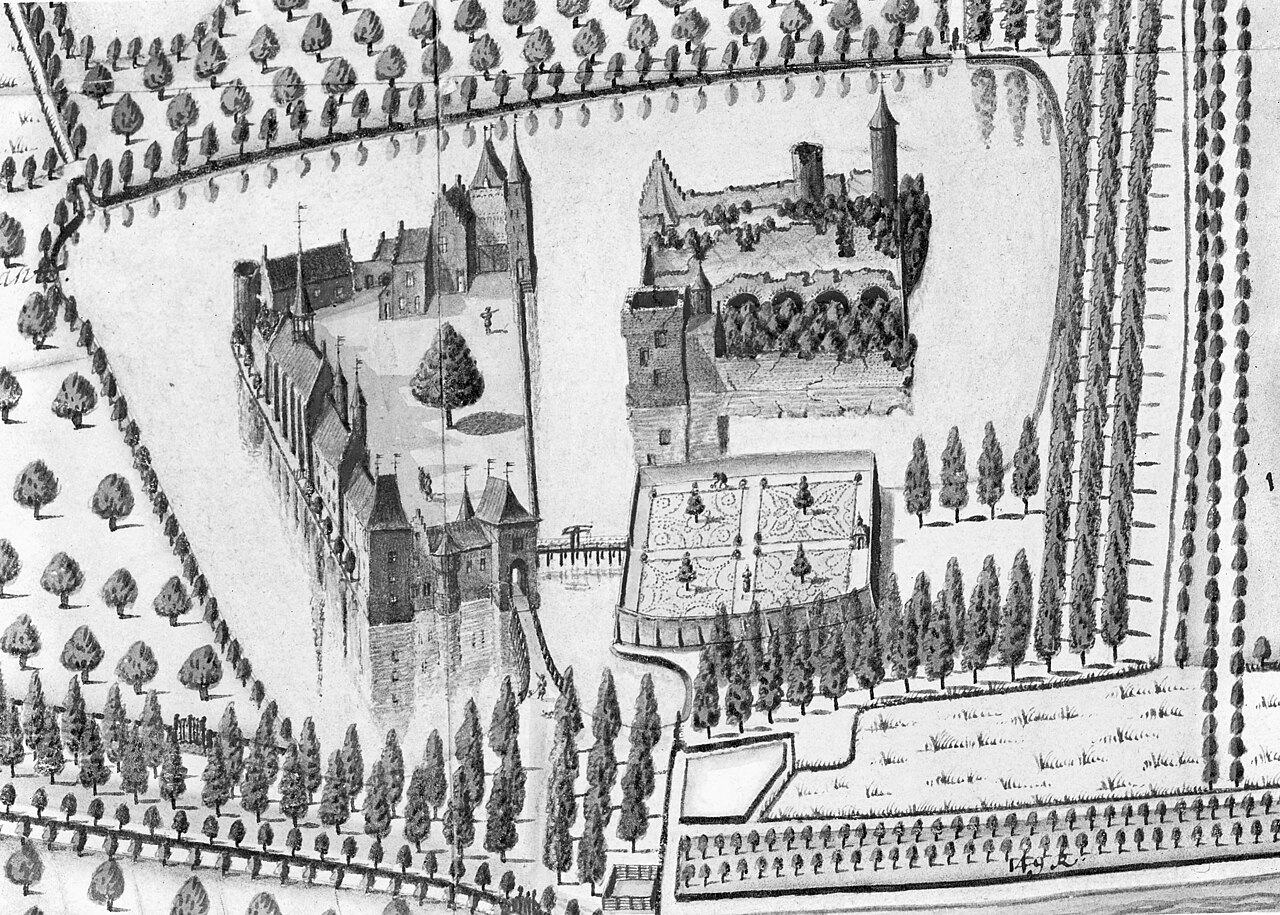
Historical depictions indicate that Kruiningen Castle was a rectangular moated castle characterized by three square corner towers. The fourth corner was occupied by a larger main building, likely serving as the lord's residence or main hall. The moat would have provided defense against attackers, a common feature in medieval Dutch castles.
The castle's design reflects typical medieval fortification principles in the Low Countries, combining residential and defensive functions. The presence of multiple towers and a moat suggests it was constructed to withstand sieges and assert noble authority in the region.
Legacy and current status
Today, Kruiningen Castle exists only in historical records and artistic representations. Its demolition in the early 18th century and subsequent absence of ruins mean that archaeological evidence is limited. The site behind Slotstraat 14 in Kruiningen marks where the castle once stood.
The castle's history offers insight into the feudal and military dynamics of medieval Zeeland and the broader Dutch provinces. Its involvement in regional conflicts and political shifts during the 80 Years' War illustrates the complex allegiances of noble families during this turbulent period.
Frequently asked questions (FAQ)
- When was Kruiningen Castle first mentioned in historical records?
- Kruiningen Castle was first mentioned in 1304, although the Lords of Kruiningen were documented as early as 1198.
- What type of castle was Kruiningen Castle?
- Kruiningen Castle was a moated water castle with three square corner towers and a larger building in the fourth corner.
- Why was Kruiningen Castle demolished?
- The castle was demolished in 1721 by Pieter Anthonie de Huijbert due to its dilapidated state and lack of habitation.
- What role did Kruiningen Castle play during the 80 Years' War?
- During the 80 Years' War, the last lord sided with the Spanish Crown, leading to the castle's confiscation by the Dutch Republic.
- Are there any remains of Kruiningen Castle today?
- No physical remains of Kruiningen Castle exist today; the site is marked behind Slotstraat 14 in Kruiningen.
Information
Address
Behind Slotstraat 14, Kruiningen, Netherlands
Loading map...
Visitor reviews
No reviews yet. Been here? Write the first review and help other travelers!
Write the first reviewVisited this castle? Share your experience
Your review helps other travelers and adds first-hand knowledge to our encyclopedia.