Fort de Roovere
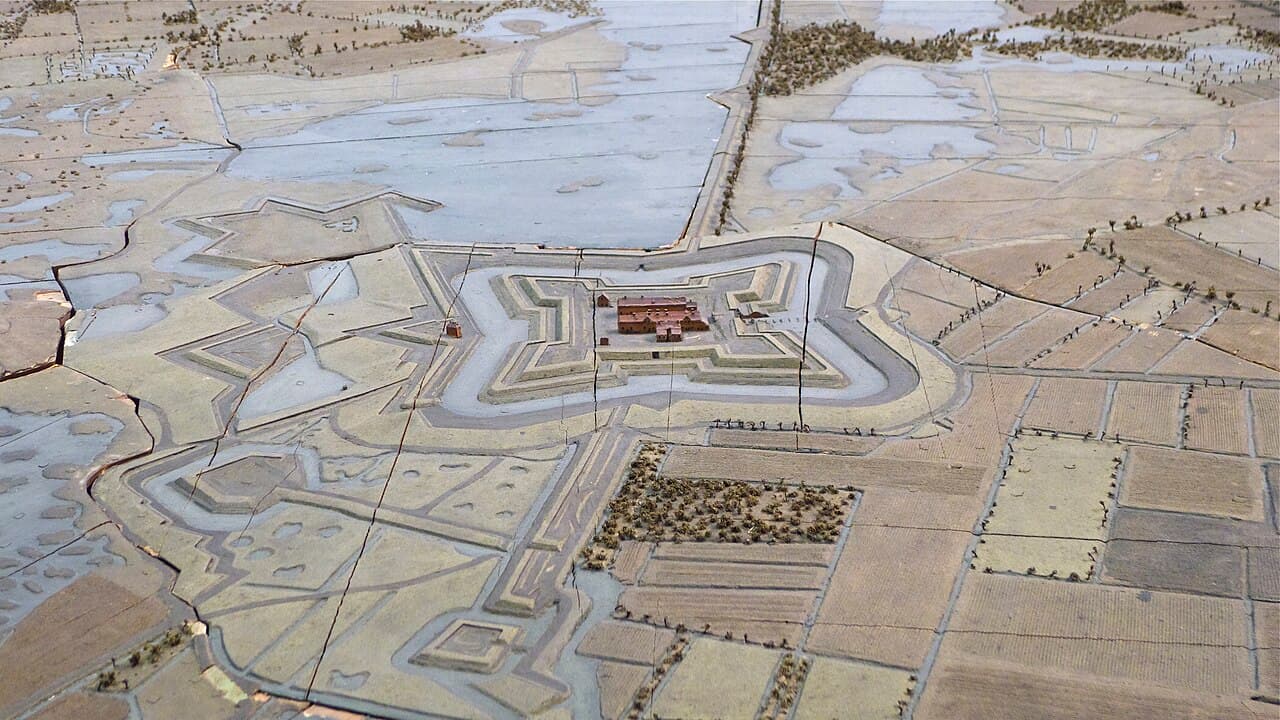
Fort de Roovere stands as a significant example of a Renaissance bastioned fortress in the Netherlands, located near Bergen op Zoom in the province of North Brabant. Constructed in 1628 as part of the Dutch Water Line (Hollandse Waterlinie), this fort played a strategic role in the military defense system devised by Maurice of Nassau during the Eighty Years' War. The fort's design reflects the military architectural principles of the Renaissance period, emphasizing earthworks and bastions to withstand artillery attacks.
Strategic role and historical context
The Dutch Water Line was a sophisticated network of water-based defenses intended to protect the core provinces of the Dutch Republic by flooding low-lying areas to impede enemy advances. Fort de Roovere was a key component of this system, guarding the approaches to the fortress city of Bergen op Zoom. Its location near Halsteren allowed it to control access routes and support neighboring forts such as Fort Pinssen.
Throughout its history, Fort de Roovere witnessed significant military activity. In 1747, during the Austrian War of Succession (1740–1748), the fort endured a siege by French forces. This siege is well-documented and forms an important chapter in the fort's military heritage. Although the fortress of Bergen op Zoom eventually fell, the siege of Fort de Roovere was abandoned, highlighting the fort's resilience.
Later, during the Napoleonic Wars, the fort again played a defensive role when English troops besieged Bergen op Zoom as they pursued French forces. While Fort de Roovere did not come under direct attack during this period, it received maintenance and upkeep to bolster its defenses. After these conflicts, the fort was gradually abandoned and fell into disrepair.
Architectural features and design
Fort de Roovere is characterized by its earthen construction, typical of bastioned fortresses from the Renaissance era. The fort features two prominent bastions at the front, designed to provide overlapping fields of fire and to resist cannon bombardment. The fort's dry moat and surrounding banks were originally integral to its defense, though over time these became overgrown with trees and vegetation.
The fort is accessible from the 'back,' where the entrance is situated, while the front presents the imposing bastions facing outward. The earthen walls absorb artillery impact better than stone, a common feature in 17th-century fortifications adapting to gunpowder weaponry.
The moses bridge: innovative access across the moat
A distinctive modern addition to Fort de Roovere is the Moses Bridge, a partially submerged wooden bridge that crosses the moat. Designed to be almost invisible from a distance, the bridge creates the illusion of parting the waters, allowing visitors to cross at water level with minimal visual impact on the historic landscape.
Constructed entirely of waterproofed wood, the bridge's design respects the fort's historic integrity by avoiding traditional bridge structures that would disrupt the fort's defensive appearance. This innovative solution has garnered attention for its blend of modern engineering and heritage conservation.
Restoration and preservation efforts
After decades of neglect, Fort de Roovere underwent significant restoration beginning in 2010, led by the organization Friends of Fort de Roovere. Restoration efforts included clearing dense undergrowth, deepening the moat to restore its original defensive function, and repairing earthworks. These measures aimed to make the fort more recognizable as a historic military structure and to preserve it for future generations.
The restoration was not without controversy; local protests arose due to concerns about environmental impact and the disturbance of the natural habitat. Despite this, archaeological research has been limited, though amateur metal detectorists continue to find artifacts such as cannonballs around the site, remnants of the fort's active military past.
Cultural significance and visitor experience
Today, Fort de Roovere is open to the public and serves as a cultural heritage site that offers insight into the military history of the Netherlands. Visitors can explore the fort's bastions, walk across the Moses Bridge, and appreciate the integration of historic architecture with modern conservation techniques.
The fort's location within the Dutch Water Line network provides context for understanding the strategic defense systems of the 17th and 18th centuries. Its well-preserved earthworks and innovative bridge make it a unique destination for history enthusiasts, architects, and tourists alike.
Frequently asked questions (FAQ)
- What is the historical significance of Fort de Roovere?
- Fort de Roovere, built in the 17th century, is a key example of Dutch military architecture and played a vital role in the defense of the region during the Eighty Years' War. Its design reflects the innovative engineering techniques of the time, showcasing the importance of fortifications in protecting the Netherlands from invasions.
- When was Fort de Roovere constructed?
- Fort de Roovere was constructed between 1627 and 1629 as part of the Defense Line of Antwerp. This fortification was strategically built to protect the city of Bergen op Zoom and its surroundings from potential threats during a turbulent period in Dutch history.
- How do I get to Fort de Roovere?
- Fort de Roovere is easily accessible by car and public transportation. Visitors can reach the site via local bus services from Bergen op Zoom, and ample parking is available on-site for those traveling by car.
- What are the opening hours of Fort de Roovere?
- Fort de Roovere is open to visitors year-round, with specific hours varying by season. Generally, the fort is open daily from 10 AM to 5 PM, but it's advisable to check the official website for any updates or changes to these hours.
- Can I take guided tours at Fort de Roovere?
- Yes, guided tours are available at Fort de Roovere, providing visitors with in-depth insights into its history and architecture. These tours are led by knowledgeable guides who can enhance your understanding of the fort's significance and its role in Dutch military history.
- Is Fort de Roovere accessible for visitors with disabilities?
- Fort de Roovere strives to be accessible to all visitors, with pathways designed for easier navigation. However, some areas may present challenges due to the fort’s historical nature, so it's recommended to contact the site in advance to inquire about specific accessibility options.
- What is the best time to visit Fort de Roovere?
- The best time to visit Fort de Roovere is during the spring and early autumn when the weather is mild and ideal for outdoor exploration. Additionally, visiting during weekdays may help you avoid larger crowds, allowing for a more leisurely experience.
- Are there any ticket prices for visiting Fort de Roovere?
- Admission to Fort de Roovere is generally free, making it an accessible destination for everyone. However, some special events or guided tours may require a nominal fee, so it's a good idea to check in advance for any specific pricing details.
- What nearby attractions can I visit while at Fort de Roovere?
- While visiting Fort de Roovere, you can explore other nearby attractions, such as the historic city center of Bergen op Zoom and the beautiful Zoommeer lake. The region is rich in history and natural beauty, making it perfect for a full day of exploration.
Photo gallery

Information
Loading map...
Visitor reviews
No reviews yet. Been here? Write the first review and help other travelers!
Write the first reviewVisited this castle? Share your experience
Your review helps other travelers and adds first-hand knowledge to our encyclopedia.