St Catherine's Castle
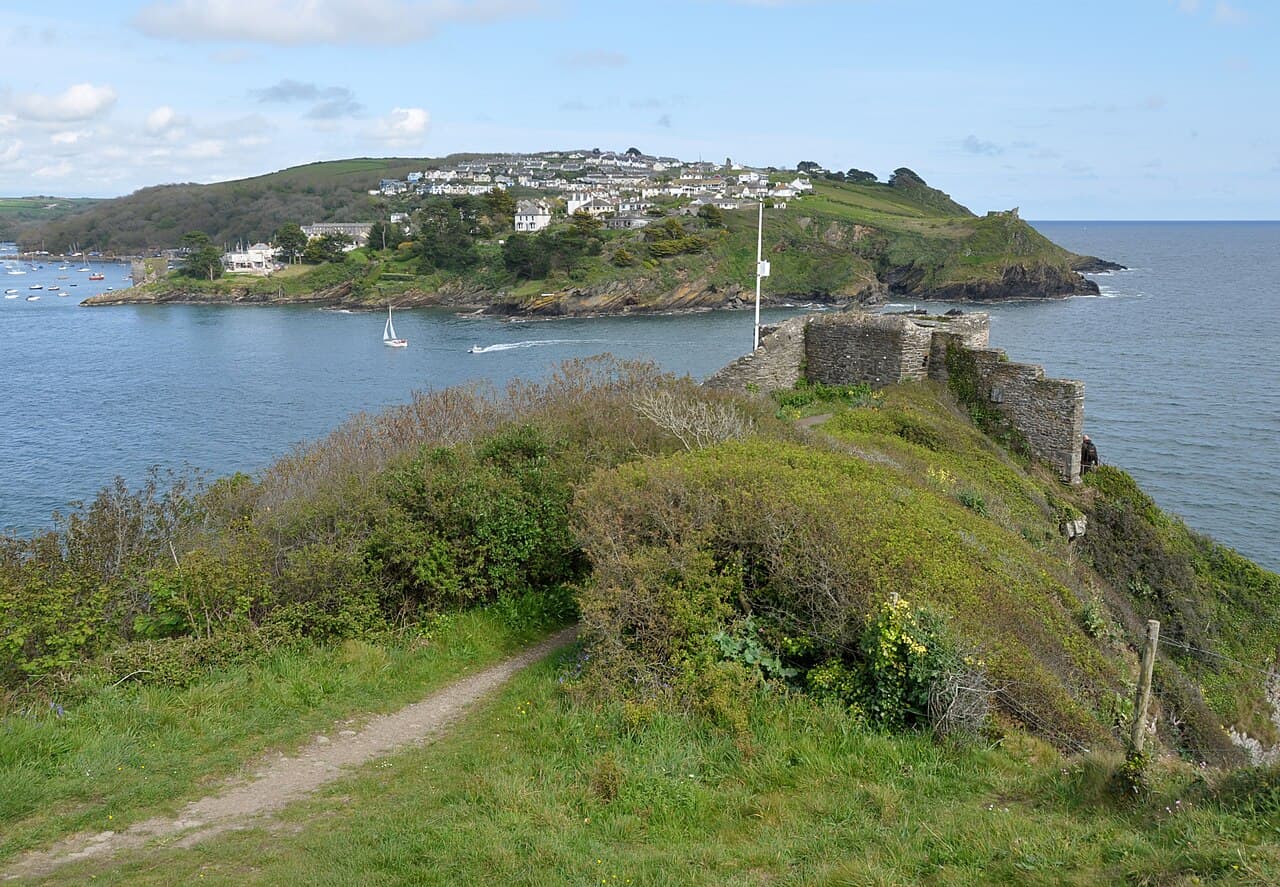
St Catherine's Castle stands as a remarkable example of Tudor coastal fortifications in Cornwall, England. Constructed between 1538 and 1540 by Thomas Treffry, a prominent local landowner, the castle was part of a strategic response to the heightened invasion threats posed by France and the Holy Roman Empire during the reign of King Henry VIII. This Henrician fortress was designed to protect the vital trading harbor at Fowey, commanding the mouth of the River Fowey estuary with a commanding view over the sea approaches.
The castle's D-shaped blockhouse is a distinctive architectural feature, constructed with thick slate rubble walls up to 1.35 meters thick, built directly onto a platform carved from the bedrock. This robust structure was equipped with five gun-ports designed for mounting cannons, providing a formidable defense against naval assault. The blockhouse's two floors included cannon embrasures on both levels and smaller musket loops, allowing defenders to cover multiple angles. Inside, the presence of a fireplace and chimney indicates provisions for the garrison's comfort during extended deployments.
Historical context and construction
The castle was commissioned during a period of significant political upheaval, following Henry VIII's break with the Catholic Church and the formation of alliances between England's enemies. The threat of invasion led to a nationwide program of coastal defenses, with St Catherine's Castle replacing earlier, less substantial fortifications such as blockhouses and a chain boom across the estuary. Funding for the castle's construction was a combined effort involving both the local community and the Crown, reflecting its strategic importance.
Military use through the centuries
Tudor period and the english civil war
During the English Civil War in the 1640s, the castle was held by Royalist forces loyal to King Charles I. Despite falling into some disrepair by the late 17th century, it remained an active defensive site. Into the 18th century, the castle continued to serve as a coastal battery, with six cannons installed to guard against privateers and enemy fleets, particularly during the Napoleonic Wars which concluded in 1815.
19th-century modifications and the crimean war
The mid-19th century saw renewed military interest during the Crimean War, when the castle was refortified in 1855. Two new artillery positions were constructed, featuring circular gun platforms with rails to facilitate aiming and movement of heavy guns. A new magazine cut into the rock provided secure storage for gunpowder. These improvements were overseen by the War Department, as indicated by plaques inscribed "WD 1855" on the curtain walls.
20th-century use and world war ii
During the Second World War, St Catherine's Castle was once again brought into military service. It housed a battery of naval guns, including a French 75mm field gun, and served as a control post coordinating minefields protecting the estuary. Concrete defensive structures and gun platform markings from this period remain visible today, underscoring the castle's enduring strategic role until its decommissioning in 1945.
Architectural features and layout
The castle's main structure is the D-shaped blockhouse, measuring approximately 5 by 4.4 meters internally. Its thick walls and elevated position on a rocky headland provided excellent defensive advantages. The ground floor featured three semi-circular cannon openings facing the sea, though one has been filled in over time. The upper floor contained two additional gun ports and multiple smaller windows for handheld firearms, allowing defenders to repel attackers from multiple angles.
A parapet walk once crowned the blockhouse, enabling sentries to patrol and maintain vigilance. Surrounding the blockhouse is a curtain wall forming a semi-circular courtyard of about 500 square meters. This wall is pierced with narrow musket slits, allowing defenders to cover the approaches while remaining protected.
To the landward side, a rectangular bastion measuring roughly 5.7 by 3.2 meters internally with 0.75-meter-thick walls provided additional defense against ground assaults. The castle's original access path has been replaced by 19th-century steps, reflecting modifications made during its later military use.
Preservation and public access
Today, St Catherine's Castle is managed by English Heritage and stands as a well-preserved example of Tudor coastal defense architecture. Visitors can explore the castle's remains, including the blockhouse, curtain walls, bastion, and later additions from the 19th and 20th centuries. The site offers insight into the evolution of military architecture over four centuries, from the Henrician era through to World War II.
The castle's location on a rocky promontory provides stunning views over the Fowey estuary and the surrounding coastline, enhancing its appeal as a heritage and tourist destination. Interpretive signage and guided tours help visitors understand the castle's historical significance and architectural features.
Significance in english coastal defense
St Catherine's Castle exemplifies the Henrician program of coastal fortifications initiated in the 16th century to protect England from European invasion threats. Its combination of robust stone construction, strategic siting, and layered artillery defenses illustrates the military engineering advances of the period. The castle's continued use and adaptation through subsequent conflicts highlight its enduring strategic value.
As a heritage site, it offers a tangible connection to England's Tudor past and the broader history of coastal defense. Its preservation allows for ongoing study and appreciation of military architecture, making it a vital part of Cornwall's cultural landscape and England's historical narrative.
Frequently asked questions (FAQ)
- When was St Catherine's Castle built and by whom?
- St Catherine's Castle was built between 1538 and 1540 by Thomas Treffry, a local Cornish landowner, as part of Henry VIII's coastal defense program.
- What is the architectural style of St Catherine's Castle?
- The castle is a Henrician fortress featuring a D-shaped blockhouse with thick slate rubble walls, characteristic of Tudor military architecture.
- Can visitors explore the castle today?
- Yes, St Catherine's Castle is managed by English Heritage and is open to the public, offering access to its blockhouse, curtain walls, and later military additions.
- What military roles did the castle serve during its history?
- The castle defended against French and Holy Roman Empire threats in the 16th century, was used in the English Civil War, Napoleonic Wars, Crimean War, and was refortified during World War II.
- Are there visible remains from different historical periods at the castle?
- Yes, visitors can see features from the original Tudor construction, 19th-century artillery platforms, and 20th-century World War II defenses.
Photo gallery

Information
Sources & official resources
Verify the information above using these authoritative references.
Loading map...
Visitor reviews
No reviews yet. Been here? Write the first review and help other travelers!
Write the first reviewVisited this castle? Share your experience
Your review helps other travelers and adds first-hand knowledge to our encyclopedia.