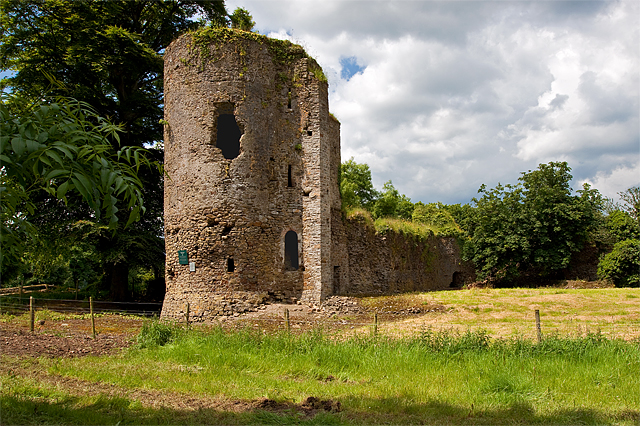
Springfield Castle
Springfield Castle, located near Newcastlewest in Northern Ireland, is a historic complex that embodies centuries of architectural evolution and noble heritage. The castle stands as a testament to the region's turbulent history and the enduring legacy of the families who shaped its development. Originally established in the late 13th century, Springfield Castle has witnessed significant transformations, from medieval fortifications to Georgian elegance, reflecting broader socio-political changes in Ireland.
The origins of Springfield Castle trace back to around 1280, when the Norman Fitzgerald family settled on the site after forming an alliance through marriage with the local Gaelic Ó Colleáin clan. This union granted them the hereditary title of Lords of Claonghlais, symbolizing a fusion of Norman and Gaelic traditions. The Fitzgeralds' influence is evident in the castle's early fortifications, including the construction of a stone keep during the 15th century, which served as a stronghold and residence for the family.
Medieval origins and the fitzgerald legacy
The medieval keep at Springfield Castle is a prominent feature, representing the military and residential architecture of the period. This keep is distinguished by its mural staircase, an ingenious design element where the staircase is embedded within the thickness of the external wall, optimizing interior space and providing defensive advantages. Such staircases are characteristic of medieval fortifications and showcase the architectural ingenuity of the era.
Throughout the 15th and 16th centuries, the Fitzgerald family maintained their status and expanded the castle's facilities to accommodate the needs of a noble household. The castle's strategic location on a hill provided natural defenses and a commanding view of the surrounding landscape, which was essential during times of conflict and unrest in Ireland.
Georgian expansion and architectural evolution
In the 17th century, Springfield Castle became a cultural hub under the patronage of the Fitzgerald family, notably supporting the Irish poet Dáibhí Ó Bruadair (1625–1698), who composed an elegy honoring their lineage. However, the castle's fortunes changed dramatically after 1691 when the Fitzgerald lands were confiscated by English authorities following political upheavals. The family subsequently relocated to France, marking the end of their direct association with Springfield.
The estate was acquired by William Fitzmaurice, a younger son of the 20th Lord Kerry, whose family initiated a new chapter in the castle's history. His son, John Fitzmaurice, constructed a significant Early Georgian mansion adjacent to the medieval keep, blending the fortress's defensive legacy with the refined domestic architecture of the Georgian period. This three-storey mansion introduced classical proportions and symmetry, characteristic of Georgian style, contrasting with the rugged medieval stonework.
In 1780, the estate passed into the hands of the Deane family through the marriage of Ann Fitzmaurice to Sir Robert Deane, 1st Baron Muskerry. This alliance further cemented the castle's status as a noble residence and expanded its social and political connections.
20th-century challenges and restoration efforts
The Irish War of Independence brought significant turmoil to Springfield Castle. In 1921, the Georgian mansion was devastated by fire, a casualty of the conflict that swept through Ireland. Despite this destruction, parts of the estate, including the servants' wing dating from the 18th century, survived and were later modernized.
Restoration efforts were spearheaded by Sir Robert Deane, 5th Baron Muskerry, who undertook rebuilding and renovation work to preserve the castle's historical fabric. These efforts included the restoration of the medieval keep and the maintenance of ancillary buildings such as workshops and stables, which had supported the castle's operational needs for centuries.
Architectural features and estate layout
The castle complex is arranged around a central courtyard, a common feature in medieval and later castle designs that facilitated both defense and daily activities. The ensemble includes two principal stone towers from distinct periods: the original 15th-century keep and an 18th-century tower that complements the Georgian mansion's style.
The mural staircase within the keep is a notable architectural highlight, demonstrating medieval space-saving techniques and defensive considerations. The keep's robust stone walls and battlements reflect its original purpose as a fortress designed to withstand sieges and attacks.
Surrounding the main structures are various ancillary buildings, including workshops, stables, and other service facilities that supported the estate's functioning. These buildings illustrate the self-sufficiency typical of large noble estates, providing spaces for craft, storage, and animal husbandry.
Current status and heritage significance
Today, Springfield Castle remains a family residence on an estate spanning approximately 200 acres (81 hectares). The property includes several lodges occupied by family members, reflecting its continued use as a private home rather than a public museum or heritage site.
The ongoing maintenance and adaptation of the castle complex highlight the layered history embedded within its walls, showcasing a blend of medieval fortification and Georgian domestic architecture. Springfield Castle stands as a valuable cultural landmark in Northern Ireland, representing centuries of architectural evolution, noble lineage, and historical resilience.
Frequently asked questions (FAQ)
- How do I visit Springfield Castle?
- Springfield Castle is a private residence and is not generally open to the public. Visitors should check for any special open days or events before planning a visit.
- What architectural styles are present at Springfield Castle?
- Springfield Castle features a mix of medieval and Georgian architectural styles, including a 15th-century stone keep and an 18th-century Georgian mansion.
- When was Springfield Castle originally built?
- The original settlement at Springfield Castle dates back to around 1280, with significant construction phases in the 15th and 18th centuries.
- Why was Springfield Castle partially destroyed in 1921?
- The Georgian mansion at Springfield Castle was devastated by fire during the Irish War of Independence in 1921, reflecting the conflict's impact on the estate.
- Is Springfield Castle still inhabited?
- Yes, Springfield Castle remains a family residence owned and occupied by descendants of the Deane family, currently under Robert Deane, 9th Baron Muskerry.
Information
Sources & official resources
Verify the information above using these authoritative references.
Loading map...
Visitor reviews
No reviews yet. Been here? Write the first review and help other travelers!
Write the first reviewVisited this castle? Share your experience
Your review helps other travelers and adds first-hand knowledge to our encyclopedia.