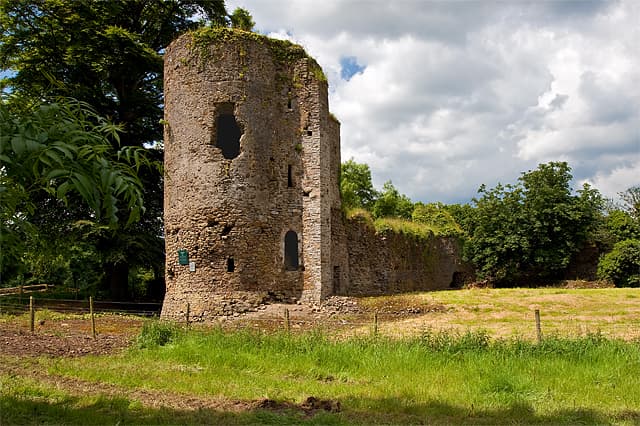
Kilbolane Castle
Kilbolane Castle stands prominently atop Kilbolane Hill, just half a kilometre from the village of Milford in County Cork, Ireland. This historic fortification was constructed in the 15th or 16th century, embodying the architectural characteristics of a Norman-style hill castle despite its later Renaissance-period origins. Its design features high curtain walls connected by circular guard towers and was originally surrounded by a moat, a defensive feature common to castles such as Liscarroll and Ballincollig.
Architectural features and defensive design
The castle's layout reflects typical Norman military architecture with an emphasis on strong vertical defenses. The circular towers provided vantage points for surveillance and defense, allowing defenders to cover the curtain walls effectively. The moat added a further layer of protection, deterring direct assaults on the walls. Although much of the castle now lies in ruins, the south tower and west wall remain intact, offering valuable insight into the castle's original form and scale.
Historical context and ownership
The land on which Kilbolane Castle stands was historically church property belonging to the Bishop of Cloyne, as recorded in the Pipe Roll of Cloyne in 1291. Early historical accounts, including those by Father Vaughan, suggest that the Synan family had an interest in the area before relocating to Doneraile. The castle itself was likely built shortly after the arrival of Strongbow and the Anglo-Normans, serving as a stronghold for the De Cogan family.
Subsequently, Kilbolane Castle came under the control of the Earls of Desmond and the Fitzgibbon branch of the Fitzgeralds. In 1587, it was granted to Hugo Cuffe, though he struggled to maintain authority in the region. By 1590, the castle reverted indirectly to the Fitzgibbons when it was granted to Sir William Power, husband of Helena Fitzgibbon.
Destruction and later developments
The castle suffered significant damage during the 1642 Cromwellian conquest of Ireland, when Cromwell's forces destroyed much of the structure, leaving only two towers standing. During this period, the remains of an ancient church on the site were removed, and the Synan family tomb, dated 1446, was relocated to a new church building.
Following the destruction, the east tower was acquired by Captain John Nicholls, who constructed a modest single-storey house adjoining the bawn wall. The property was later inherited by his grandson, John Bowen, who around 1695 began building Kilbolane House near the castle grounds.
A new church was erected in 1832, largely funded by the Rev. J. Bruce with assistance from the Ecclesiastical Commissioners, marking continued ecclesiastical presence in the area.
Modern ownership and preservation
By the late 19th century, Kilbolane Castle had fallen into disuse and was vacant for some time. In 1897, the ruins were purchased by David O'Leary Hannigan JP, who also acquired Mountshannon House in 1915. Presently, the castle ruins are maintained by the Office of Public Works, which ensures the preservation of the surviving structures.
The castle's south tower and west wall remain the most prominent features visible today. The vantage point from the southwest offers a clear view of the castle's original defensive layout, highlighting its high walls and tower placements.
Cultural and architectural significance
Kilbolane Castle is a notable example of a hill castle that blends Norman military architectural elements with the historical context of the Renaissance period in Ireland. Its association with prominent families such as the De Cogans, Earls of Desmond, and Fitzgibbons reflects the complex socio-political dynamics of medieval and early modern Ireland.
The castle's ruins provide valuable evidence of defensive construction techniques from the late medieval period, including the use of circular towers for flanking fire and the strategic placement of walls and moats. Its history of destruction and partial survival illustrates the impact of the Cromwellian wars on Irish fortifications.
Today, Kilbolane Castle remains a site of historical interest, attracting visitors keen to explore its architectural remnants and understand its place within Ireland's medieval heritage.
Frequently asked questions (FAQ)
- What is the historical significance of Kilbolane Castle?
- Kilbolane Castle dates back to the 15th century and is a fine example of medieval architecture in Ireland. It has played an important role in the region's history, serving as a stronghold for various noble families and witnessing many historical events over the centuries.
- When was Kilbolane Castle built?
- Kilbolane Castle was constructed in the early 1400s and has undergone several renovations since then. Its original design reflects the defensive needs of the time, with thick stone walls and a commanding position overlooking the surrounding landscape.
- Is it possible to visit Kilbolane Castle?
- Yes, Kilbolane Castle is open to visitors, allowing you to explore its rich history and beautiful architecture. However, it is recommended to check the castle's official website for any specific visiting guidelines or restrictions before planning your trip.
- What are the opening hours for Kilbolane Castle?
- Kilbolane Castle typically opens its doors to visitors from 10 AM to 5 PM, with extended hours during the summer months. It is advisable to verify the current hours on the website or contact the castle directly, especially during holidays.
- Can I access Kilbolane Castle with public transport?
- While public transport options may be limited, visitors can reach Kilbolane Castle via local bus services that connect to nearby towns. For those traveling from major cities, renting a car or arranging a taxi may provide a more convenient option for reaching the castle.
- What is the best time to visit Kilbolane Castle?
- The best time to visit Kilbolane Castle is during the late spring and early autumn months when the weather is generally mild and pleasant. Additionally, visiting during these seasons allows you to enjoy the surrounding gardens and landscape in full bloom.
- Are there any nearby attractions to Kilbolane Castle?
- Yes, several attractions are located near Kilbolane Castle, including beautiful walking trails and historical sites. Visitors can also explore the charming local villages and enjoy the scenic beauty of the Irish countryside.
- What are the ticket prices for Kilbolane Castle?
- Ticket prices for Kilbolane Castle vary depending on the age of the visitor, with discounts available for children and seniors. It is always a good idea to check the official website for the most current pricing and any special offers available during your visit.
Photo gallery

Information
Loading map...
Visitor reviews
No reviews yet. Been here? Write the first review and help other travelers!
Write the first reviewVisited this castle? Share your experience
Your review helps other travelers and adds first-hand knowledge to our encyclopedia.



