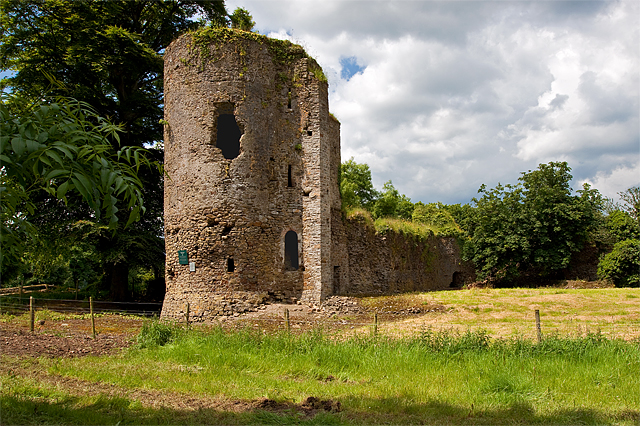
Kilbolane Castle
Kilbolane Castle is a medieval moated fortress located east of the village of Milford in County Cork, Ireland. Constructed in the late 13th century, it represents an important example of Anglo-Norman military architecture in the region. The castle's original design was a keep-less rectangular layout surrounded by a moat, featuring round corner towers at each angle, similar to the nearby Liscarroll Castle.
Architectural design and features
The castle's plan was distinctive for its omission of a central keep, which was unusual for the period. Instead, the fortification relied on its strong curtain walls and corner towers for defense. Of the original four towers, only the south and west corner towers remain today, along with two stretches of the curtain walls. These surviving structures give insight into the castle's defensive capabilities, with thick stone walls and narrow windows designed for archers.
The moat surrounding Kilbolane Castle would have added a significant obstacle to attackers, enhancing the castle's defensive position. The castle's rectangular shape and corner towers allowed for overlapping fields of fire, a common feature in 13th-century military architecture.
Historical context and ownership
Kilbolane Castle was likely built by Maurice de Rocheford, an Anglo-Norman knight, during the late 13th century. The castle was part of the wave of Anglo-Norman fortifications established in Ireland following the Norman invasion, serving both as a military stronghold and a symbol of Norman authority in the region.
In the late 14th century, ownership passed to Thomas MacShane FitzGibbon, whose family undertook extensive rebuilding in the 15th century. This period saw enhancements to the castle's defenses and residential accommodations, reflecting the evolving needs of its occupants.
The FitzGibbon family retained Kilbolane until 1587, when their lands were forfeited. The castle was granted to Hugh Cuffe, but just three years later, it was reclaimed by Helena Gibbon, an heiress of the family, and her husband William Power of County Waterford.
Decline and partial destruction
In 1642, during the turbulent period of the Irish Confederate Wars, Kilbolane Castle was attacked and largely destroyed by Cromwellian troops. This marked the beginning of its decline as a military stronghold.
Shortly after, the ruined castle was granted to Captain John Nicholls, who constructed a modest residence abutting the now-lost east corner tower and adjoining curtain wall. This adaptation represents the castle's transition from a defensive fortress to a more domestic use.
By around 1695, John Bowen, Nicholls' grandson, demolished much of the remaining medieval structure to reuse the stone for building Kilbolane House, a nearby country residence. This practice of recycling castle stone was common in post-medieval Ireland, reflecting changing architectural tastes and the reduced military importance of castles.
Preservation and current status
The survival of the south and west corner towers is largely due to their ownership by the Weekes family, who purchased these sections separately. This led to legal disputes with the Bowens, who sought control over the entire site, but the towers remain distinct remnants of the original castle.
Kilbolane House itself was demolished in the 19th century, leaving the castle ruins as the primary historical feature on the estate.
Today, Kilbolane Castle stands on private grounds near a country house and is not open to the public due to safety concerns from unstable masonry. Despite its ruinous state, the castle's remaining structures provide valuable insight into medieval Irish fortifications and the architectural legacy of the Anglo-Norman period in County Cork.
Frequently asked questions (FAQ)
- What is the historical significance of Kilbolane Castle?
- Kilbolane Castle is a remarkable example of medieval architecture in the United Kingdom, with roots tracing back to the 12th century. It has played a crucial role in the region's history, witnessing numerous battles and changes in ownership, which reflect the turbulent past of the area.
- When was Kilbolane Castle built?
- Kilbolane Castle was constructed in the late 12th century, making it one of the oldest surviving structures in the region. Its construction is attributed to the local lords, who sought to establish their dominance and protect their lands from invaders.
- How do I get to Kilbolane Castle?
- Kilbolane Castle is conveniently located next to the R-515 road, making it easily accessible by car. Public transportation options are also available, with nearby bus stops that connect to larger towns in the area.
- What are the opening hours for Kilbolane Castle?
- Kilbolane Castle is open to visitors from 10 AM to 5 PM, Tuesday through Sunday. It is advisable to check for seasonal variations in hours or special closures before planning your visit.
- Are there any ticket prices for visiting Kilbolane Castle?
- Admission to Kilbolane Castle is generally free, allowing visitors to explore its grounds and appreciate its historical architecture. However, guided tours or special events may have associated fees, so it's best to check in advance.
- Is it possible to take guided tours of Kilbolane Castle?
- Yes, guided tours are available at Kilbolane Castle, providing visitors with in-depth knowledge about its history and architecture. These tours are typically led by knowledgeable guides who can answer questions and share fascinating stories about the castle.
- What is the best time to visit Kilbolane Castle?
- The best time to visit Kilbolane Castle is during the spring and summer months, when the weather is mild and the gardens are in full bloom. Additionally, these seasons often feature various events and activities that enhance the visitor experience.
- Are there any nearby attractions to visit?
- Yes, there are several attractions near Kilbolane Castle, including picturesque walking trails and other historical sites. Visitors can also explore local villages and enjoy traditional cuisine at nearby restaurants, making it a great day trip.
- Is Kilbolane Castle accessible for visitors with disabilities?
- Kilbolane Castle strives to be accessible for all visitors, with paths and facilities designed to accommodate those with mobility challenges. It is recommended to contact the site in advance to inquire about specific accessibility features and any assistance that may be available.
Loading map...
Visitor reviews
No reviews yet. Been here? Write the first review and help other travelers!
Write the first reviewVisited this castle? Share your experience
Your review helps other travelers and adds first-hand knowledge to our encyclopedia.