Sporkenburg Castle
Sporkenburg Castle stands as a remarkable example of a late medieval spur castle nestled on a wooded hill south of the village of Eitelborn in the Rhineland-Palatinate region of Germany. This castle, built in 1310 by Heinrich II von Helfenstein, occupies a strategic location on a roughly rectangular hill spur overlooking the Emsbach stream, with steep drops to the west, south, and east, offering natural defense advantages. The castle's historical and architectural legacy reflects the turbulent medieval period in this part of Germany, marked by feudal allegiances, warfare, and shifting ownership.
Architectural features and layout
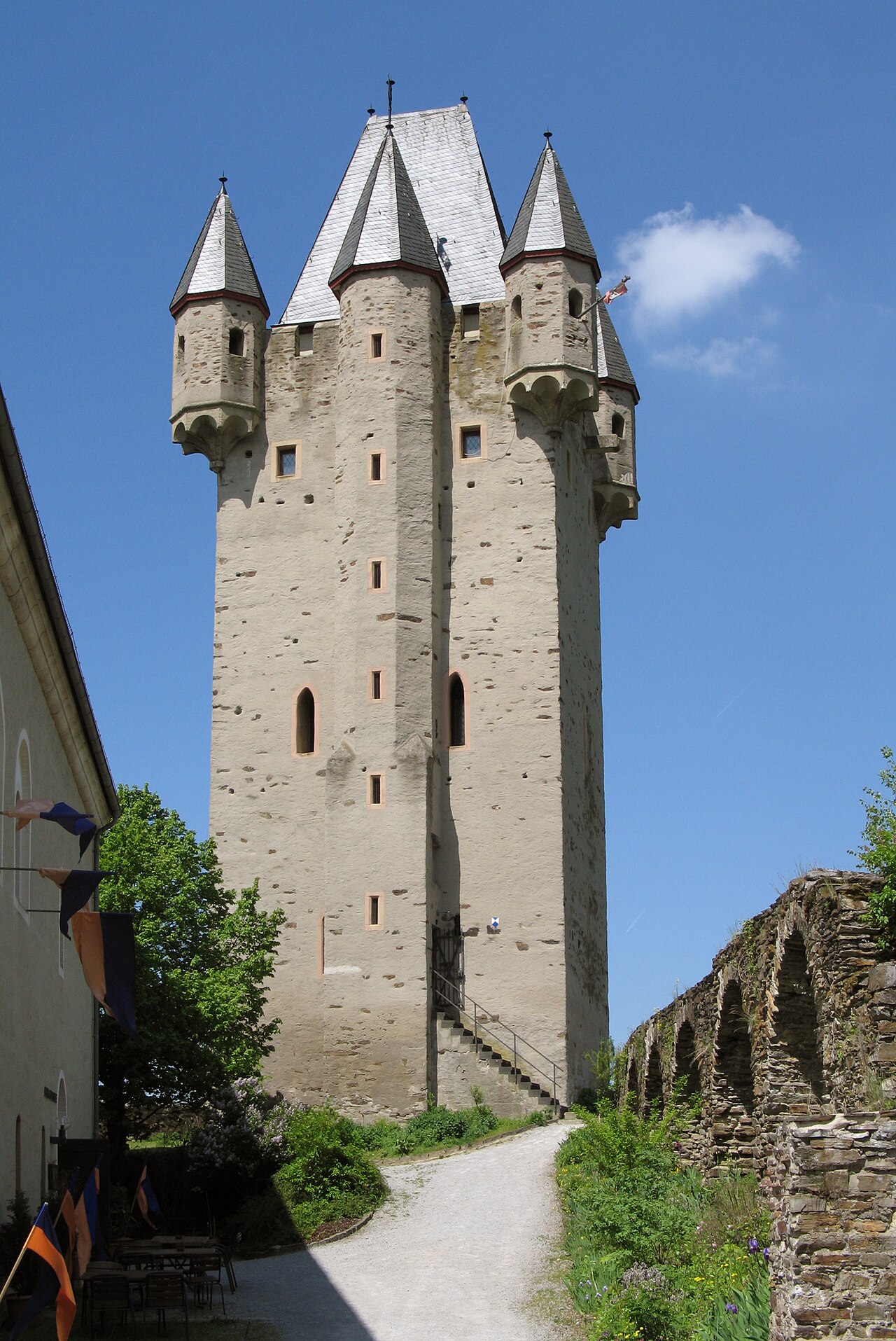
Sporkenburg Castle is classified as a spur castle, a type of fortification built on a projecting ridge or spur of a hill, which provides natural protection on several sides. The castle's layout is roughly rectangular, with the inner ward (Kernburg) measuring approximately 35 meters in length and 18 meters in width. Unlike many medieval castles, Sporkenburg notably lacks a traditional keep (bergfried), instead relying on a massive shield wall on its northern side for defense.
This shield wall is a dominant feature of the castle, rising to nearly 20 meters in height and reinforced with bartizans—small overhanging turrets that provided vantage points for defenders. The wall is slightly angled, enhancing its defensive capabilities. The main entrance to the inner ward is located in the western section of this shield wall, which would have been a critical choke point for any attackers.
The Palas, or great hall, is situated on the southern side of the inner ward. Its exterior walls have survived, offering insight into the castle's residential and administrative functions during its peak. The eastern part of the inner ward has been completely removed, likely due to destruction and later quarrying activities.
Originally, the castle would have been protected by an outer ward and a Zwinger—a narrow enclosed area between two curtain walls designed to trap and expose attackers. However, these outer defenses have almost entirely disappeared over time. To the north, the castle was defended by a length of ditch known as a Halsgraben, which further enhanced its defensive posture by isolating the spur from the surrounding terrain.
Historical context and ownership
The region around Sporkenburg Castle, known as the Lower Engersgau, was historically under the influence of the Electorate of Trier. The earliest records indicate that the land was enfeoffed to local lords by the Archbishop of Trier, with Archbishop Poppo (1016–1047) playing a key role in the early medieval governance of the area. The village of Dezerhaid, near the castle, was gifted to the Benedictine Abbey of St. Matthew by Archbishop Engelbert (1079–1101), highlighting the intertwining of ecclesiastical and feudal authorities.
In the late 13th century, the site was associated with Emmerich of Andernach and Henry of Lahnstein, who began constructing a castle that was later destroyed by Count Otto of Nassau, the advocate (Vogt) of Kurtrier. Following this destruction, Henry of Lahnstein transferred his rights to Henry II of Helfenstein, who rebuilt the castle in 1310, probably not on the exact site of the earlier fortress. Heinrich II von Helfenstein then assigned the castle as a fief to Archbishop Baldwin of Luxembourg (1307–1354), strengthening its ties to the Electorate of Trier.
Sporkenburg became the center of the lordship of Helfenstein-Sporkenburg. By 1515, the castle was described as "almost ruined" when Johann von Helfenstein sold it to the brothers Johann and Quyrin von Nassau, a different branch from the well-known counts of Nassau. Ownership passed to the Von Metternich family around 1603 through inheritance.
The castle's final destruction came during the Thirty Years' War in 1635, when French troops razed it. After its destruction, the ruins served as a convenient stone quarry for local inhabitants, accelerating its decline. In 1811, the ruins were sold by the State Chancellor, Prince of Metternich. Later, ownership transferred to Prussia in 1900 and then to the state of Rhineland-Palatinate in 1948.
Restoration and current status
Despite its ruinous state, Sporkenburg Castle remains an important cultural and historical landmark. Starting in 1967, the State Office for Cultural Heritage initiated gradual restoration efforts to stabilize and preserve the remaining walls and architectural features. These efforts have helped maintain the castle as a significant example of medieval fortification architecture in the region.
Today, the castle is freely accessible to visitors and is set in a beautiful wooded area, making it a popular destination for hikers and history enthusiasts. The ruins, while not extensively managed, offer a tangible connection to the medieval past and the complex feudal history of the Rhineland.
Access and visitor information
Sporkenburg Castle is located approximately one kilometer south of Eitelborn and is somewhat hidden within the forest, making it a serene and less crowded site. The easiest access is via the marked castle path (Burgweg) starting from the eastern exit of Eitelborn near the cemetery on Erlenweg. Visitors pass through a barrier and follow the right-hand path downhill to reach the ruins.
Alternatively, visitors can approach from the L 329 road, from where the castle is visible above the valley. The site is open at all times, as it is not actively managed, allowing for flexible visiting hours. However, visitors should be prepared for a natural terrain hike and take care when exploring the ruins.
Historical significance in regional context
Sporkenburg Castle played a strategic role in the feudal power struggles of the Rhineland during the late medieval period. Its connection to the Archbishopric of Trier and various noble families illustrates the complex web of allegiances and conflicts that shaped the region's history. The castle's destruction during the Thirty Years' War is emblematic of the widespread devastation that many such fortifications suffered during this prolonged conflict.
Architectural uniqueness
One of the castle's distinctive features is its lack of a traditional bergfried, which was common in many contemporary castles. Instead, the massive shield wall served as the primary defensive structure, an architectural choice that reflects both the natural topography and evolving military needs of the time. The surviving Palas walls provide valuable insight into the residential aspects of the castle, contrasting with the more austere defensive elements.
Natural setting and preservation challenges
Situated in a densely wooded area, the castle's natural surroundings contribute to its atmospheric ruins but also pose challenges for preservation. The forest environment accelerates weathering and vegetation growth, which can threaten the structural integrity of the remaining walls. Ongoing conservation efforts aim to balance maintaining the site's historical authenticity with protecting it from natural decay.
Frequently asked questions (FAQ)
- How do I get to Sporkenburg Castle?
- Sporkenburg Castle is located in Eitelborn, Germany, and can be easily reached by car or public transportation. If you are traveling by train, the nearest station is in Koblenz, from where you can take a local bus or taxi to the castle.
- What is the historical significance of Sporkenburg Castle?
- Sporkenburg Castle dates back to the 12th century and has played a crucial role in the region's history as a fortification and noble residence. It has witnessed many historical events, including battles and changes in ownership, making it a significant landmark in the area.
- When was Sporkenburg Castle built?
- The construction of Sporkenburg Castle began in the early 12th century, with various additions and renovations made over the centuries. Its architecture reflects the transition from Romanesque to Gothic styles, showcasing the evolution of castle design during that time.
- Can I visit Sporkenburg Castle year-round?
- Yes, Sporkenburg Castle is open to visitors throughout the year, but it's advisable to check specific opening hours before planning your visit. Guided tours are available, providing insights into the castle's history and architecture.
- Why is Sporkenburg Castle known for its architecture?
- Sporkenburg Castle is renowned for its impressive blend of Romanesque and Gothic architectural elements, which are evident in its towers, walls, and interior design. The castle's unique structure and historical features make it a popular subject for both architectural enthusiasts and history buffs.
- Is it possible to host events at Sporkenburg Castle?
- Yes, Sporkenburg Castle offers facilities for hosting various events, including weddings, conferences, and private gatherings. The scenic surroundings and historical ambiance make it a picturesque location for special occasions.
- What are the ticket prices for visiting Sporkenburg Castle?
- Ticket prices for Sporkenburg Castle vary depending on age and group size, with discounts often available for students and seniors. It's recommended to check the official website for the most current pricing and any special offers.
- What are the opening hours of Sporkenburg Castle?
- The opening hours of Sporkenburg Castle may vary by season, typically opening daily from 10 AM to 6 PM. During holidays or special events, hours may be extended, so it's best to verify on the castle's official website before your visit.
- What nearby attractions should I visit while at Sporkenburg Castle?
- While visiting Sporkenburg Castle, consider exploring nearby attractions such as the historic town of Koblenz, the beautiful Rhine Valley, and other castles in the region. These sites offer additional insights into the rich history and stunning landscapes of the area.
Information
Loading map...
Visitor reviews
No reviews yet. Been here? Write the first review and help other travelers!
Write the first reviewVisited this castle? Share your experience
Your review helps other travelers and adds first-hand knowledge to our encyclopedia.