Ehrenbreitstein Fortress
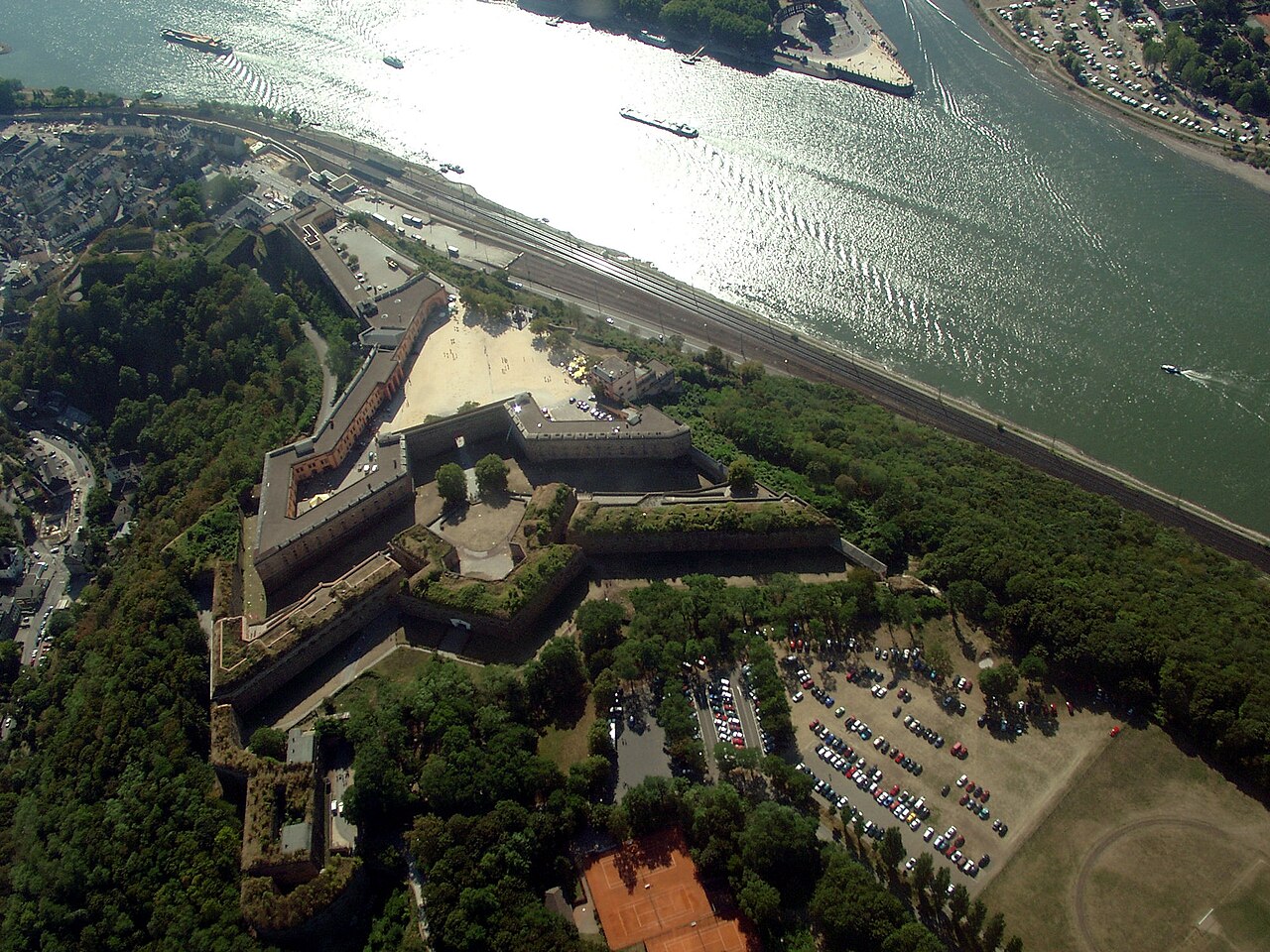
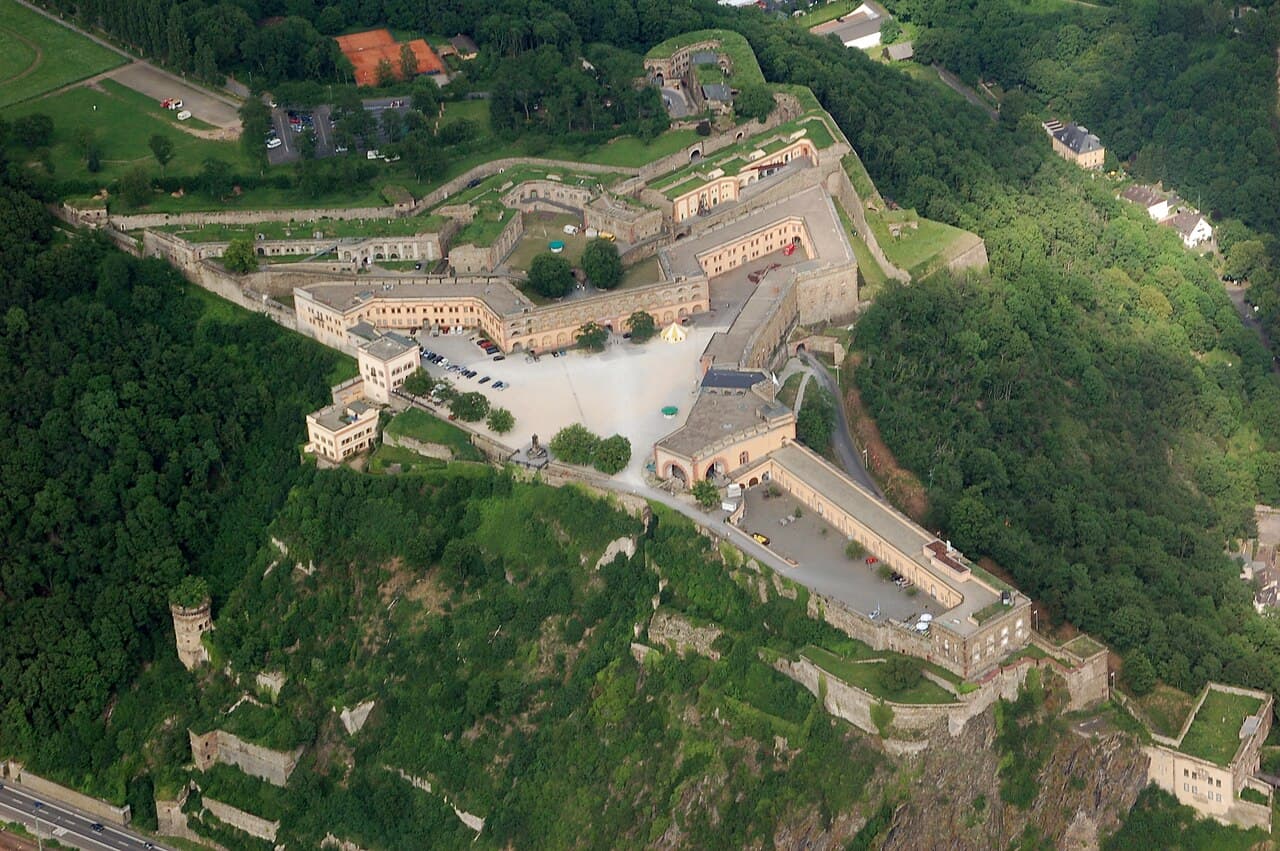
Ehrenbreitstein Fortress is a prominent bastioned fortress located on the east bank of the Rhine River in Koblenz, Germany. This imposing fortress was constructed by Prussia between 1817 and 1832 as the key stronghold in the regional fortification system known as Festung Koblenz. Strategically positioned to oversee the confluence of the Rhine and Moselle rivers, it guarded the middle Rhine region, an area that had experienced repeated invasions by French troops in earlier centuries. Remarkably, Ehrenbreitstein Fortress was never directly attacked during its active military use, underscoring its formidable defensive design and strategic importance.
Early history and origins
The site of Ehrenbreitstein Fortress has a long history of fortification dating back to approximately 1000 BC. Around AD 1000, a castle was established by a figure named Ehrenbert, from whom the fortress derives its name. In the medieval period, the fortress was expanded and fortified by the Archbishops of Trier, who constructed a supporting castle called Burg Helferstein. This ecclesiastical stronghold held significant religious importance as it safeguarded the Holy Tunic from 1657 to 1794, a revered relic attracting pilgrims and enhancing the fortress's status.
Medieval strategic significance
Throughout the 17th century, the fortress played a pivotal role in regional power dynamics. The Archbishops leveraged its strategic position to negotiate and maintain influence between competing European powers. For example, in 1672, at the outbreak of hostilities between France and Germany, the Archbishop refused to grant passage across the Rhine to troops from both Louis XIV of France and Brandenburg's ambassador, Christoph Caspar von Blumenthal. This demonstrated the fortress's role not only as a military asset but also as a political bargaining chip.
Sieges and French occupation
During the turbulent period of the French Revolutionary Wars, the fortress came under siege multiple times. French revolutionary forces conquered Koblenz in 1794 and attempted to seize Ehrenbreitstein on three occasions without success. However, a prolonged siege lasting about a year starting in 1798 eventually forced the fortress's defenders to surrender in 1799 due to starvation. Following the Treaty of Lunéville, the French were compelled to withdraw from the right bank of the Rhine. To prevent its use by enemy forces, the French dismantled the fortress in 1801, rendering it unusable.
Prussian reconstruction and military role
After the Congress of Vienna in 1815, the Rhineland became part of Prussia, which prioritized the fortification of Koblenz due to its strategic location near France and its role as a transportation hub. From 1817 to 1832, the Prussians constructed the new Ehrenbreitstein Fortress as the centerpiece of the Festung Koblenz defensive ring. This system was one of the largest military fortifications in Europe at the time, second only to Gibraltar. Ehrenbreitstein itself could accommodate up to 1200 soldiers and remained a key military installation until 1890.
Architectural features and design
The fortress exemplifies 19th-century bastioned fortress architecture, characterized by thick stone walls, angled bastions designed to deflect artillery fire, and extensive defensive works including moats and underground casemates. Its elevated position atop a rocky plateau provided commanding views over the Rhine valley, enabling defenders to monitor and control river traffic and approaches by land. The design incorporated modern military engineering principles of the era, emphasizing layered defenses and strongholds capable of withstanding prolonged sieges.
Cultural significance and later uses
In 1822, the English translation of Ehrenbreitstein's name, "The Broad-Stone of Honour," was used as the title of Kenelm Henry Digby's influential work on chivalry, highlighting the fortress's symbolic resonance beyond its military function. In 1897, the nearby Deutsches Eck (German Corner) monument to Emperor Wilhelm I was erected, reinforcing the fortress's image as a symbol of German strength and vigilance along the Rhine, famously referenced in the patriotic song "Die Wacht am Rhein."
20th-century military and civilian roles
During World War I, Ehrenbreitstein served as a military headquarters. After the war, American General Henry Tureman Allen intervened to prevent the fortress's destruction, recognizing its historical value. The fortress was subsequently occupied by American and then French troops during the Rhineland occupation. In World War II, it was used for safekeeping archives and cultural artifacts and housed anti-aircraft flak guns.
Post-war transformation and preservation
Following World War II, the fortress was initially used by the French Army before being transferred to the State of Rhineland-Palatinate. Today, Ehrenbreitstein Fortress serves multiple civilian purposes including a museum, youth hostel, restaurant, and archive. It is a major cultural and tourist attraction, offering visitors insight into military architecture and regional history.
World Heritage status and recent developments
Since 2002, Ehrenbreitstein Fortress has been part of the UNESCO World Heritage Site Upper Middle Rhine Valley, recognizing its outstanding cultural and historical significance. In 2011, the fortress was a key venue for the National Garden Show in Koblenz, which prompted extensive renovations to restore and adapt its facilities for public use while preserving its historic character.
Visitor experience and accessibility
Today, visitors to Ehrenbreitstein can explore its extensive fortifications, museums, and cultural exhibitions. The fortress's elevated location offers panoramic views of the Rhine and Moselle rivers and the city of Koblenz. Its well-preserved bastions, gates, and underground passages provide a tangible connection to the military engineering of the 19th century. The site is accessible by cable car from Koblenz, enhancing visitor convenience and making it a popular destination for tourists interested in history and architecture.
Frequently asked questions (FAQ)
- How do I get to Ehrenbreitstein Fortress?
- Ehrenbreitstein Fortress is easily accessible via the Koblenz cable car, which offers stunning views of the Rhine and Moselle rivers. Alternatively, you can reach the fortress by car or public transport, with nearby parking options available.
- What is the historical significance of Ehrenbreitstein Fortress?
- Ehrenbreitstein Fortress, built in the 19th century, played a crucial role in the defense of the city of Koblenz and the confluence of the Rhine and Moselle rivers. It has served various military purposes throughout its history and is now a symbol of regional heritage.
- When was Ehrenbreitstein Fortress constructed?
- The current structure of Ehrenbreitstein Fortress was built between 1817 and 1828, although the site has been fortified since the Roman era. Its strategic location has made it a vital military stronghold for centuries.
- Can I visit Ehrenbreitstein Fortress with children?
- Yes, Ehrenbreitstein Fortress is family-friendly and offers various activities suitable for children, including guided tours and interactive exhibits. The fortress grounds are spacious, allowing for exploration and play.
- Why is Ehrenbreitstein Fortress a popular tourist attraction?
- Ehrenbreitstein Fortress is popular for its rich history, stunning architecture, and breathtaking panoramic views of Koblenz and the surrounding landscapes. Additionally, it hosts cultural events and exhibitions throughout the year, enriching the visitor experience.
- Is it possible to access Ehrenbreitstein Fortress year-round?
- Yes, Ehrenbreitstein Fortress is open year-round, although specific attractions and exhibitions may have limited hours during the winter months. It’s best to check the official website for the latest information on opening hours and seasonal events.
- What are the ticket prices for Ehrenbreitstein Fortress?
- Ticket prices for Ehrenbreitstein Fortress vary, with discounts available for children, students, and seniors. Family tickets and group rates are also offered, making it accessible for various visitors.
- What are the opening hours of Ehrenbreitstein Fortress?
- Ehrenbreitstein Fortress typically opens at 10 AM and closes at 6 PM, but hours can vary seasonally. It’s advisable to check their official site before planning your visit to ensure you have the most current information.
- What nearby attractions can I visit while at Ehrenbreitstein Fortress?
- While visiting Ehrenbreitstein Fortress, you can also explore the charming old town of Koblenz, the Deutsches Eck, where the Moselle meets the Rhine, and several museums in the area. The picturesque landscapes along the rivers offer various recreational activities such as hiking and cycling.
Photo gallery

Information
Website
Visit websiteSources & official resources
Verify the information above using these authoritative references.
Loading map...
Visitor reviews
No reviews yet. Been here? Write the first review and help other travelers!
Write the first reviewVisited this castle? Share your experience
Your review helps other travelers and adds first-hand knowledge to our encyclopedia.