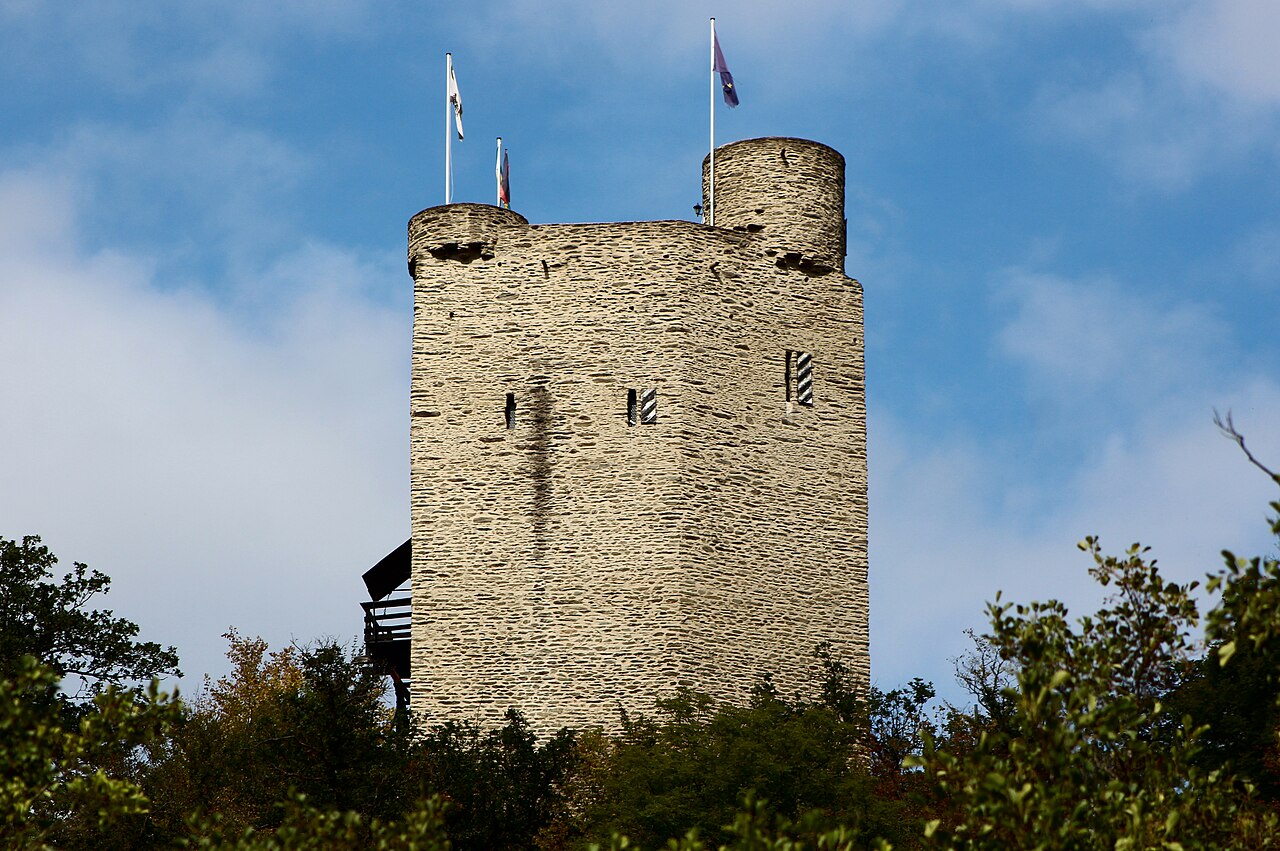
Nassau Castle stands as a significant medieval fortress perched on a rocky hill in Nassau, Germany, overlooking the Lahn River valley approximately 120 meters below. Founded in the early 12th century, this hill castle served as the original seat of the influential House of Nassau, an aristocratic dynasty whose descendants include the present-day monarchies of the Netherlands and Luxembourg. The castle's strategic location atop a rock outcrop provided commanding views and defensive advantage, characteristic of high medieval fortifications.
Early history and foundation
The castle's origins trace back to around 1100, attributed to Dudo of Laurenburg, the progenitor of the House of Nassau. Although a 1093 document mentioning the castle is considered a later forgery, reliable historical evidence confirms its establishment in the early 12th century. By 1120, Dudo's sons, Counts Rupert I and Arnold I, had taken residence at Nassau Castle, expanding the initial tower into a more extensive complex by 1124.
During this period, Nassau Castle was situated within the territory of the Bishopric of Worms, which led to a protracted and bitter dispute over ownership and authority. Rupert I's inheritance of the vogtship of Weilburg, including the former Königshof Nassau, did not resolve tensions. When Rupert I adopted the title "Count of Nassau," the bishopric contested this claim vigorously.
The conflict culminated in 1159, after Rupert's death, when his son Walram I secured a formal resolution through the mediation of Archbishop Hillin of Falmagne of Trier. The Laurenburg family relinquished their allodial claims and accepted Nassau Castle and its town as a fief from the archbishop, thereby officially becoming the Counts of Nassau.
Medieval expansion and architecture
Between 1220 and 1230, Henry II the Rich, son of Walram I, commissioned the construction of the castle's late Romanesque palas (main residential building). This structure featured robust stonework with light tuff blocks and coarse dark slate foundations, showcasing the architectural style of the period.
In 1255, the County of Nassau was divided between Henry II's sons, Walram II and Otto I, in the so-called "Brothers' Division" (Bruderteilung). Despite this partition, Nassau Castle remained a shared possession (Ganerbschaft), a common arrangement in medieval Germanic inheritance law that allowed multiple family branches to co-own a castle.
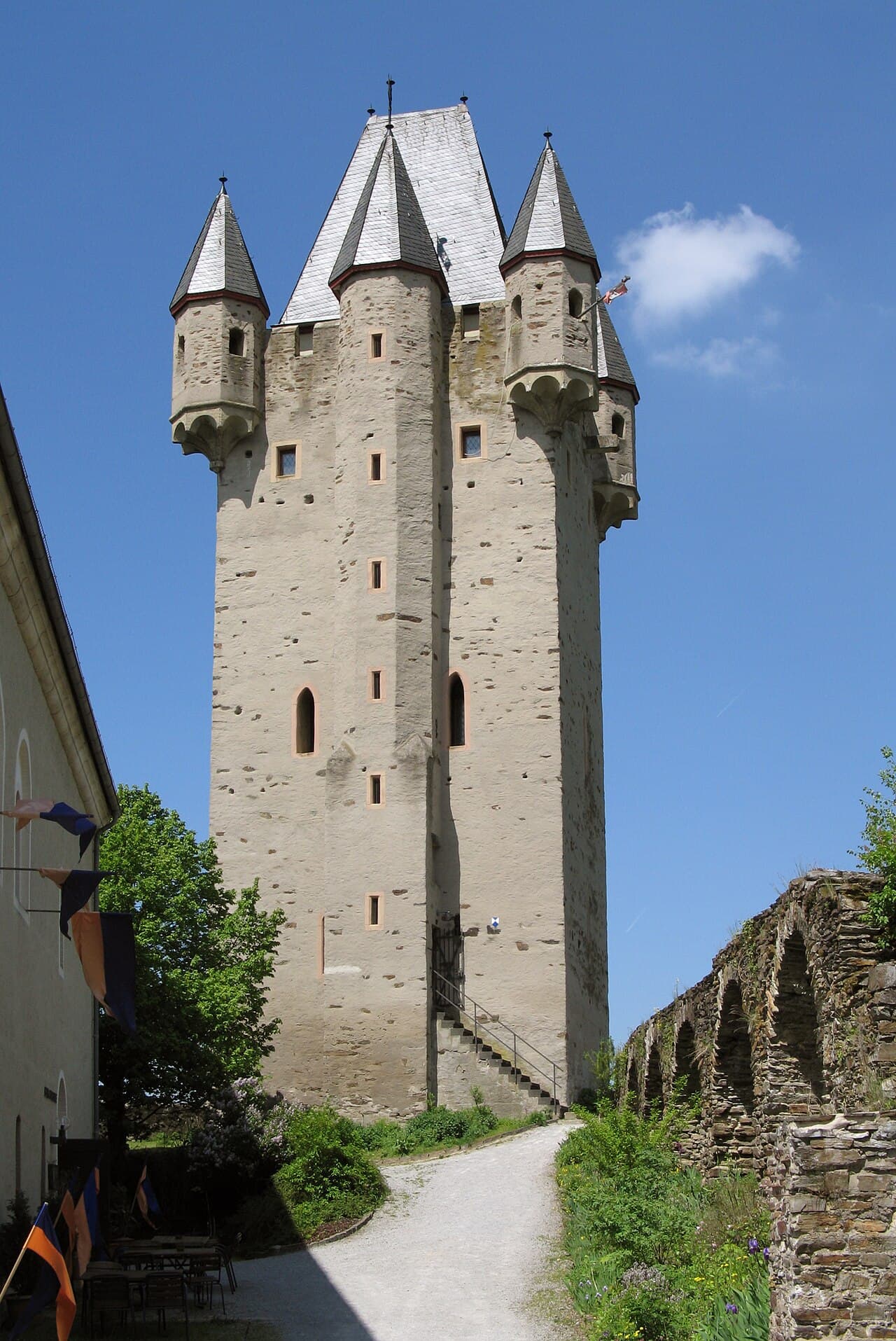
During the first half of the 14th century, the castle's most prominent feature, the 33-meter-high pentagonal bergfried (a type of keep), was constructed. This bergfried served as a fortified tower for defense and residence, notable for its unique five-sided shape. A second tower is recorded in 1346 but has since disappeared.
The castle suffered damage during a violent family feud in 1372, which destroyed the housing of the castle keepers. Despite these conflicts, the counts continued to reside at Nassau Castle until the late Middle Ages, after which it was gradually abandoned as a primary residence.
Later history and decline
A 17th-century etching by Matthäus Merian depicts Nassau Castle with an intact palas, bergfried, and gate building, indicating its well-preserved state at that time. However, the castle endured significant destruction during the final phase of World War II, leaving mostly ruins.
Archaeological investigations in 1970 revealed only remnants of the castle's rectangular walls, as much of the original structure had been lost over centuries of conflict and decay.
Restoration and current use
In 1965, Nassau Castle was transferred to the State Castle Administration of Rhineland-Palatinate (Staatliche Schlösserverwaltung Rheinland-Pfalz), which undertook extensive restoration efforts beginning in the 1970s. Restoration of the bergfried started in 1976, guided by Merian's engraving, reconstructing its hipped roof, battlements, and corner turrets. The interior vaulted halls, featuring arches between six and eight meters high, were also restored, along with the clearing of the dungeon access in the tower's basement.
The palas and knights' hall were reconstructed between 1979 and 1980. During this work, late-Gothic window arcades were rediscovered, adding to the architectural significance of the site. Although some parts of the palace were rebuilt with modern materials, the restoration aimed to reflect the castle's historical appearance.
Today, the bergfried houses a civil registry office wedding room on its third floor, while the palas serves as a restaurant, offering visitors a unique blend of history and hospitality. The castle grounds also feature a beer garden and kiosk within the courtyard, making Nassau Castle a vibrant cultural and tourist destination.
Architectural features and layout
Nassau Castle is classified as a hill castle due to its elevated position on a rocky summit approximately 215 meters above sea level. The castle complex includes the prominent pentagonal bergfried, the reconstructed late Romanesque palas, and remnants of a ring wall that once enclosed the site.
The bergfried, rebuilt in the 14th century, stands 33 meters tall and features a hipped roof with battlements and corner towers, all restored based on historical engravings. Inside, the vaulted rooms with high arches and a stair tower lead to a circular viewing gallery, offering panoramic views of the surrounding landscape.
The palas, originally constructed in the early 13th century, was built with a foundation of coarse dark slate and upper floors of finely cut light tuff blocks. Restoration revealed six blocked Romanesque triforium windows and a surviving original stone capital decorated with leaf motifs from the Staufer period.
The castle's courtyard has been adapted for modern use but retains its medieval character, with the knights' hall now functioning as a restaurant and event space.
Historical significance and legacy
Nassau Castle holds immense historical importance as the birthplace and ancestral seat of the House of Nassau, a dynasty that played a vital role in European history. The family's legacy extends to the royal houses of the Netherlands and Luxembourg, linking the castle to contemporary European monarchies.
The castle's history reflects the complex feudal relationships and territorial conflicts of the High Middle Ages in Germany, illustrating the dynamics between noble families and ecclesiastical authorities such as the Bishopric of Worms and the Archbishopric of Trier.
Today, Nassau Castle serves not only as a monument to medieval architecture and aristocratic heritage but also as a cultural venue that connects visitors with the rich history of the region.
Visitor information
The castle is accessible to the public, with the bergfried open for free visits and the palas hosting a restaurant. Visitors can explore the restored towers, vaulted halls, and enjoy panoramic views from the viewing gallery. The site also offers a beer garden and kiosk, enhancing the visitor experience.
Its location in the town of Nassau in the Rhineland-Palatinate region makes it a notable destination for those interested in medieval architecture, German history, and aristocratic lineages.
Frequently asked questions (FAQ)
- How do I visit Nassau Castle and what can I expect?
- Nassau Castle is open to the public with free access to the bergfried tower and a restaurant in the palas. Visitors can explore the restored medieval architecture, enjoy panoramic views from the bergfried's viewing gallery, and relax in the castle's beer garden.
- What is the historical significance of Nassau Castle?
- Nassau Castle is the ancestral seat of the House of Nassau, a noble family whose descendants include the monarchies of the Netherlands and Luxembourg. It played a key role in medieval territorial disputes and feudal politics in Germany.
- When was Nassau Castle built and by whom?
- The castle was founded around 1100 by Dudo of Laurenburg, the founder of the House of Nassau. His sons expanded the castle in the early 12th century, establishing it as a significant medieval fortress.
- What architectural styles are represented at Nassau Castle?
- Nassau Castle primarily features late Romanesque architecture, especially visible in the palas constructed between 1220 and 1230. The bergfried and other elements reflect medieval fortification styles typical of the High Middle Ages.
- Is Nassau Castle accessible for events or weddings?
- Yes, the bergfried's third floor houses a civil registry office wedding room, making it a unique historic venue for ceremonies. The castle also hosts a restaurant and event spaces within the palas.
Photo gallery

Information
Sources & official resources
Verify the information above using these authoritative references.
Loading map...
Visitor reviews
No reviews yet. Been here? Write the first review and help other travelers!
Write the first reviewVisited this castle? Share your experience
Your review helps other travelers and adds first-hand knowledge to our encyclopedia.