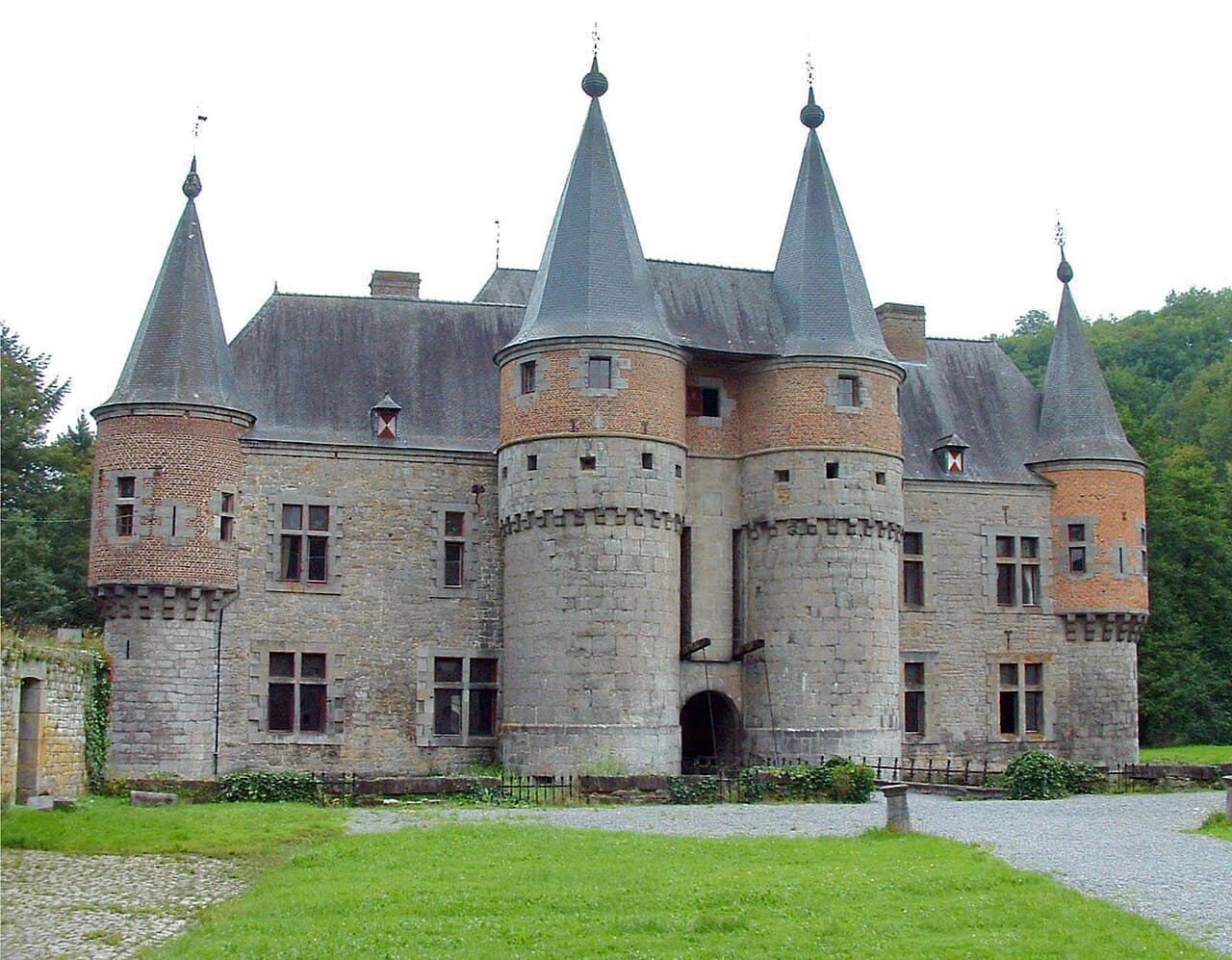
Spontin Castle
Spontin Castle, also known locally as Château de Spontin, is a remarkable example of a medieval fortress that evolved into a noble residence over several centuries. Located in the village of Spontin within the municipality of Yvoir in the province of Namur, Wallonia, Belgium, the castle occupies a strategic position in the Bocq valley, near an ancient Roman road connecting the towns of Dinant and Huy. This location was historically significant for controlling travel and trade routes in the region.
The origins of Spontin Castle date back to the 13th century, when the first fortification was constructed by the Lords of Beaufort, specifically Pierre de Beaufort between 1266 and 1284. The initial structure was a simple but formidable square tower, or keep, built on a small island formed by the bend of the Bocq river. This tower served both as a defensive lookout and a symbol of lordly authority, designed to protect the surrounding valley and the important Roman road.
Medieval origins and early expansions
Following Pierre de Beaufort's foundational work, his son Guillaume II de Beaufort expanded the castle significantly in the late 13th century. Rewarded with the fiefdom for his services to Henry VII, Count of Luxembourg, Guillaume II enhanced the castle by raising the original tower to three floors and thickening its walls, transforming it into a fortified residence. He added two round defensive turrets, curtain walls, and a gate building, giving the castle a roughly square ground plan and increasing its defensive capabilities.
Throughout the 14th century, the castle continued to develop as a typical medieval fortress. The addition of a drawbridge in the 15th century further strengthened its defenses by controlling access across the moat, which was fed by the Bocq river flowing around the castle. The natural water defenses included cascading waterfalls, enhancing the castle's security and aesthetic appeal.
Sieges and military history
Spontin Castle was located in a border region between the County of Namur and the Principality of Liège, making it strategically important and a frequent target during regional conflicts. In 1429, the castle was besieged by troops from the city of Liège but successfully resisted the attack. However, in 1465-66, forces from the city of Dinant managed to capture and partially destroy the castle. Despite this setback, the castle was rebuilt and continued to serve as a noble residence and stronghold.
In 1554, the castle was seized and dismantled by François I, Duke of Nevers, commanding troops of the French King Henry II. This event marked another phase of destruction and subsequent restoration, reflecting the turbulent military history of the region.
Transition from fortress to residence
Following the military conflicts of the 16th century, the castle's role as a fortress diminished. By 1622, restoration efforts had transformed the castle into a more comfortable manor house rather than a purely defensive structure. The castle's facades were accentuated with red brickwork, and large windows replaced the narrow defensive openings, allowing more light into the interiors. The roofs were redesigned with distinctive pepperpot-shaped towers, replacing earlier battlements.
A fortified farm was constructed beyond the castle's moat in 1622, reflecting the estate's shift toward agricultural production and rural management. This farm complex supported the castle's self-sufficiency and economic viability during peacetime.
Architectural features and interior details
Spontin Castle is built primarily of stone and brick, with massive walls characteristic of medieval fortifications. The oldest section remains the square donjon, or keep, which served as the last refuge during sieges. The castle's towers are topped with slate roofs, and the moat is crossed by a drawbridge, emphasizing its defensive origins.
The interior spaces feature thick walls, Gothic-style fireplaces, and wood paneling from the Louis XIII period, reflecting the castle's evolution through the Baroque era. Sandstone flooring adds to the historic ambiance. The southern wing was redecorated in the 19th century in a neo-Gothic style by architects Jean-Baptiste Bethune and Auguste Van Assche, blending medieval and revivalist elements. The courtyard includes a wrought iron well frame crafted by Van Boeckel, adding decorative interest to the historic setting.
19th and 20th century history and preservation
Ownership of Spontin Castle passed through several noble families after the Beaufort-Spontin lineage ended in the mid-19th century. In the late 20th century, the castle was acquired by a company that operated it as a hotel and conference center. Unfortunately, mismanagement led to the castle's decline and neglect, and it has been closed to the public in recent years.
The castle was officially recognized as a protected historic monument in 1950, underscoring its cultural and architectural significance. Despite its precarious condition, efforts have been made to maintain its structural integrity, although the current status of restoration is uncertain.
Modern cultural significance
In addition to its historical importance, Spontin Castle has served as a filming location, notably for the 2016 movie "Le Fantôme de Canterville." The castle's picturesque setting beside the rapid-flowing Bocq river and its combination of medieval and neo-Gothic architectural elements make it a compelling site for cultural productions.
The castle's tragic recent history includes the murder of its last known lord, Robert Vermeersch, in 2004, an event that brought renewed attention to the site. Although currently private property and closed to visitors, Spontin Castle remains an important heritage landmark in Belgium.
Geographical and environmental context
Situated at approximately 186 meters above sea level, Spontin Castle overlooks a mostly flat agricultural landscape with hills rising to the west. The castle's location on a bend of the Bocq river provides natural defensive advantages and scenic beauty, with cascading waterfalls enhancing the moat's water flow. This setting has contributed to the castle's longevity and its appeal as both a fortress and residence.
The surrounding environment includes farmland, forests, and rural villages, reflecting the castle's historical role as a center of local governance and estate management. The proximity to the ancient Roman road highlights the site's long-standing strategic importance.
Visitor information and accessibility
Currently, Spontin Castle is private property and closed to the public, with no regular visiting hours. A sign at the main gate indicates closure, and access is generally restricted. Prospective visitors should verify any possible special openings or events through local heritage organizations or tourism offices in Namur or Yvoir.
Despite limited public access, the castle's exterior can be admired from nearby vantage points, particularly along the Bocq river, where the cascading waterfalls and moat are visible. The castle's picturesque setting makes it a notable landmark in the region.
Frequently asked questions (FAQ)
- When was Spontin Castle originally built and by whom?
- Spontin Castle was originally built in the 13th century by Pierre de Beaufort, with significant expansions by his son Guillaume II de Beaufort in the late 13th century.
- What architectural styles are present in Spontin Castle?
- The castle features a mix of medieval fortress architecture with later neo-Gothic renovations, especially in the 19th century southern wing by architects Jean-Baptiste Bethune and Auguste Van Assche.
- Is Spontin Castle open to the public for visits?
- Currently, Spontin Castle is private property and closed to the public, with no regular visiting hours, though the exterior can be viewed from nearby areas.
- What significant historical events involved Spontin Castle?
- The castle was besieged multiple times, notably in 1429 by Liège troops and in 1465-66 by Dinant forces who captured and partially destroyed it. It was also dismantled by French troops in 1554.
- What changes occurred to Spontin Castle in the 16th and 17th centuries?
- In the late 16th century, the castle was transformed from a fortress into a residence with larger windows and brick facades. A fortified farm was added in 1622, and some defensive walls were dismantled.
Photo gallery

Information
Current owner
Private owner
Website
Visit websiteAddress
Chaussée de Dinant, Spontin, Yvoir, Namur, Belgium
Sources & official resources
Verify the information above using these authoritative references.
Loading map...
Visitor reviews
No reviews yet. Been here? Write the first review and help other travelers!
Write the first reviewVisited this castle? Share your experience
Your review helps other travelers and adds first-hand knowledge to our encyclopedia.


