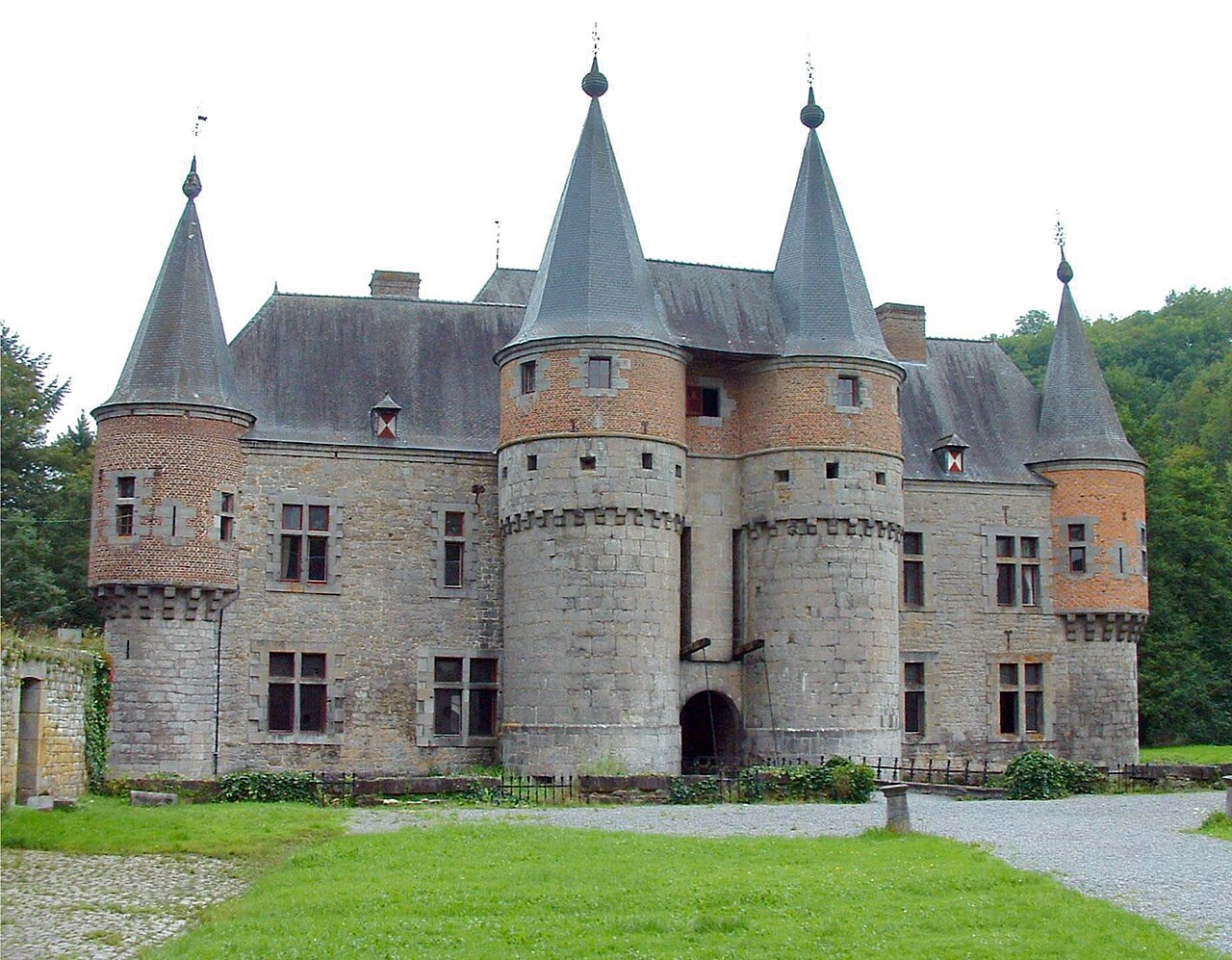
Crupet Castle
Crupet Castle, also known as Carondelet Castle, is a remarkable example of a medieval moated donjon located in the village of Crupet within the municipality of Assesse, in the Namur province of Belgium. This castle's origins trace back to the early 13th century, although some historical sources suggest the late 11th or 12th century. The castle stands today as a testament to the evolution of medieval defensive architecture and its adaptation to residential and agricultural functions over centuries.
The castle is situated on a small lake, with its core donjon connected to the surrounding bailey by a distinctive stone arched bridge. The original structure was a squat, robust keep built from limestone, featuring battlements and a wall walk that offered defenders a vantage point over the surrounding landscape. This fortified tower, typical of lowland castles, was surrounded by a deep moat, emphasizing its defensive purpose in a region characterized by flat terrain.
Early construction and medieval origins
The earliest documentary evidence of the lordship of Crupet dates to 1278, with the first mention of a building on the site, referred to as the "mannoir de Cripeit," recorded in 1304. Architectural analysis supports a construction date in the early 13th century, aligning with the period's common fortification styles. The initial fortification was commissioned by the Count of Luxembourg, reflecting the strategic importance of the site during the medieval period.
Originally, the castle was designed as a strong donjon—a fortified tower that served both as a defensive structure and a noble residence. The thick limestone walls and moat provided formidable protection against attacks. Soon after its initial construction, additional buildings were erected around the tower, creating a fortified domain with enhanced residential and agricultural capabilities.
Ownership transitions and architectural transformations
Ecclesiastical control and the prince-bishop of liège
In the 14th century, ownership of Crupet Castle passed to the Prince-Bishop of Liège, marking a significant shift from secular to ecclesiastical governance. This transition likely influenced the castle's role and maintenance, as the Prince-Bishopric was a powerful ecclesiastical principality within the Holy Roman Empire.
The carondelet family and renaissance modifications
In 1549, the castle was acquired by the influential Carondelet family. They undertook significant modifications that transformed the medieval fortress into a château-ferme, or fortified farmhouse. The most notable architectural addition was a projecting upper floor with a distinctive pyramidal roof atop the original donjon. This addition not only enhanced the castle's silhouette but also reflected Renaissance architectural influences, including the installation of Renaissance-style windows that allowed more light and comfort within the living spaces.
The Carondelet family also constructed additional buildings to form a basse-cour, or lower courtyard, which enclosed the castle's agricultural and residential functions within a fortified perimeter. Heraldic elements such as the family's name and crest are still visible throughout the castle, underscoring their lasting legacy.
Later noble ownership and preservation
Following the Carondelet tenure, the castle passed to the House of Merode in the 17th century, either in 1629 or 1667. Through inheritance and marriage, it subsequently came under the possession of the Count of Thiennes and later the Marquis of La Boëssière. The castle remained in aristocratic hands until the early 20th century, preserving its historical and architectural integrity through these transitions.
20th century restoration and modern use
In 1925, the castle was purchased by the architect Adrien Blomme, who undertook extensive restoration and modernization efforts. Blomme adapted the medieval structure for contemporary residential use while carefully preserving its historical character. His restoration work respected the castle's original fabric, maintaining the defensive features of the donjon and the Renaissance additions.
The castle continued to be inhabited by Blomme's descendants until recent times. Today, it is owned by a Dutch family from 's-Hertogenbosch. The grounds historically included a well-known trout farm near the donjon, which is no longer operational, and a hospitality establishment that reflects the site's ongoing adaptation.
Architectural features and defensive elements
The defining feature of Crupet Castle is its medieval moated donjon, a hallmark of lowland castles designed to provide both defense and residence. The donjon's thick limestone walls, battlements, and wall walk offered protection and surveillance capabilities. The deep moat surrounding the tower enhanced its defensibility by creating a physical barrier against attackers.
The 16th-century additions by the Carondelet family introduced a projecting upper floor with a pyramidal roof, which altered the castle's profile and added residential space. The Renaissance-style windows brought in more natural light, signaling a shift toward greater comfort and aesthetic refinement typical of the Renaissance period.
The basse-cour or lower courtyard, enclosed by additional buildings, created a multifunctional space combining agricultural activities with security. This transformation from a purely military fortification to a fortified farmhouse illustrates the adaptive reuse of medieval castles in response to changing social and economic conditions.
Cultural significance and preservation status
Crupet Castle stands as a well-preserved example of a high medieval defensive structure that evolved into a Renaissance fortified farmhouse. Its layered history reflects the broader political and social shifts in the Namur region and the Low Countries over several centuries.
Today, the castle is in well-preserved condition, retaining key architectural elements from its medieval origins through its Renaissance modifications and 20th-century restorations. It remains a private residence but continues to attract interest for its historical and architectural value.
The castle's moated setting and stone bridge, along with its heraldic decorations and structural evolution, offer valuable insights into medieval military architecture and noble lifestyle adaptations. Crupet Castle is an important cultural landmark within the Namur province, embodying the heritage of feudal Belgium.
Frequently asked questions (FAQ)
- How do I get to Crupet Castle?
- Crupet Castle is located in Assesse, Belgium, easily accessible by car or public transportation. If you are driving, follow the signs to Assesse and look for parking near the castle. Public transport options include local buses that connect to nearby towns.
- What is the historical significance of Crupet Castle?
- Crupet Castle dates back to the 11th century and has played an important role in the region's history. It was originally built as a defensive structure and has undergone several renovations over the centuries. Today, it serves as a remarkable example of medieval architecture in Belgium.
- When was Crupet Castle built?
- Crupet Castle was constructed in the 11th century, with many of its current features added during the 15th and 16th centuries. The castle reflects the architectural styles and defensive needs of its time, making it a fascinating site for history enthusiasts.
- Can I visit Crupet Castle year-round?
- Yes, Crupet Castle is open to visitors year-round, but it's important to check specific opening hours as they may vary by season. Guided tours are available, providing insights into the castle's rich history and architecture. Be sure to plan your visit in advance to secure a spot.
- Why is Crupet Castle a popular tourist attraction?
- Crupet Castle is popular for its stunning architecture, rich history, and picturesque surroundings. Visitors appreciate the opportunity to explore the castle grounds and learn about its historical significance. Additionally, the beautiful landscape adds to the overall appeal of the site.
- Is it possible to take guided tours of Crupet Castle?
- Yes, guided tours of Crupet Castle are available and offer a comprehensive overview of its history and architecture. Knowledgeable guides provide fascinating insights during the tour, making it an enriching experience for visitors of all ages. Reservations may be required, so it's best to check in advance.
- What are the opening hours for Crupet Castle?
- Crupet Castle typically opens to visitors from 10 AM to 5 PM, but hours may vary depending on the season or special events. It's advisable to check the official website or contact the castle directly for the most up-to-date information on opening hours before your visit.
- Are there any nearby attractions to visit while in Assesse?
- Yes, Assesse is home to several attractions, including scenic walking trails and beautiful parks. Visitors can also explore nearby historical sites and charming villages that showcase the region's rich culture. Consider planning a full day to enjoy everything the area has to offer.
- What are the ticket prices for Crupet Castle?
- Ticket prices for Crupet Castle are generally affordable, with discounts available for children, students, and seniors. It's best to check the official website for the most current pricing and any special offers that may be available during your visit. Group rates may also apply for larger parties.
Information
Website
Visit websiteSources & official resources
Verify the information above using these authoritative references.
Loading map...
Visitor reviews
No reviews yet. Been here? Write the first review and help other travelers!
Write the first reviewVisited this castle? Share your experience
Your review helps other travelers and adds first-hand knowledge to our encyclopedia.