Spiez Castle
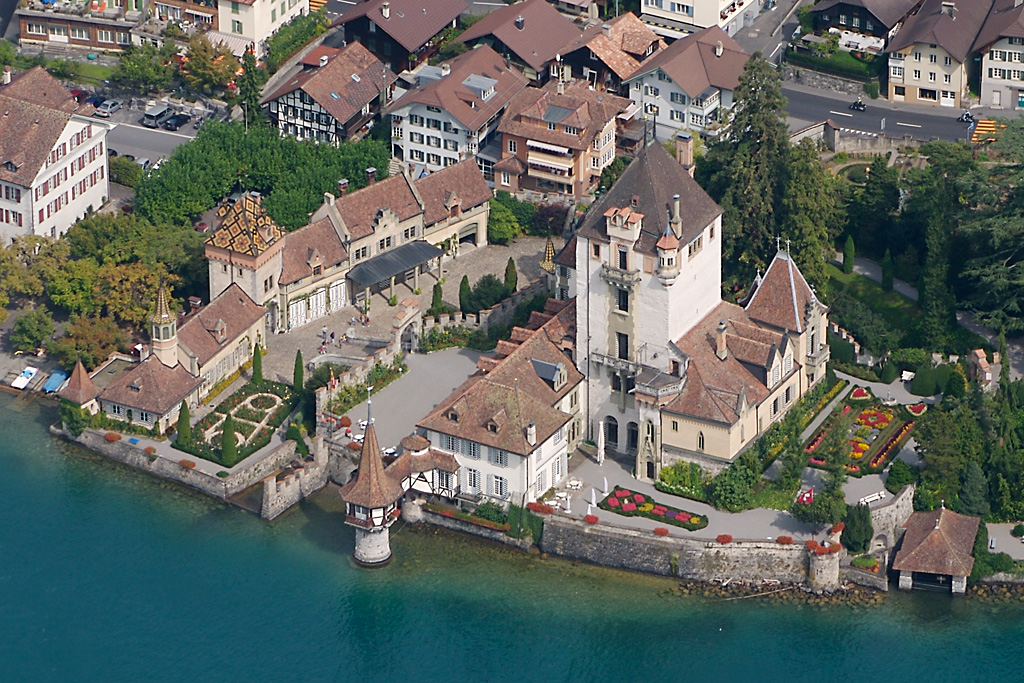
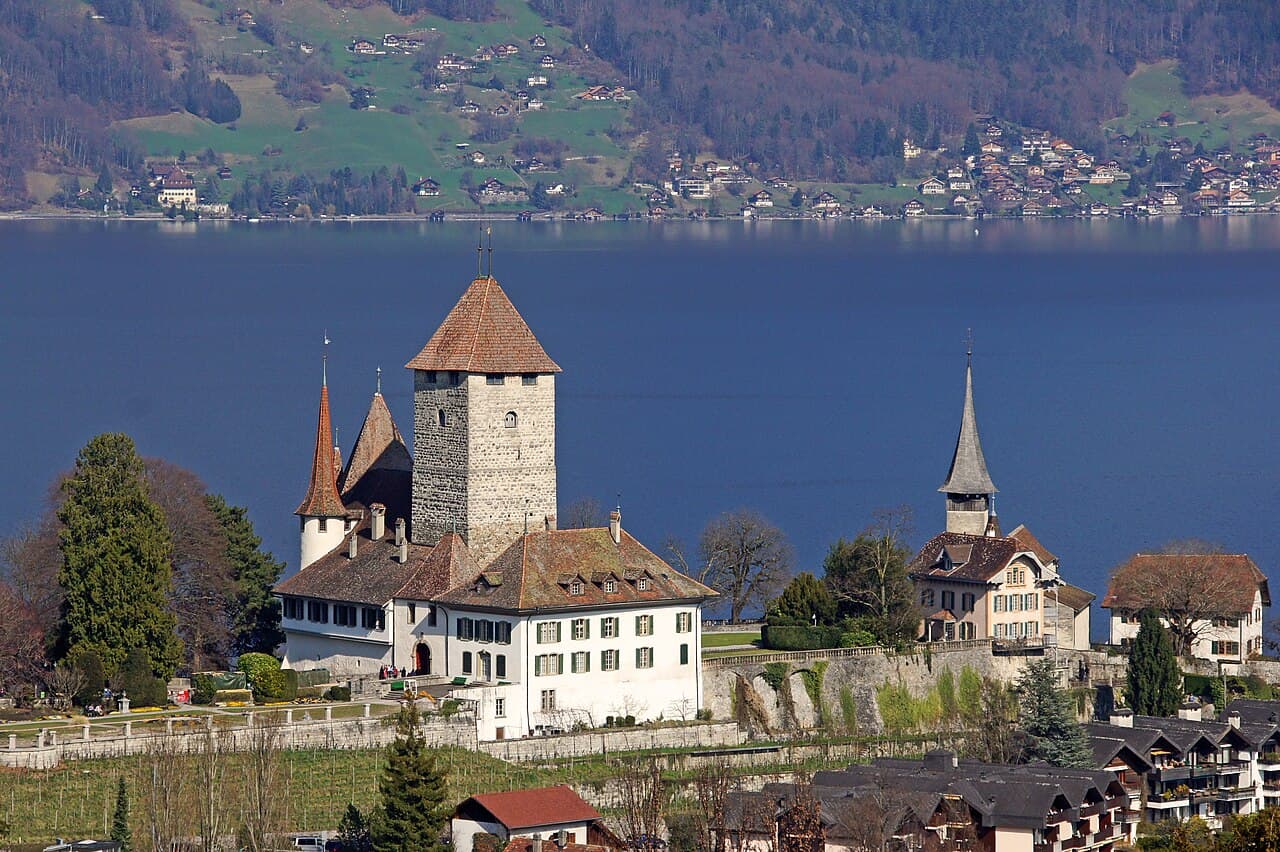
Spiez Castle is an iconic hill castle located on a picturesque peninsula extending into Lake Thun in the canton of Bern, Switzerland. Its origins trace back to the early medieval period, with the castle reportedly founded in 933 by King Rudolph II of Burgundy. This early foundation marked the beginning of a strategic and noble residence that would play a significant role in the region’s history for over a millennium. Shortly after its establishment, the castle became the seat of the Freiherr von Strättligen family, first documented in 1175, who maintained control until their extinction before 1350.
Medieval origins and early development
The massive square keep at the heart of Spiez Castle was constructed around 1200, showcasing the robust defensive architecture typical of the high medieval period. The keep’s lower walls measure approximately three meters thick, tapering as they ascend to a final height of about 39 meters. Originally, the tower was surrounded by several free-standing wooden buildings, which were gradually replaced by a sturdy stone curtain wall and a series of two concentric moats, enhancing the castle’s fortifications.
The castle’s gatehouse, opening to the west, provided controlled access and was integrated into the defensive perimeter. Around 1300, a residential wing was added north of the keep, initially connected by a wooden gallery. This wing was expanded in the 14th century with an additional northern extension, reflecting the castle’s evolution from a purely military fortress to a noble residence.
Ownership and political significance
By the 13th century, a fortified settlement had developed just south of the castle, enclosed by defensive walls. This small town thrived alongside the castle but disappeared by the late 19th century. In 1280, Spiez Castle was recorded as an Imperial fief under Vogt Richard de Corbières. Ownership passed through several noble families, including the Freiherr von Strättligen and later the Bubenberg family, who acquired it in 1338 and maintained control until their extinction in 1506.
Following a brief tenure by Ludwig von Diesbach, the castle was acquired by the influential von Erlach family in 1515. The von Erlachs, prominent Bernese patricians, ruled the castle and its surrounding lands until the French invasion of 1798. Although they lost judicial authority after the invasion and the establishment of the Helvetic Republic, they retained ownership of the castle until 1875.
Architectural transformations and expansions
During the late medieval period, the castle underwent multiple expansions, though specific dates and details are scarce. Around 1600, under the direction of Franz Ludwig von Erlach, the castle experienced significant renovations, including the addition of a richly decorated great hall on the second floor. This hall features elaborate stucco work by Gian Antonio Castelli, a renowned artist from Ticino, depicting heraldic arms, biblical scenes like the Prodigal Son and the legend of Susanna, as well as classical deities such as Poseidon, Ceres, Mars, Venus, Bacchus, Apollo, and Artemis.
The castle’s Trüel was added to the northwest side of the keep in the 16th century. From the 17th to the 18th centuries, the south 'New Castle' was constructed and later expanded and redecorated in the late Baroque style. This section of the castle includes elegant residential quarters and is surrounded by beautifully maintained gardens, vineyards, and forests, contributing to the estate’s aesthetic and cultural value.
Cultural heritage and modern use
In the 20th century, after passing through several private owners, a foundation purchased Spiez Castle and its associated church in 1929 following a nationwide fundraising campaign aimed at preserving this important cultural monument for the Swiss people. Restoration efforts in 1935-1936 removed later additions deemed unsuitable, with architect Karl Indermühle transforming the “New Castle” into a Bernese country house.
Today, the castle’s gardens are open to the public, offering visitors a chance to explore the historic landscape featuring rose and baroque herb gardens. The castle rooms serve as a venue for conferences, concerts, exhibitions, and other cultural events, enriching the local community and tourists alike.
The Romanesque castle church adjacent to the castle is a significant cultural and historical gem, renowned for its frescoes and architectural value. The castle and church together form a cultural asset of national importance in Switzerland.
Visitor experience and educational offerings
Spiez Castle offers an interactive exhibition that presents the 1300-year history of the site, including the stories of the three main noble families: the Strättligen, Bubenberg, and von Erlach. The exhibition features 3D viewing stations and hands-on activities such as the Rittertrail, making the visit engaging for children and families.
The castle hosts annually changing special exhibitions that attract art enthusiasts and historians. The grounds, including the park, rose garden, and baroque herb garden, invite leisurely strolls and provide a picturesque setting for private events such as weddings.
Frequently asked questions (FAQ)
- How do I visit Spiez Castle and what are the opening hours?
- Spiez Castle is open to the public with visiting hours typically from 10:00 to 17:00 daily, but it is advisable to check the official website for seasonal variations and special events.
- What is the historical significance of Spiez Castle?
- Spiez Castle has a rich history dating back to 933 and was home to important noble families like the Strättligen, Bubenberg, and von Erlach, playing a key role in regional politics and culture.
- Can I attend events or exhibitions at Spiez Castle?
- Yes, the castle hosts conferences, concerts, and exhibitions throughout the year, including annually changing special art exhibitions that showcase local and historical themes.
- Is Spiez Castle suitable for family visits?
- Absolutely, the castle offers interactive exhibitions with 3D viewing stations and activities like the Rittertrail, making it engaging and educational for children and families.
- What architectural styles are represented in Spiez Castle?
- Spiez Castle features a mix of architectural styles including medieval defensive structures, late Baroque residential expansions, and Romanesque elements in the castle church.
Photo gallery

Information
Sources & official resources
Verify the information above using these authoritative references.
Loading map...
Visitor reviews
No reviews yet. Been here? Write the first review and help other travelers!
Write the first reviewVisited this castle? Share your experience
Your review helps other travelers and adds first-hand knowledge to our encyclopedia.