Sokolec
Sokolec Castle, also known historically as Falkenstein, stands at the foot of the rocky summit of Krzyżna Góra in Poland. Although today only modest remnants of this fortress remain, the site holds significant historical and architectural interest. The earliest written records of the castle date back to the mid-14th century, though some hypotheses suggest it may have been constructed as early as the 13th century. However, no conclusive archaeological evidence currently confirms this earlier date.
The castle's original purpose remains somewhat uncertain. Scholars speculate that Sokolec Castle was likely built to protect the settlements in the Kotlina Jeleniogórska (Jelenia Góra Basin) or to guard a strategic trade route running along the Bóbr River. By the second half of the 14th century, it was one of the fortifications within the Duchy of Świdnica-Jawor. After the death of Duke Bolko II, the castle passed into the hands of ducal vassals who controlled the surrounding lands.
Architectural design and fortifications
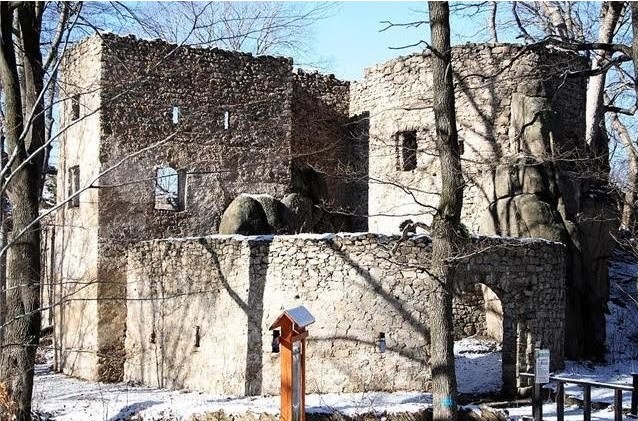
The fortress was constructed on a plan roughly resembling a rectangle. Its eastern and northern flanks were protected by a perimeter stone wall, while the western side was naturally defended by imposing 20-meter-high rocky cliffs. The main stone building was built against the steep face of Krzyżna Góra, with preserved beam sockets indicating it had several floors.
Opposite this structure, along the perimeter wall, a row of buildings was erected, enclosing a small internal courtyard. The remaining castle buildings were likely made of wood, a common practice for secondary structures in medieval fortifications. At the summit of the mountain, which was possibly artificially shaped to serve defensive purposes, a wooden watchtower was constructed to serve as a lookout post.
Notably, the castle lacked a well, an unusual feature for a fortress. To secure a water supply, a cistern was carved into the rock, accessible from the courtyard via stone steps. This ingenious solution highlights the challenges posed by the castle’s rocky terrain and its elevated position.
Historical context and legends
Sokolec Castle is enveloped in intriguing local legends, particularly involving the knight Hanusz Czirn from nearby Niesytno Castle. According to tradition, in 1434, Hanusz, initially aligned with the Hussite movement, switched allegiances and lured Hussite leaders, including Biedrzych ze Strażnicy and Michałek, starost of Niemcza, to Sokolec. He then betrayed them to the forces of the Bishop of Wrocław, Konrad. Legend recounts that during the ensuing arrest, a battle broke out, resulting in the castle being set ablaze. Some Hussites escaped but were said to have fallen from a cliff now called Hussite Rock.
Alternative accounts suggest the castle survived the Hussite Wars and later became a refuge for robber knights (raubritters). This version claims the fortress was not destroyed until 1475. However, recent historical research and archaeological investigations challenge these stories, suggesting the castle was likely abandoned or destroyed by the end of the 14th century. There is no evidence that it was ever owned by Hanusz Czirn. It may have been temporarily rebuilt or used during the Hussite conflicts, but this remains unconfirmed without further archaeological evidence.
Current state and preservation
Today, Sokolec Castle exists only as small fragments of its original stone walls at the base of Krzyżna Góra. Despite its modest remains, the site is a valuable historical monument that offers insight into medieval fortification techniques and regional history. The castle is classified as a late medieval bastioned fortress, reflecting its defensive architectural style adapted to the rocky terrain.
Though the structure is largely in ruins, it has undergone some restoration efforts to preserve what remains. The site is accessible to visitors interested in medieval history, castle architecture, and the legends surrounding the Hussite Wars. The surrounding landscape of the Jelenia Góra Basin and the nearby mountains add to the site's appeal for tourists and historians alike.
Architectural significance and regional role
Sokolec Castle exemplifies the strategic use of natural terrain in medieval military architecture. The combination of man-made fortifications and natural rock defenses created a formidable stronghold in the region. Its position guarding trade routes and settlements highlights the castle's importance in the political and economic landscape of the Duchy of Świdnica-Jawor.
The castle’s design also reflects the transitional period of military architecture in the late medieval era, where stone walls were complemented by bastions and lookout towers to improve defense capabilities. The carved rock cistern demonstrates adaptation to environmental challenges, a feature not commonly found in many contemporary castles.
Comparative context
Compared to other castles in the region, such as Niesytno Castle and Chojnik Castle, Sokolec was smaller and less elaborate but strategically significant due to its location. Its relatively modest scale and the predominance of wooden structures suggest it served more as a fortified residence or watchpoint rather than a major military fortress.
Visiting Sokolec Castle today
Visitors to the site can explore the remnants of the stone walls and the rocky terrain that shaped the castle's defenses. The site offers a unique opportunity to experience a medieval bastioned fortress integrated with natural rock formations. Hiking trails in the surrounding area provide scenic views of the Jelenia Góra Basin and the Sudetes mountains.
While the castle itself is in ruins, informational panels and local guides help visitors understand its historical context and architectural features. The site is especially appealing to enthusiasts of medieval history, archaeology, and castle architecture.
In summary, Sokolec Castle remains a fascinating example of a late medieval bastioned fortress in Poland, with a rich history intertwined with regional conflicts and legends. Its preserved ruins continue to attract scholars and visitors eager to uncover the stories embedded in its stones.
Frequently asked questions (FAQ)
- When was Sokolec Castle originally built?
- Sokolec Castle was first mentioned in the mid-14th century, with possible origins in the 13th century, though this earlier date is unconfirmed.
- What architectural features characterize Sokolec Castle?
- The castle features a rectangular plan with stone perimeter walls on two sides and natural rock cliffs on the west, a multi-storey main building, a wooden watchtower, and a rock-carved cistern for water.
- Is Sokolec Castle open to visitors today?
- Yes, visitors can explore the ruins and surrounding hiking trails, with informational panels providing historical context about the castle.
- What is the historical significance of Sokolec Castle?
- Sokolec Castle served as a defensive stronghold in the Duchy of Świdnica-Jawor, guarding trade routes and settlements in the Jelenia Góra Basin during the late medieval period.
- Are there any legends associated with Sokolec Castle?
- Local legends tell of knight Hanusz Czirn betraying Hussite leaders at the castle in 1434, leading to a battle and the castle's burning, though these stories are historically disputed.
Information
Loading map...
Visitor reviews
No reviews yet. Been here? Write the first review and help other travelers!
Write the first reviewVisited this castle? Share your experience
Your review helps other travelers and adds first-hand knowledge to our encyclopedia.