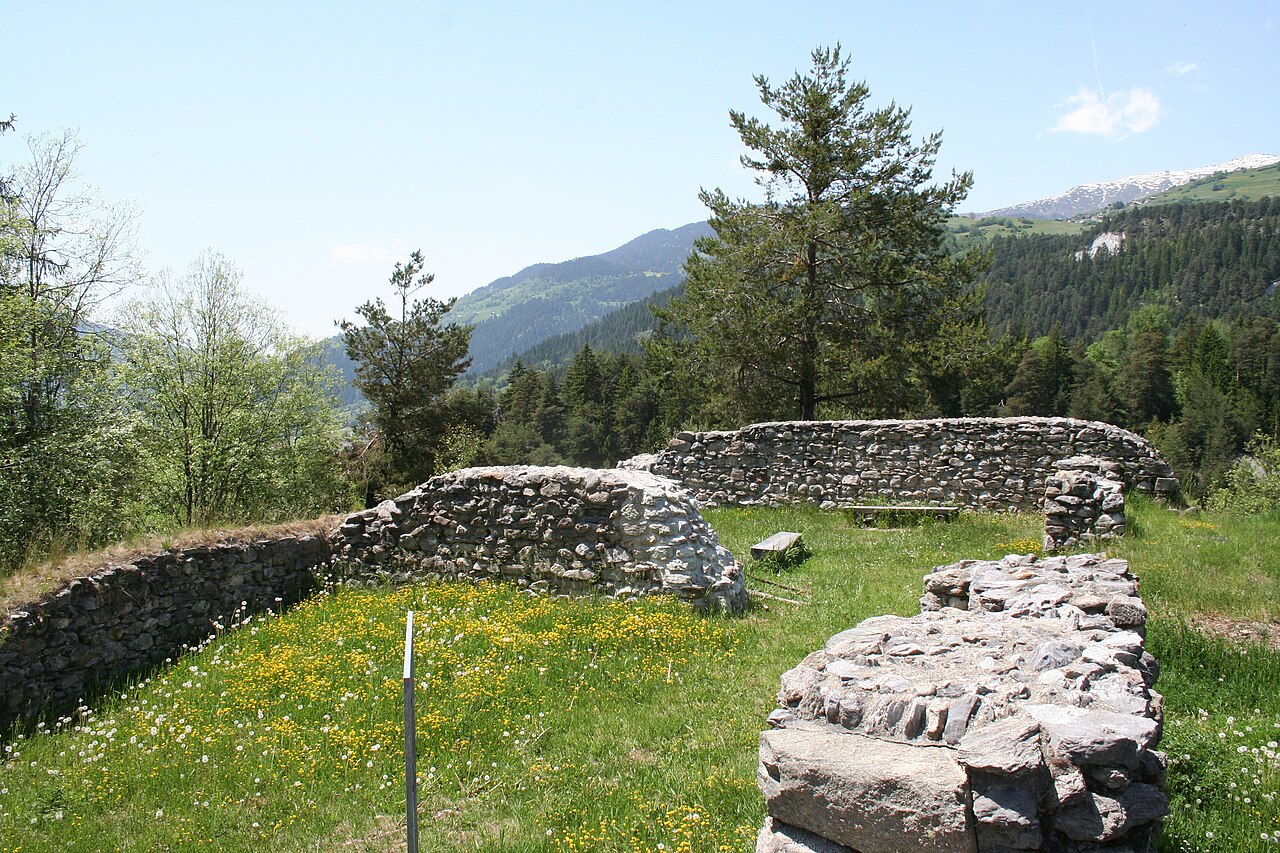
Sogn Parcazi Castle Ruins
Sogn Parcazi castle ruins are perched on a steep hill west of the village of Trin in Switzerland, offering a striking example of a high medieval fortified church and feudal castle complex. The site is named after the hill it occupies and is historically significant for its early religious and defensive functions as well as its role in regional lordship. The castle's origins are intertwined with a religious foundation, possibly dating back to the 8th century, and it evolved over centuries into a fortified residence and administrative center.
The early religious and defensive origins
The earliest known structure on the site is the Church of St. Pancras, which likely dates from around the 11th century but may have replaced an even earlier church from the 8th century. This early church was probably built on a pre-Christian cult site, indicating the hill's long-standing spiritual significance. Originally, the site functioned as a fortified church and refuge castle, serving as a sanctuary for local inhabitants during times of conflict. It may have been the first parish church for the communities of Tamins and Trin.
Historical records mention Pepin, the father of Charlemagne, as a possible founder of the castle, though this claim remains unproven. By the 9th or 10th century, the imperial estates of Trin, Tamins, and Reichenau were combined into the Herrschaft of Hohentrin and granted to Reichenau Abbey, marking the beginning of ecclesiastical control over the site.
Transformation into a feudal castle
During the 11th and 12th centuries, the site underwent significant changes, with the addition of a tower and the construction of the first residential buildings, marking its transition from a purely religious refuge to a fortified residence. The tower, measuring approximately 11 by 7 meters with walls up to 1.8 meters thick, served both defensive and residential purposes.
Around 1300, a palas was added on the northern end of the complex. This 18-meter-long building functioned as the main residential and representative hall of the castle, illustrating the growing importance of the site as a noble residence. The castle's architecture reflects typical high medieval styles with robust stone construction and defensive features adapted to the steep hilltop location.
Historical ownership and conflicts
The castle first appears in historical documents in the early 14th century. In 1314, ownership passed from Reichenau Abbey to the Freiherr von Frauenberg, and by 1325 it was held by Count Hugo III von Werdenberg-Heiligenberg. The mid-14th century saw local noble conflicts involving the Werdenberg-Heiligenberg and Werdenberg-Sargans families, although Sogn Parcazi itself remained intact during these disputes.
Throughout the late 14th century, the castle was used as collateral in various loans, reflecting its value and strategic importance. It was pawned to Ulrich Brun von Rhäzüns and later to Albrecht von Werdenberg-Bludenz, a Habsburg supporter. However, the owners joined the anti-Habsburg Grey League shortly thereafter, highlighting the complex political allegiances of the region.
In 1428, the castle passed to the von Hewen family, who appointed vogts to administer the estate. The last vogt, Otto Capol, suffered a tragic fate when a fire destroyed the castle in 1470, killing three of his children and a maid. The cause of the fire remains uncertain, with theories suggesting arson by debtors seeking to destroy financial records.
Decline and modern preservation efforts
Following the fire, Sogn Parcazi was never rebuilt. The vogts continued to administer the Herrschaft until at least 1524, but likely from other residences such as Canaschal Castle or local villages. Ownership changed hands several times, with the municipality of Trin eventually buying its freedom from the Lords of Schauenstein in 1616.
Excavations began in 1931 but were interrupted due to funding shortages, leading to partial collapse of some walls. During World War II, the Swiss Army constructed two bunkers on the hill, incorporating the site into modern military defenses. Post-war, the army maintained the ruins, which were re-excavated and reinforced in 1964.
In 2004, the ruins were transferred to the municipality of Trin. Between 2006 and 2010, extensive repairs and archaeological excavations revealed much of the castle's history, contributing valuable insights into its architectural development and historical significance.
Architectural features of the ruins
The castle ruins occupy a flat plateau approximately 50 by 80 meters atop the hill. The Church of St. Pancras stands centrally, oriented east-west, with a simple rectangular layout. A rectangular cistern or baptistery was added in the 12th century, reflecting the site's continued religious function during the castle's evolution.
The tower south of the church is a substantial structure from the 11th or 12th century, notable for its thick walls and defensive design. The northern palas building, dating from the 13th century, is the largest surviving residential structure, measuring 18 meters in length and illustrating the castle's role as a noble residence.
Overall, the ruins provide a clear example of the architectural transition from a fortified church to a feudal castle, with layers of construction spanning several centuries. The site's location on a steep hill provided natural defense advantages, which were enhanced by the castle's robust stone walls and strategic layout.
Military and strategic significance
Sogn Parcazi's hilltop position allowed control over the surrounding valleys and routes, making it a valuable stronghold in the region. Its use as a refuge castle and later as a feudal seat underlines its importance in local power dynamics during the high medieval period.
Religious importance
The presence of the church and baptistery highlights the castle's dual role as both a military and religious center. The continuity of worship from possibly the 8th century through the medieval period reflects the site's enduring spiritual significance for the communities of Trin and Tamins.
Frequently asked questions (FAQ)
- How do I get to Sogn Parcazi Castle Ruins?
- Sogn Parcazi Castle Ruins is located in Trin, Switzerland, and can be accessed by car or public transport. The nearest train station is about 15 minutes away by foot, and there are local bus services that connect to the area. Once you arrive, a short hike will lead you to the ruins.
- What is the historical significance of Sogn Parcazi Castle Ruins?
- Sogn Parcazi Castle Ruins dates back to the 13th century and served as a strategic defense point in the region. Its remnants offer insight into the medieval architecture and the feudal history of the Grisons canton. The site is a testament to the area's rich cultural heritage and historical development.
- When was Sogn Parcazi Castle built?
- Sogn Parcazi Castle was constructed in the early 13th century, around 1220, during a time of territorial conflict in the region. It was part of a network of fortifications built to protect the local population from invasions. The castle played a crucial role in the defense of the valley until its decline in the late medieval period.
- Can I explore the castle ruins freely?
- Yes, visitors are welcome to explore the Sogn Parcazi Castle Ruins freely. There are no entry fees, allowing you to enjoy the historical site at your own pace. However, please be respectful of the ruins and follow any posted guidelines to preserve the site.
- Why is Sogn Parcazi Castle a popular tourist attraction?
- Sogn Parcazi Castle is popular due to its breathtaking views of the surrounding landscape and its intriguing history. The ruins provide a picturesque setting for photography and a glimpse into medieval life in Switzerland. Additionally, the location offers various hiking trails, making it a favorite for nature enthusiasts.
- Is it possible to visit Sogn Parcazi Castle year-round?
- Yes, Sogn Parcazi Castle Ruins is open to visitors year-round. However, accessibility may vary during the winter months due to snow and weather conditions. It's recommended to check local weather forecasts and plan your visit accordingly to ensure a safe and enjoyable experience.
- What are the best times to visit Sogn Parcazi Castle?
- The best times to visit Sogn Parcazi Castle are during the spring and autumn months when the weather is mild, and the scenery is particularly stunning. These seasons offer vibrant foliage and pleasant hiking conditions. Summer can also be a great time, but it may be more crowded with tourists.
- Are there any nearby attractions to visit?
- Yes, the area around Sogn Parcazi Castle is rich in attractions. Nearby, you can explore the charming village of Trin or take a hike in the surrounding mountains. Additionally, the beautiful Rhine Gorge, often referred to as the "Grand Canyon of Switzerland," is just a short drive away.
- What are the opening hours for Sogn Parcazi Castle?
- Sogn Parcazi Castle Ruins is open to the public at all times, allowing visitors to explore the site whenever they wish. There are no specific opening hours, but it’s best to visit during daylight for safety and to fully appreciate the vistas. Always check local information for any seasonal changes that may affect access.
Loading map...
Visitor reviews
No reviews yet. Been here? Write the first review and help other travelers!
Write the first reviewVisited this castle? Share your experience
Your review helps other travelers and adds first-hand knowledge to our encyclopedia.