Belmont Castle
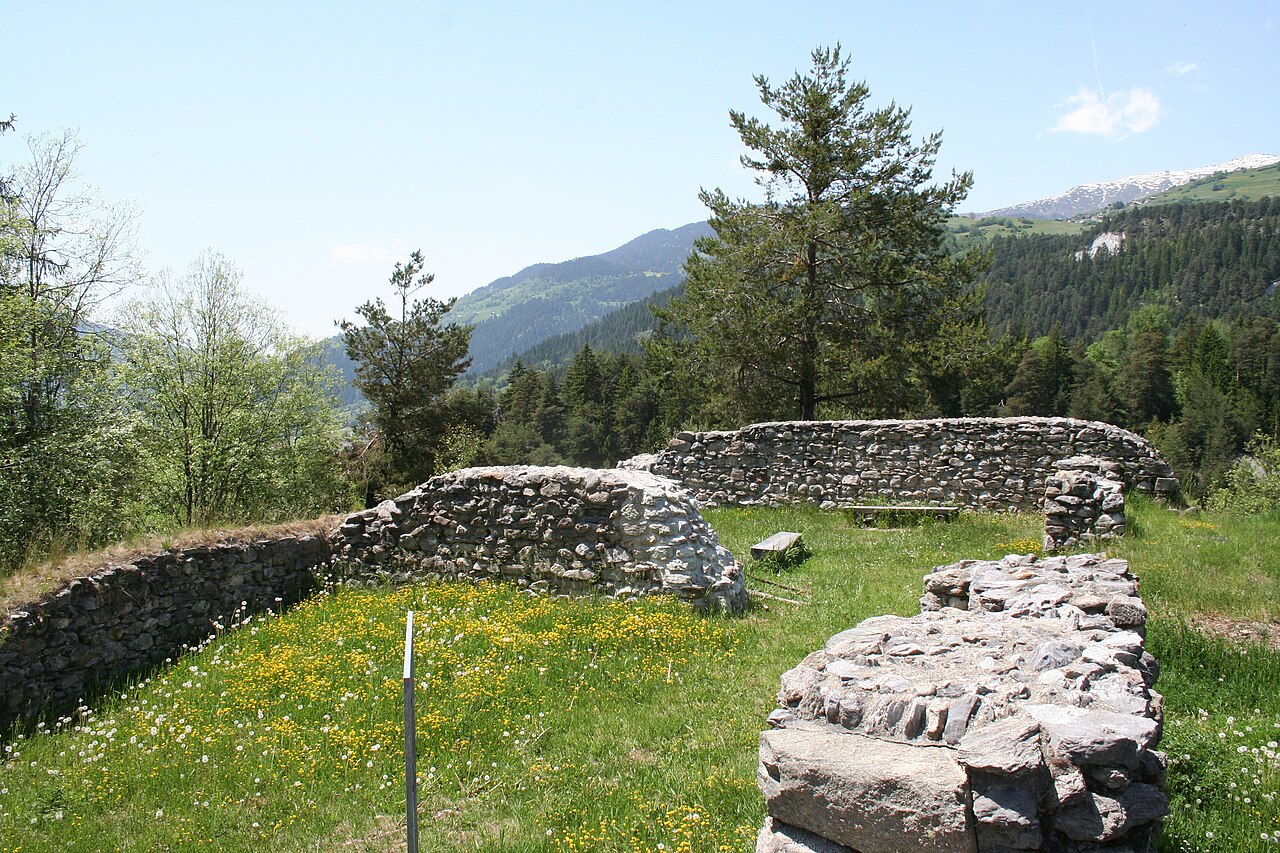
Belmont Castle is a historic hill castle located near Flims in the canton of Graubünden, Switzerland. Constructed in the 10th century, it served as the ancestral seat of the noble Freiherr von Belmont family, a significant power in the region during the Early Medieval period. The castle's strategic position on a rocky spire with sheer cliffs on the north and east sides provided natural defenses, characteristic of hill castles built for both protection and control over surrounding territories.
The Belmont family and their influence in Graubünden
The first recorded member of the Belmont family was Lutefridus de Belmonte in 1137/39. The family was closely related to other notable Raetian noble houses, including the influential von Vaz family. By the 13th century, the Belmonts had become one of the most powerful families in Graubünden, owning numerous castles and villages throughout the region. Their influence extended into ecclesiastical roles as well; notably, Konrad von Belmont served as the Bishop of Chur from 1273 to 1282.
In 1267, Heinrich von Belmont became the first student from Raetia to study at the prestigious University of Bologna, reflecting the family's prominence and commitment to education. Around the year 1200, the Belmont family appears to have shifted their residence to another castle near Castrisch and later to Tuma Casti near Domat/Ems, likely leaving a bailiff or vogt to oversee Belmont Castle.
Architectural features and layout of Belmont Castle
The castle's construction took advantage of the natural rocky spire, with two semi-circular ring walls encircling the east, north, and northwest sides of the peak. The inner ring wall was built first, followed by the outer wall, creating a layered defense system. These walls connected at least three buildings, with the central and eastern structures probably serving as residential quarters.
One notable feature at the heart of the castle is a 5.7-meter-deep cistern, essential for water storage during sieges and dry periods. To the south of the castle lies a smaller rocky peak about 8 meters higher than the main castle, with a flat top measuring roughly 10 by 30 meters. Although no stone ruins have been found on this peak, it is believed to have supported one or more wooden buildings, possibly for lookout or additional defensive purposes.
Historical events and decline
In 1352, Ulrich Walter von Belmont played a key role in a successful uprising against the Counts of Werdenberg-Heiligenberg. Leading forces allied with the Montalt and Rhäzüns families, they defeated the Werdenberg-Heiligenberg army at Mundaun near Ilanz. In retaliation, the Werdenberg forces burned Ilanz to the ground shortly thereafter.
The fate of Belmont Castle during these conflicts is uncertain; it is unclear whether it was attacked and destroyed or bypassed. However, by the late 14th century, the castle had fallen into ruins. Ulrich Walter von Belmont died childless in 1371, and the family's lands were inherited by the Montalt and Sax-Misox families. In 1380, the Sax-Misox family traded the ruins of Belmont Castle, along with other lands, to Brun von Rhäzüns. Following this transaction, the castle remained abandoned and continued to deteriorate.
Excavation and preservation efforts
Between 1932 and 1936, archaeological excavations and repairs were undertaken to stabilize and preserve the ruins of Belmont Castle. These efforts revealed much about the castle's layout and construction techniques, helping to protect this valuable cultural heritage site. Today, the castle ruins stand as a testament to the region's medieval history and the legacy of the Belmont family.
Location and environment
Belmont Castle was built near the now vanished Walser village of Fidaz, close to Flims. Its location atop a rocky spire with steep cliffs provided a natural fortress, typical of hill castles designed for defense and surveillance. The surrounding landscape of Graubünden, with its mountainous terrain and strategic valleys, made such castles vital for controlling trade routes and local territories during the medieval period.
Frequently asked questions (FAQ)
- How do I get to Belmont Castle?
- Belmont Castle is located in Flims, Switzerland. You can reach the castle by taking public transport to Flims and then walking approximately 20 minutes. Alternatively, there are parking facilities nearby if you choose to drive.
- What is the historical significance of Belmont Castle?
- Belmont Castle, built in the late 19th century, serves as a stunning example of the neo-Gothic architectural style. It was originally constructed as a summer residence for a wealthy family and has since become a symbol of the region's rich cultural heritage.
- When was Belmont Castle built?
- Construction of Belmont Castle began in 1880 and was completed in 1884. The castle has been preserved over the years, allowing visitors to appreciate its original charm and historical importance.
- Can I visit Belmont Castle year-round?
- Yes, Belmont Castle is open to visitors year-round, although some areas may have restricted access during the winter months. It's best to check the official website for any seasonal changes to the visiting hours or special events.
- Why is Belmont Castle considered a popular tourist attraction?
- Belmont Castle attracts visitors due to its breathtaking views of the surrounding landscape and its unique architecture. Additionally, the castle hosts various cultural events and exhibits throughout the year, making it a vibrant part of the local community.
- Is it possible to take guided tours of Belmont Castle?
- Yes, guided tours of Belmont Castle are available, offering in-depth insights into its history and architecture. These tours are led by knowledgeable guides who enrich the visitor experience with fascinating stories and facts about the castle.
- What are the ticket prices for Belmont Castle?
- Ticket prices for Belmont Castle vary depending on the type of tour and age group. Generally, adult tickets are around CHF 10, while discounts are available for children and seniors.
- What are the opening hours for Belmont Castle?
- Belmont Castle typically opens at 10 AM and closes at 5 PM, but hours may vary during holidays or special events. It's advisable to check the castle's official website for the most current information before planning your visit.
- What is the best time to visit Belmont Castle?
- The best time to visit Belmont Castle is during the spring and summer months when the weather is pleasant and outdoor activities are abundant. Visiting during this time also allows you to enjoy the beautiful gardens surrounding the castle and participate in various events.
- Are there any nearby attractions to Belmont Castle?
- Yes, nearby attractions include the stunning Lake Flims and the beautiful hiking trails in the area. Additionally, the picturesque village of Flims offers charming shops, restaurants, and other historical sites to explore.
Information
Loading map...
Visitor reviews
No reviews yet. Been here? Write the first review and help other travelers!
Write the first reviewVisited this castle? Share your experience
Your review helps other travelers and adds first-hand knowledge to our encyclopedia.