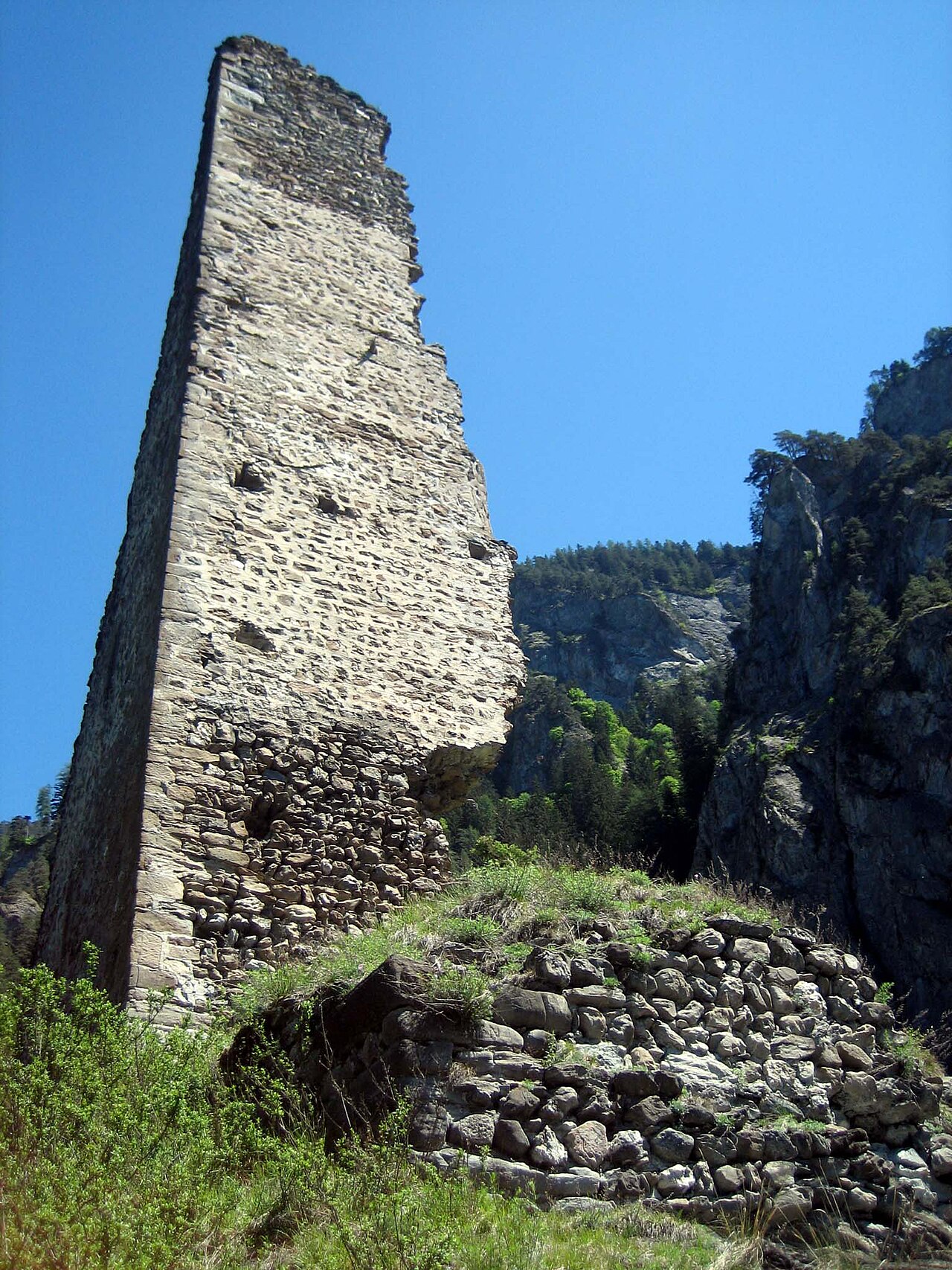
Rhäzüns Castle
Rhäzüns Castle stands as one of the oldest surviving castles in Switzerland, with origins tracing back to the 10th century. Its earliest recorded mention dates to 960, when Emperor Otto I transferred a church located in "in castello Beneduces et Ruzunnes" (the castle of Bonaduz and Rhäzüns) to the Bishop of Chur. This transaction, confirmed again by Otto II in 976, provides the first documentary evidence of the castle's existence. Originally, the site housed a fortified church that gradually evolved into a feudal stronghold over the subsequent centuries.
The castle is located strategically on a cliff above the Hinterrhein river, near the village of Rhäzüns in the canton of Graubünden. Its position afforded commanding views and control over the surrounding valley, a key factor in its historical significance. The castle's early defensive structures likely included a ring wall encircling the site, though this original fortification was partly lost due to erosion caused by the river.
Medieval origins and noble lineage
By the 12th and 13th centuries, Rhäzüns Castle had become the seat of the powerful Rhäzüns family, a Romansh noble lineage first appearing in records in 1139 with Arnoldus de Ruzunne. The castle’s first explicit mention as a fortress dates to 1282. Over the centuries, the Rhäzüns family expanded their influence, acquiring lands in Domleschg and around Heinzenberg Castle. Their growing power culminated in 1343 when a peace treaty between Disentis Abbey and Glarus was signed in the castle's courtyard, underscoring its role as a regional political center.
The late 14th century saw tensions rise between the Rhäzüns family and the Bishop of Chur, leading to the formation of the Ober Bund or Upper Alliance in 1395. This alliance, including the abbot of Disentis Abbey and other regional nobles, sought to counterbalance episcopal power. However, the prolonged conflict weakened the Rhäzüns family, who eventually joined the Grey League in 1424, a significant political federation in the region.
Ownership changes and architectural evolution
The death of Georges Brun von Rhäzüns in 1458 without heirs sparked a dispute over the castle’s inheritance. After a prolonged conflict, the castle and its lands passed to Niclas von Zollern in 1473. Ownership changed hands frequently in the following centuries, involving families such as the von Marmels, von Stampa, von Planta, and the Planta-Wildenstein lineage. The castle also became a Habsburg fief, reflecting the broader political shifts in the region.
During the Swabian War in 1499, troops of the Three Leagues occupied Rhäzüns Castle to prevent it from becoming a Habsburg stronghold. In 1553, significant structural changes were necessary when the eastern round bergfried was demolished due to erosion by the Hinterrhein river threatening collapse. The 16th century also saw the addition of a mill, bath houses, a jail, and residential buildings, reflecting the castle’s adaptation to changing needs.
17th-century expansions and Austrian administration
Under Austrian control, the castle underwent further modifications. The hereditary fief was dissolved in 1595, and a vogt (bailiff) was appointed to administer the territory. The vogt added a chapel on the north side and an outer gatehouse on the south-west side around 1700. The castle served as the residence for various Austrian vogts over the next two centuries, maintaining its administrative importance.
Modern history and preservation
Following the Napoleonic Wars, the castle changed hands again. Austria ceded Rhäzüns to Napoleon in 1809, reclaimed it in 1814, but the Congress of Vienna in 1815 transferred it to the Canton of Graubünden. The canton sold the castle to private owners in 1823, and it served various roles including a private residence for the Vieli family and later a girls' school. After a period of neglect, the castle was restored in the early 20th century and converted into a vacation resort by 1929.
World War II halted tourism, leading to abandonment of the resort. In 1960, the castle was acquired by Ems-Chemie and later rented by Christoph Blocher, a prominent Swiss politician, until his death. Today, Rhäzüns Castle remains closed to the general public but maintains a unique educational tradition: for over 30 years, fourth-grade students from the local school have been invited annually to tour the historic site.
Architectural features and layout
Rhäzüns Castle's architecture reflects its long history and the adaptations made over centuries. The original castle likely featured a ring wall encircling the site, though the eastern section was lost due to river erosion. The surviving north and south walls terminate at the cliff edge, with a newer wall along the cliff forming the current eastern boundary.
The 14th-century inner gate tower and northern residential wing are notable for their preserved frescoes, including the coat of arms of the Barons of Rhäzüns and a hunting scene. The 16th-century reconstruction introduced the eastern wall after the bergfried's demolition, along with repairs and renovations to existing structures.
The 17th-century outer gatehouse and chapel on the north side were later additions under Austrian administration. Residential quarters were expanded during the 16th and 17th centuries, reflecting the castle's evolving function from a feudal fortress to an administrative center and noble residence.
Today, Rhäzüns Castle stands as a well-preserved hill castle that embodies the complex feudal and political history of the Graubünden region. Its combination of medieval fortifications, Renaissance modifications, and Baroque-era expansions offer valuable insights into the architectural and historical developments of Swiss castles over the last millennium.
Frequently asked questions (FAQ)
- How do I get to Rhäzüns Castle?
- Rhäzüns Castle is located in the charming village of Rhäzüns, Switzerland, easily accessible by car or public transport. The nearest major city is Chur, from where you can take a train or bus to reach the castle. Parking is available nearby for those arriving by car.
- What is the historical significance of Rhäzüns Castle?
- Rhäzüns Castle is a remarkable example of medieval architecture, dating back to the 13th century. It served as a stronghold for local nobility and played a crucial role in the region's history, particularly during the power struggles of the Middle Ages. Today, it stands as a testament to the rich heritage of the area.
- When was Rhäzüns Castle built?
- Construction of Rhäzüns Castle began in the early 13th century, with significant expansions and modifications occurring in subsequent centuries. The castle has been well-preserved, allowing visitors to glimpse its historical architecture and appreciate its evolution over time. Its enduring presence reflects the strategic importance of the region throughout history.
- Can I visit Rhäzüns Castle?
- Yes, Rhäzüns Castle is open to the public, offering guided tours that provide insight into its history and architectural features. Visitors can explore the castle grounds and enjoy stunning views of the surrounding landscape. It's advisable to check the official website for any specific visiting requirements or restrictions.
- Why is Rhäzüns Castle a popular tourist destination?
- Rhäzüns Castle attracts visitors due to its fascinating history, stunning architecture, and picturesque location. The castle's well-preserved structures and breathtaking views of the Rhine Valley make it an ideal spot for history enthusiasts and photographers alike. Additionally, its proximity to other attractions in the region enhances its appeal.
- Is it possible to host events at Rhäzüns Castle?
- Yes, Rhäzüns Castle is available for private events, including weddings and corporate gatherings. The unique setting and historical ambiance make it a memorable venue for special occasions. It's recommended to contact the castle management for detailed information on availability and services offered.
- What are the opening hours for Rhäzüns Castle?
- Rhäzüns Castle typically opens to visitors from April to October, with varying hours depending on the season. During peak tourist months, the castle may have extended hours to accommodate more visitors. Always check the official website for the most current opening hours before planning your visit.
- What are the ticket prices for visiting Rhäzüns Castle?
- Tickets for Rhäzüns Castle are reasonably priced, with discounts available for students, seniors, and children. A family ticket is also offered for those visiting with kids. Be sure to check the official website for the latest pricing information and any special promotions.
- What nearby attractions can I visit after exploring Rhäzüns Castle?
- After visiting Rhäzüns Castle, consider exploring the nearby town of Chur, known for its charming old town and vibrant cultural scene. The stunning landscapes of the Rhine Valley and the surrounding mountains offer excellent opportunities for hiking and outdoor activities. Other attractions include local museums and scenic viewpoints, making it easy to fill your day with memorable experiences.
Information
Loading map...
Visitor reviews
No reviews yet. Been here? Write the first review and help other travelers!
Write the first reviewVisited this castle? Share your experience
Your review helps other travelers and adds first-hand knowledge to our encyclopedia.