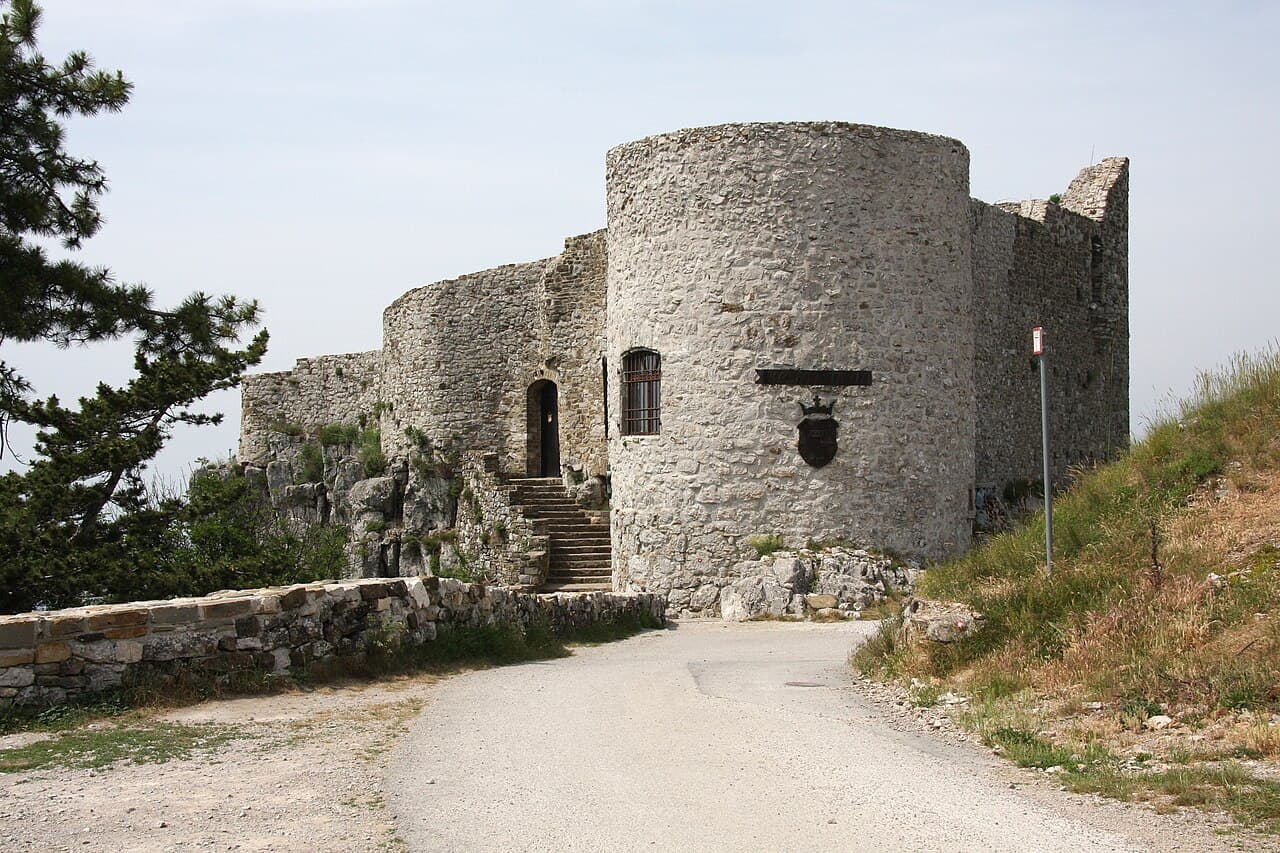
Socerb Castle
Socerb Castle, also known as Grad Socerb or Grad Strmec, is a historic fortress perched on the edge of a 300-meter high karst cliff overlooking the Gulfs of Koper and Trieste. Located in the village of Socerb in Slovenia's Koper region, this castle's commanding position has made it a vital stronghold from ancient times through the medieval period and beyond.
The site of Socerb Castle has been of strategic importance since Illyrian times, with archaeological evidence suggesting early fortifications. During the Roman period, the stronghold was modified and reinforced to control the crucial trade routes and coastal approaches. The current castle structure primarily dates back to the 13th century, placing it firmly in the high medieval period. Its location on a rocky outcrop provided natural defenses, complemented by man-made fortifications.
Medieval origins and strategic significance
Socerb Castle's medieval history is marked by its role as a key defensive and administrative center controlling the hinterlands of Trieste and the commercial routes between Carniola and the Adriatic coast. Throughout the 14th century, the castle was owned by prominent noble families, including the Venetian Ducaini family. Its position made it a coveted asset, resulting in frequent changes of ownership as regional powers vied for control.
In the early 16th century, following the Trieste-Veneto war, the castle came under Austrian Habsburg control. Emperor Charles V granted the fief to the Carniolan nobleman Nicholas II Ravbar in 1521. The castle briefly returned to Venetian hands after the Council of Trent decision in 1535 but was lost again during the turbulent conflicts of the period.
The uskok war and baron benvenuto petazzi
During the Uskok War (1615-1617), Socerb Castle was a focal point of military action. Venetian attempts to regain the castle resulted in a costly battle in 1615, where Venice lost approximately 3,000 infantrymen. The castle's defense was led by Baron Benvenuto Petazzi, who commanded a private Uskok army. Petazzi purchased the castle in 1622 and was later titled Count of Socerb in 1630, establishing a noble lineage that controlled the castle until the late 17th century.
Architectural features and later history
Socerb Castle's architecture reflects its medieval origins and subsequent modifications. The fortress was built to exploit the natural karst rock defenses, with thick stone walls, battlements, and towers designed for surveillance and defense. The castle complex included residential quarters, a courtyard, and defensive structures adapted over centuries to meet evolving military needs.
In 1678, the castle was documented by the noted historian Johann Weikhard von Valvasor, who included detailed drawings and descriptions in his work "Topographia Ducatus Carnioliae Modernae". This record provides valuable insight into the castle's layout and condition in the late 17th century.
Ownership changed hands several times in the 18th century. The castle was acquired by the Petač family in 1702 and later sold to the Montecuccoli family of Modena in 1766. A devastating fire caused by lightning in 1780 severely damaged the castle, leading to its gradual decline and partial ruin.
20th-century restoration and modern use
In the early 20th century, the dilapidated castle was purchased by Demetrio Economo, a baron from Trieste, who undertook partial restoration efforts in 1924-25. His work focused mainly on stabilizing and restoring the castle's surrounding walls, while other parts remained in ruin.
During World War II, Socerb Castle's strategic location again made it a military asset. In 1944, it served as the seat of the VOS (Security-Intelligence Service) and the People's Court. The castle was occupied by German forces and fortified as a stronghold during the conflict.
Today, Socerb Castle functions as a restaurant and tourist destination, offering visitors spectacular views of the Adriatic Sea and the surrounding karst landscape. Access to the castle is primarily through the restaurant, but the panoramic vistas alone make the journey worthwhile.
The holy grotto and cultural heritage
Near the castle entrance, at about 150 meters elevation, lies the Holy Grotto, a cave approximately 44 meters deep and 200 meters long. According to local legend, the young Saint Socerb (San Servolo) lived here as a hermit after converting to Christianity. He was reportedly executed around 283 or 284 AD by the Roman governor of Trieste due to his faith.
The cave was transformed into a sanctuary where an annual mass was held on May 24 until the Second World War. This religious site adds a layer of spiritual significance to the castle's cultural landscape, linking it to early Christian history in the region.
Historical significance and tourism
Socerb Castle's rich history spans from ancient Illyrian fortifications through medieval power struggles involving Venice, Austria, and local noble families. Its role in regional conflicts, including the Austro-Venetian wars and the Uskok War, highlights its military importance. The castle's decline after the 1780 fire and partial restoration in the 20th century reflect broader historical shifts in the region.
Today, Socerb Castle attracts visitors interested in history, architecture, and natural beauty. Its hill castle classification emphasizes its elevated defensive position, while its high medieval origins and Gothic architectural elements appeal to enthusiasts of medieval fortifications. The castle's preservation state is considered partially restored, with ongoing efforts to maintain its walls and structures.
Visitors can explore the castle grounds, enjoy meals at the onsite restaurant, and take in the breathtaking views of the Adriatic coastline and the Karst region. The nearby Holy Grotto offers an additional point of interest for those fascinated by religious history and natural caves.
Socerb Castle stands as a testament to the region's complex history and enduring cultural heritage, making it a significant landmark in Slovenia's architectural and historical landscape.
Frequently asked questions (FAQ)
- How do I get to Socerb Castle?
- Socerb Castle is located in Socerb, Slovenia, and can be accessed by car or public transportation. The nearest city is Trieste, Italy, from where you can take a bus or drive approximately 30 minutes to reach the castle.
- What is the historical significance of Socerb Castle?
- Socerb Castle dates back to the 11th century and has played a strategic role in the defense of the region. It has witnessed numerous historical events and changes in ownership, reflecting the turbulent history of Slovenia and its surrounding areas.
- Can I explore the castle grounds?
- Yes, visitors are welcome to explore the castle grounds, which offer stunning views of the surrounding landscape. There are pathways and areas where you can walk around and enjoy the historical architecture of the castle.
- Is Socerb Castle accessible for individuals with mobility challenges?
- Socerb Castle has some accessibility features, but due to its historic nature and location on a hill, certain areas may be challenging for individuals with mobility issues. It is advisable to check ahead and plan your visit accordingly to ensure a comfortable experience.
- When is the best time to visit Socerb Castle?
- The best time to visit Socerb Castle is during the spring and early autumn when the weather is pleasant and the surrounding nature is at its most beautiful. Summer can be quite warm, while winter may bring snow and limited access.
- What are the opening hours for Socerb Castle?
- Socerb Castle typically opens to visitors from March to November, with specific hours varying by season. It is recommended to check the official website or contact local tourism information for the most current opening hours before your visit.
- Are there any ticket prices to visit the castle?
- Yes, there is usually a small entrance fee to visit Socerb Castle, which helps maintain the site. Prices may vary, so it’s best to verify the latest fees on the official website or at the entrance on the day of your visit.
- What nearby attractions can I visit while in Socerb?
- While visiting Socerb Castle, you can explore nearby attractions such as the picturesque village of Socerb and the natural beauty of the surrounding karst landscape. Additionally, the coastal town of Trieste is just a short drive away, offering further cultural and historical experiences.
Photo gallery

Information
Loading map...
Visitor reviews
No reviews yet. Been here? Write the first review and help other travelers!
Write the first reviewVisited this castle? Share your experience
Your review helps other travelers and adds first-hand knowledge to our encyclopedia.



