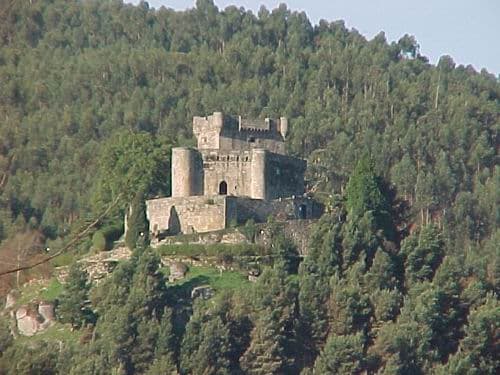
Sobroso Castle
Sobroso Castle stands as a remarkable example of a late medieval hill castle strategically perched atop the hill of Landín in Villasobroso, Galicia, Spain. Known historically as "the key of the Kingdom of Galicia," this fortress commands sweeping views over the surrounding valley and more than fifty villages extending toward the Portuguese border. Its name derives from the Latin SUBEROSUM, referring to the cork oak trees (Quercus suber) that once densely populated the area, underscoring the close relationship between the castle and its natural environment.
The earliest documented reference to Sobroso Castle dates back to 1096, although archaeological evidence indicates that the site was occupied since pre-Roman times as a fortified settlement or castro. The current structure primarily reflects construction phases from the 14th and 15th centuries, showcasing a complex layout with two main enclosures: an irregular outer curtain wall accessed via a drawbridge and a rectangular inner ward featuring the imposing keep on its most vulnerable side.
Historical significance and medieval conflicts
Sobroso Castle played a pivotal role during the Reconquista and subsequent regional power struggles in Galicia. Its strategic location made it a coveted stronghold for Christian forces aiming to consolidate control over the territory. The fortress is linked to several notable historical figures and events, including King Bermudo II of León, who sought refuge there during the Battle of Portela Arenaria in 983, and Queen Urraca I, who famously escaped a siege in 1117 through a secret passage during a blockade imposed by her son Alfonso VII and sister Teresa of León.
The castle's political importance is further emphasized by the coronation of Alfonso VII within its walls. During the late 11th and 12th centuries, Sobroso became closely associated with the church when Queen Urraca and Raimundo de Borgoña granted it to the Bishopric of Tuy in 1095. Documentation from 1170 records Villasobroso under the name "Villa San Martini de Portela Subcastelo de Suveroso," highlighting its ecclesiastical and royal significance. Ownership ties to the Sobroso family, relatives of King Alfonso IX, further cemented its noble connections.
In the turbulent 15th century, Sobroso Castle was embroiled in the Irmandiña Revolts (1467-1469), a popular uprising against feudal lords in Galicia. The fortress suffered considerable damage but was subsequently rebuilt by the nobleman Pedro Madruga (Pedro Álvarez de Soutomaior). His captivity in the late 1470s resulted in the castle's loss, and despite royal orders by the Catholic Monarchs to demolish it in 1481 and 1486, these directives were never executed. The castle continued under the ownership of noble families such as the Sarmiento and Soutomaior houses.
By the 17th century, the castle's military relevance waned, leading to gradual abandonment and ruin. Nevertheless, its aristocratic legacy persisted, exemplified by King Philip IV granting the title of Marquisate of Sobroso to García Sarmiento de Luna y Sotomayor in 1625.
Architectural features and layout
Overall structure and defensive elements
The castle occupies approximately 360 square meters on a naturally defensible hilltop, its layout adapting to the terrain with an irregular polygonal shape. The complex is divided into three main sections: the outer curtain wall, the residential quarters, and the keep (tower of homage). The outer wall features an oval northern section reflecting the original medieval design, while other parts display polygonal forms characteristic of 15th-century reconstruction efforts.
Defensive components include remnants of circular towers integrated into the curtain wall, a steep talus base reinforcing vulnerable areas, and a drawbridge providing controlled access. The curtain wall is punctuated by loopholes and battlements designed for archers and early firearms, enhancing the fortress's defensive capabilities.
The keep and residential areas
The keep rises approximately 13 meters with walls 1.5 meters thick, situated on the western side adjoining the polygonal residential building. It features a projecting parapet supported by stepped conical corbels and cylindrical turrets at each corner, crowned with crenellations atop a blind parapet wall. The tower contains medieval latrines at its base, a design element influenced by Castilian fortifications, and is adorned with mason's marks and coats of arms linked to the Sarmiento and Valladares families.
The residential section comprises two floors: the lower housed the guardhouse with defensive loopholes, and the upper floor contained the noble hall, kitchen with an original fireplace, and a bedroom decorated to celebrate the region's historic linen industry. An internal staircase leads to a chemin de ronde or wall walk along the enclosure walls, interrupted by additional loopholes. The northeast corner's wide and steep wall walk is supported by stone corbels, allowing defenders to patrol under cover.
Chapel and courtyard features
Within the northern courtyard lies a Romanesque chapel with a rectangular floor plan, providing a spiritual space consistent with the castle's medieval origins. The main entrance is adorned with a shield bearing the emblem of the Galician kingdom, symbolizing the fortress's historical alliances and status.
Restoration and current use
After centuries of decline, Sobroso Castle was rescued from ruin largely thanks to the dedication of Alejo Carrera Muñoz, a local journalist and the first mayor-pedáneo of Villasobroso. Beginning in 1923, Carrera Muñoz undertook extensive restoration efforts single-handedly, preserving the castle's medieval character until his death in 1967. In 1981, the municipality of Ponteareas acquired the castle and initiated further restoration work from 1995 onward, ensuring the fortress's preservation.
Today, Sobroso Castle is well preserved and functions as a cultural center and museum dedicated to the ethnography and traditional crafts of the region. Exhibits include tools and displays related to the historic linen industry, such as a fulling mill (batán), reflecting the castle's role in connecting medieval heritage with local artisanal traditions. The surrounding landscape remains rich with native flora, including oaks and cork oaks, enhancing the site's historical ambiance.
Recognized as a National Monument since 1949 and listed as a Bien de Interés Cultural by the regional government in 2013, Sobroso Castle continues to attract visitors interested in medieval architecture, Galician history, and cultural heritage.
Frequently asked questions (FAQ)
- How do I visit Sobroso Castle?
- Sobroso Castle is open to visitors, with access typically available during daytime hours. It is advisable to check the local municipality's website or contact the cultural center for current opening times and any guided tour options.
- What is the historical significance of Sobroso Castle?
- Sobroso Castle played a key role in the medieval history of Galicia, serving as a strategic fortress during the Reconquista and regional conflicts. It was associated with notable figures such as King Bermudo II and Queen Urraca I, and witnessed significant events including the Irmandiña Revolts.
- Can I explore the architectural features of Sobroso Castle?
- Yes, visitors can explore the well-preserved keep, curtain walls, residential quarters, and the Romanesque chapel. The castle's defensive structures, including battlements, loopholes, and the drawbridge, provide insight into medieval military architecture.
- Is Sobroso Castle accessible for people with mobility issues?
- Due to its hilltop location and historic structure, Sobroso Castle may present challenges for visitors with mobility impairments. Some areas involve uneven terrain and stairs, so it is recommended to inquire in advance about accessibility accommodations.
- When is the best time to visit Sobroso Castle?
- The castle is best visited during the spring and summer months when the weather is favorable for exploring the hilltop site and enjoying panoramic views of the surrounding landscape.
- Are there any nearby attractions to visit along with Sobroso Castle?
- Nearby attractions include the town of Mondariz and the municipality of Ponteareas, both offering cultural sites, natural parks, and traditional Galician cuisine. Visitors often combine a castle visit with exploring the scenic countryside of Galicia.
- What are the ticket prices for Sobroso Castle?
- Ticket prices vary depending on exhibitions and events. It is recommended to check with the local cultural center or municipality for the most current admission fees.
Photo gallery

Information
Sources & official resources
Verify the information above using these authoritative references.
Loading map...
Visitor reviews
No reviews yet. Been here? Write the first review and help other travelers!
Write the first reviewVisited this castle? Share your experience
Your review helps other travelers and adds first-hand knowledge to our encyclopedia.


