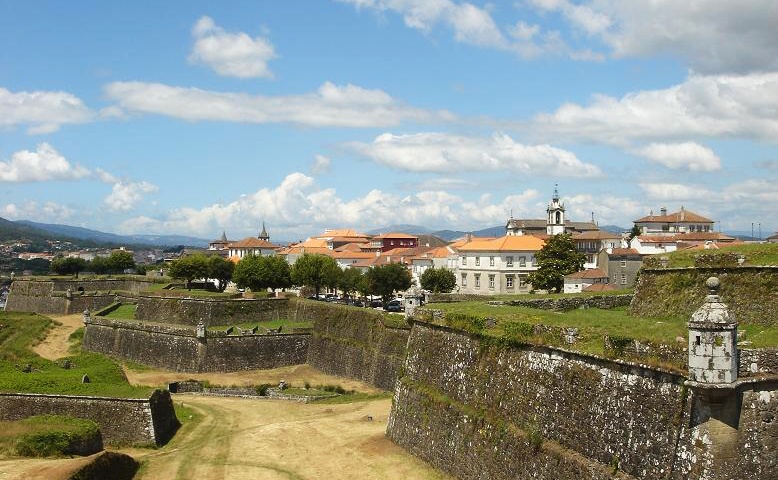
Monção Castle
Monção Castle, located in the northern Portuguese town of Monção, is a significant late-medieval fortress originally constructed in 1306 under the reign of King Denis of Portugal. This castle played an important role in the defense of the Portuguese border during the Middle Ages and later underwent substantial modifications in the 17th century to adapt to evolving military technologies.
Medieval origins and early architecture
The initial construction of Monção Castle was part of King Denis's broader efforts to fortify the northern frontier against Castilian incursions. The castle was strategically positioned to control access along the Minho River valley, a natural border between Portugal and Spain. The original medieval structure was characterized by robust defensive walls, a keep with Gothic architectural elements, and fortified gates including the main entrance and a smaller treachery door.
Today, remnants of the original castle are limited but notable. The surviving elements include two main doors, portions of the medieval curtain walls, and the Torre de Lapela, a tower that prominently displays the coat of arms of King Ferdinand I. The main gate, defended by the keep, exemplifies Gothic military architecture with its pointed arches and defensive design. The smaller treachery door served as a secondary point of access or escape route, typical of medieval fortifications.
17th-century expansion and bastioned fortifications
In 1656, during the period of the Portuguese Restoration War, Monção Castle was significantly enlarged and modernized to withstand artillery attacks. This phase introduced a bastioned fortress layout, reflecting the military architectural advances of the 17th century. The additions included new defensive walls with angular bastions designed to deflect cannon fire and improve fields of fire for the garrison.
Key surviving elements from this period include the Porta de Salvaterra, a fortified gate that provided controlled access to the expanded fortress, and several bastions that remain standing today. These structures illustrate the transition from medieval to early modern fortification techniques, emphasizing angled walls and low, thick ramparts suited to gunpowder warfare.
Architectural features and defensive elements
The castle's architecture reflects a blend of Gothic medieval and 17th-century bastioned fortress styles. The original keep and gates show typical Gothic defensive features such as pointed arches, narrow windows for archers, and thick stone walls. The later bastioned additions incorporate sloped walls and angular bastions that allowed defenders to cover all approaches with overlapping fields of fire.
The Torre de Lapela stands out as a key medieval tower, notable for its heraldic decoration and strategic position overlooking the surrounding landscape. The surviving curtain walls and gates provide insight into the castle's layered defensive system, combining high walls with artillery-friendly bastions.
Historical significance and legacy
Monção Castle's strategic location made it a focal point in the defense of Portugal's northern border throughout the late medieval and early modern periods. Its construction under King Denis was part of a broader national policy to secure territorial integrity. The 17th-century enhancements reflect the castle's continued military importance during the turbulent period of Portuguese independence from Spain.
Although much of the original medieval structure has been lost, the remaining elements offer valuable insights into the evolution of military architecture in Portugal. The castle today stands as a partially preserved monument illustrating centuries of defensive design adaptations.
Visiting Monção Castle
Visitors to Monção can explore the castle ruins, including the surviving medieval gates and towers as well as the 17th-century bastioned walls. The site offers a tangible connection to Portugal's medieval past and its military history. The castle's location in the town of Monção also provides access to local cultural attractions and scenic views of the Minho River valley.
Loading map...
Visitor reviews
No reviews yet. Been here? Write the first review and help other travelers!
Write the first reviewVisited this castle? Share your experience
Your review helps other travelers and adds first-hand knowledge to our encyclopedia.