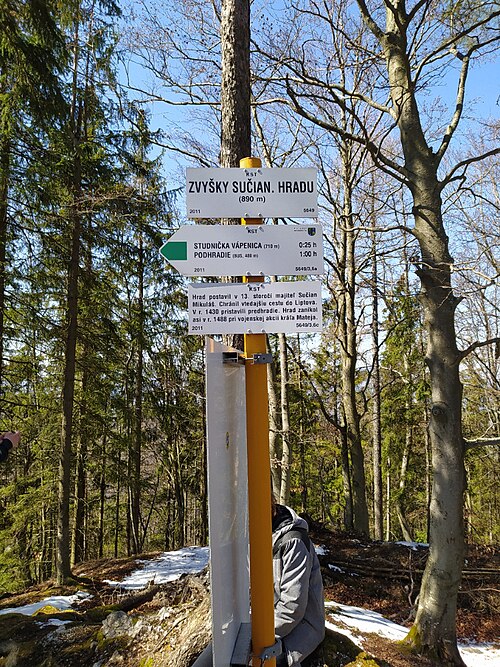
Sklabina Castle Ruins
Sklabina Castle ruins stand as a testament to the rich medieval heritage of Slovakia, located near the town of Martin in the Turiec region. Established in the 13th century, this hill castle was a significant stronghold and administrative center for the Turiec county throughout the High medieval and Renaissance periods. The castle's remains reveal a complex architectural evolution, reflecting its military, administrative, and residential functions over several centuries.
The foundation and early history of Sklabina Castle
The castle's origins trace back to the early 1200s, likely built on the site of an earlier fortified settlement. The first documented mention of the castle dates to 1242, with a more detailed record appearing in 1309 through a decree signed by the founder, the župan Donč. This early phase established Sklabina as a key regional fortress within the medieval Kingdom of Hungary.
By 1328, the castle had become the seat of the Turiec county administration, known locally as Turčianska stolica or župa. When Turiec was formally recognized as a distinct county in 1339, the castle's castellan also served as the county head, emphasizing its dual role as a military bastion and a center of local governance.
Architectural development and fortifications
Medieval fortifications and expansions
Sklabina Castle's layout was adapted to the natural terrain, featuring an irregular plan centered on an inner courtyard. The oldest section, called the upper castle, included residential buildings and utility structures surrounded by defensive walls. A water cistern was an essential feature, providing a reliable water supply during sieges.
Between 1460 and 1480, the castle underwent significant fortification enhancements, including the addition of a fortified outer bailey with a continuous ring wall. This expansion introduced two polygonal bastions on the northwest side, designed to improve defense against artillery and siege tactics. The main entrance was controlled by a wedge-shaped gate tower on the northern side, later supplemented by further defensive layers.
Renaissance additions and the manor house
In the early 17th century, the castle's military function was complemented by the construction of a Renaissance-style manor house, or kaštel, commissioned by Peter Révai between 1610 and 1612. This one-story residence, built within the outer bailey, featured a richly decorated entrance portal with inscriptions honoring its builders. The manor blended comfort and style with defensive elements, reflecting the architectural trends of the Renaissance period.
The castle also incorporated Renaissance architectural details such as window frames, entrance portals, and vault ribs, which enriched the aesthetic and functional qualities of the complex.
Historical significance and ownership
Throughout its history, Sklabina Castle was a focal point of regional power and administration. It changed hands among several prominent noble families, including the Balický family, Jan Hunyady, Matthias Corvinus, Jan Arnošt Budinský, Jan Zápolský, and the Révai family, who held it from the mid-16th century until the 20th century.
The castle endured a notable attack during the Hussite wars when it was burned in 1436, but it was subsequently repaired and expanded. After the Battle of Mohács in 1526, Emperor Ferdinand I granted half of the castle and its estates to František I Révai, who reunited the property by 1540, establishing a long period of stable ownership.
Serving as the Turiec county's administrative center until the mid-18th century, Sklabina housed county archives, a prison, and hosted county assemblies. The castle's administrative role diminished after the construction of a dedicated county house in Martin.
Decline, destruction, and preservation efforts
The Renaissance manor house remained in use until 1944 when it was destroyed by Wehrmacht troops during the Slovak National Uprising in World War II. This event marked the beginning of the castle's decline, with the ruins falling into disrepair over the following decades.
Since the late 20th century, conservation and archaeological efforts have been undertaken to stabilize the ruins and preserve the site's historical value. The local civic association Donjon took over management in 2000 and acquired ownership in 2020. Their work includes structural stabilization, archaeological research, and the establishment of a museum within a reconstructed economic building in the third bailey.
The castle grounds now host cultural events such as the annual Castle Feast, celebrating the site's history and engaging the local community. A nature trail through the castle area offers visitors a scenic experience of the historic landscape.
Architectural remains and notable features
Fortifications and bastions
The castle's defensive system comprised multiple polygonal bastions and artillery towers, some designed primarily for decoration but others serving strategic military functions. The second circle of walls included a southern bastion with battlements, providing elevated defensive positions.
The second outer bailey, added in the mid-16th century, was protected by an earthen embankment and a third wall, with a cylindrical bastion guarding the entrance road. A polygonal artillery bastion in the northwest section was later incorporated into the Renaissance manor house.
Religious and administrative structures
A chapel built in 1468 stands just outside the eastern walls of the upper castle, constructed on the site of a former 15th-century tower. Remnants include rib vaulting, decorative shafts, Gothic window frames, and plaster fragments, illustrating the castle's religious functions.
The southern section of the second wall circuit housed a large rectangular building adapted as the meeting place for county assemblies by the 1600s, highlighting the castle's civic importance.
Current condition and visitor experience
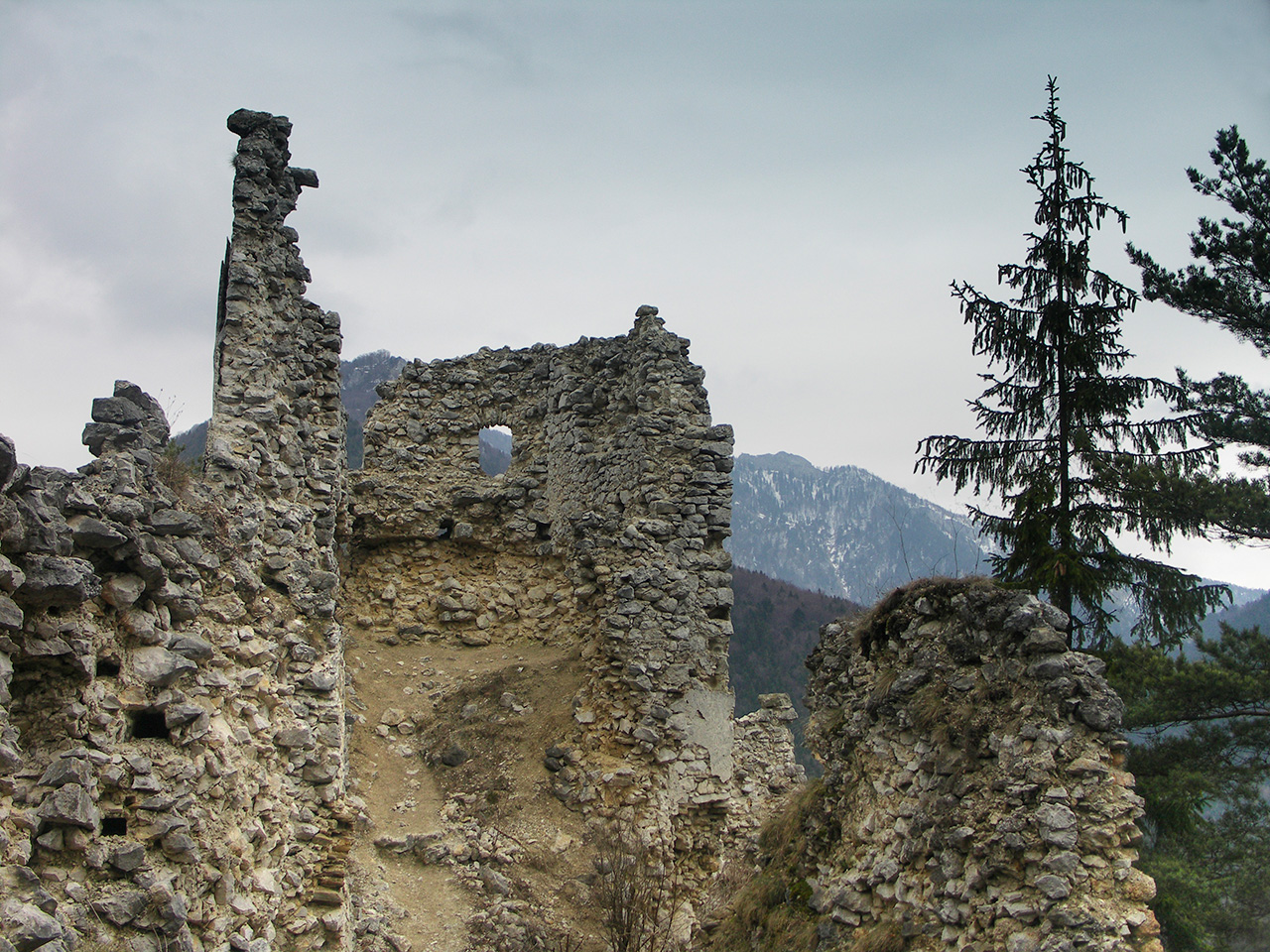
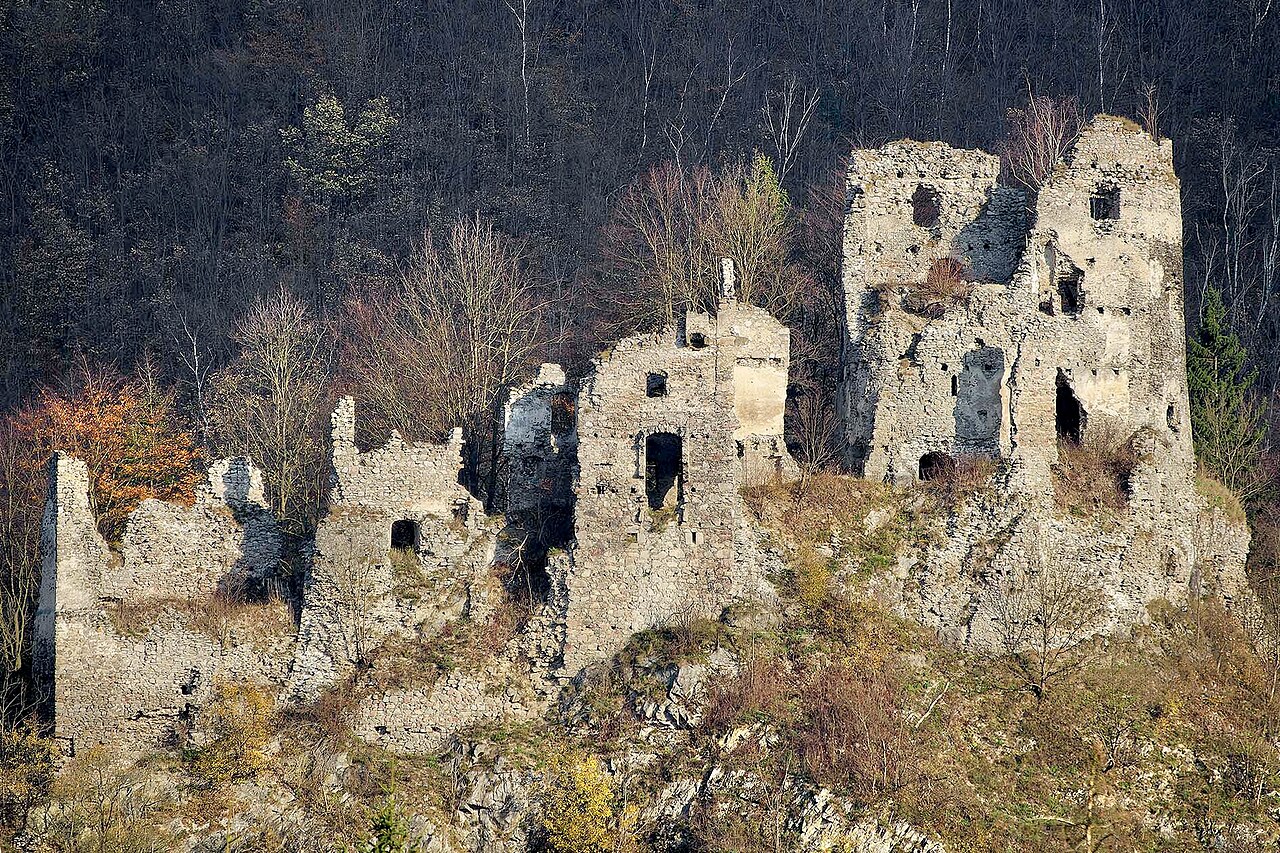
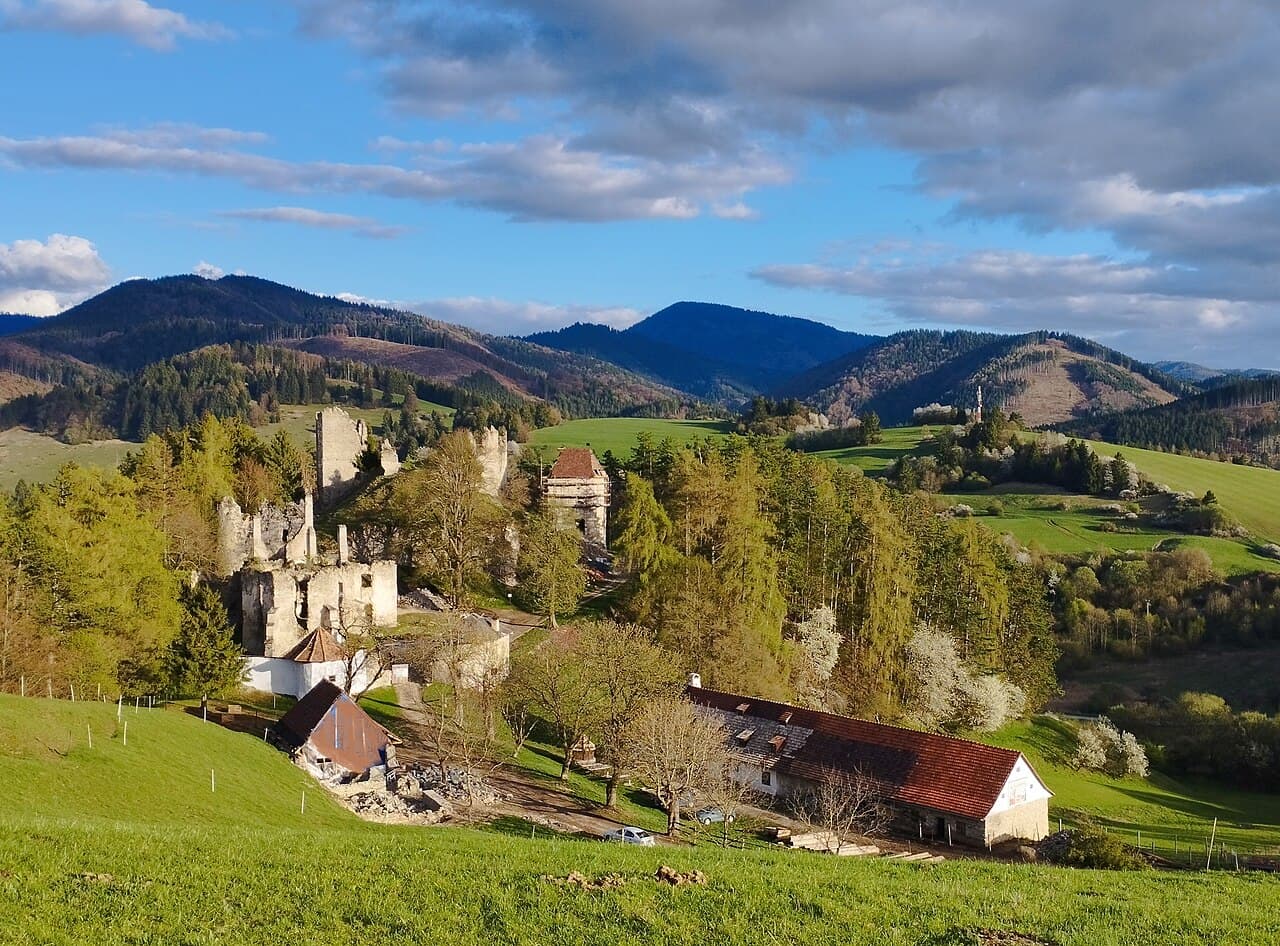
Today, visitors to Sklabina Castle can explore the ruins of the chapel, towers, palaces, economic buildings, fortification walls, bastions, and the Renaissance manor house. Some walls stand several meters tall, while others survive as ground traces, all stabilized through ongoing conservation efforts.
The reconstructed economic building now serves as a museum, providing educational exhibits on the castle's history and architecture. The site offers a blend of historical exploration and cultural engagement, making it a significant heritage destination in Slovakia.
Frequently asked questions (FAQ)
- How do I get to Sklabina Castle ruins from Martin?
- Sklabina Castle ruins are located near Martin, Slovakia, accessible by local roads and hiking trails. Visitors can drive or take public transport to the village of Sklabinský Podzámok, then follow marked paths to the castle site.
- What architectural styles are visible at Sklabina Castle?
- The castle features a blend of <strong>Gothic</strong> and <strong>Renaissance architectural elements</strong>. Visitors can observe Gothic rib vaulting and window frames, alongside Renaissance portals and vault ribs in the manor house.
- When was the Renaissance manor house built at Sklabina Castle?
- The Renaissance manor house, or kaštel, was constructed between 1610 and 1612 under the direction of Peter Révai, reflecting the architectural transition from medieval fortress to residential elegance.
- Is Sklabina Castle open to visitors year-round?
- The castle ruins are generally open to visitors throughout the year, though access may vary seasonally due to weather or conservation work. It is advisable to check local resources or the managing association Donjon for current visiting hours.
- What events are held at Sklabina Castle today?
- The Donjon association organizes cultural events such as the annual Castle Feast, which celebrates the historical significance of Sklabina Castle with reenactments, music, and community activities.
Photo gallery

Information
Sources & official resources
Verify the information above using these authoritative references.
Loading map...
Visitor reviews
No reviews yet. Been here? Write the first review and help other travelers!
Write the first reviewVisited this castle? Share your experience
Your review helps other travelers and adds first-hand knowledge to our encyclopedia.