Skipton Castle
Skipton Castle stands as a remarkable testament to medieval fortification and aristocratic residence, located in the historic market town of Skipton, England. Originally constructed in 1090 by the Norman baron Robert de Romille, this hill castle has endured for over nine centuries, maintaining much of its original structure and charm. Its strategic position atop a natural hillside overlooking the Eller Beck valley provided a formidable defensive advantage, enhanced by natural cliffs on one side.
The castle's origins lie in the High Medieval period, beginning as a classic motte and bailey design primarily of earth and timber. Over time, these wooden defenses were replaced with robust stone curtain walls and round drum towers, establishing the castle as a powerful stronghold in northern England. The transition from timber to stone reflects the evolving military architecture of the period, aimed at withstanding increasingly sophisticated siege tactics.
Early construction and the romille legacy
The initial construction by Robert de Romille was part of the Norman strategy to secure control over the newly conquered territories in England, particularly to defend against frequent Scottish incursions. The castle's early form included a motte—a raised earthwork mound—and an enclosed bailey that housed essential domestic and military buildings.
Following the extinction of the Romille family line, the castle was granted by King Edward II in 1310 to Robert Clifford, 1st Lord Clifford of Skipton. The Clifford family would become synonymous with Skipton Castle, undertaking significant fortifications and expansions that cemented the castle's role as a major aristocratic residence and military base.
The clifford family and medieval prominence
The Cliffords were a powerful noble family deeply involved in England's medieval conflicts. They participated in key battles such as Bannockburn (1314), Crécy (1346), Agincourt (1415), and the Wars of the Roses. The castle served as their principal seat, reflecting their status and influence.
George Clifford, 3rd Earl of Cumberland, was a particularly notable figure who served as Queen Elizabeth I's Champion. His military exploits included defending England against the Spanish Armada and ransoming the Spanish-held territory of Puerto Rico. The Clifford family motto, Desormais (Henceforth), remains emblazoned above the castle's imposing gatehouse, symbolizing their enduring legacy.
Architecture and defensive features
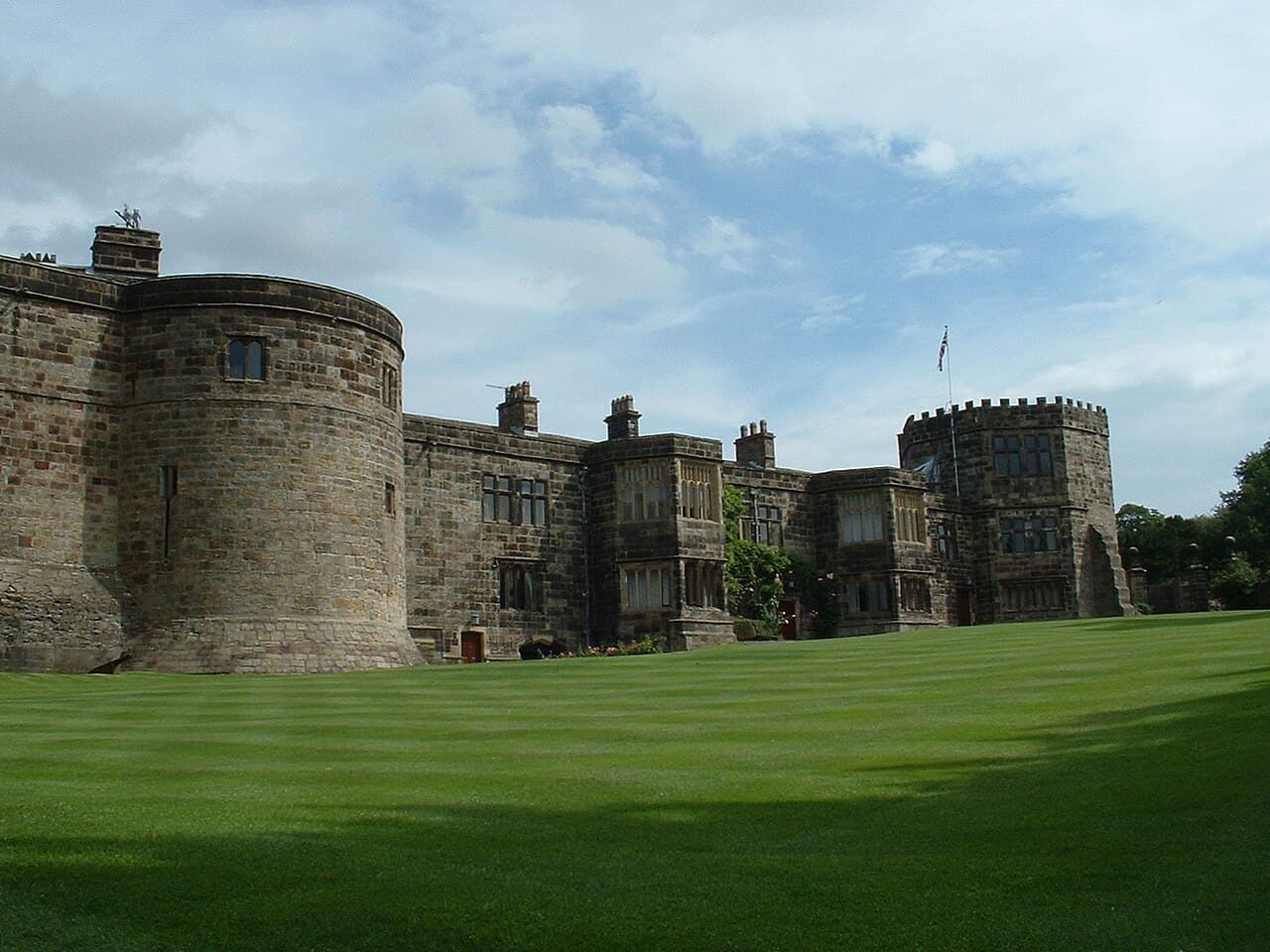
Skipton Castle's architecture is distinguished by its six round drum towers, connected by thick curtain walls enclosing the inner wards and domestic ranges. The Norman twin-towered gatehouse is a highlight, featuring battlements, a portcullis, and an inscription commemorating the mid-17th-century restoration.
Inside the gatehouse's east tower lies a rare 17th-century shell grotto decorated in the Renaissance style, one of only two such grottos surviving in England. The central courtyard, known as Conduit Court, was remodeled during the Tudor period and includes the castle's only water conduit and a venerable yew tree planted by Lady Anne Clifford in 1659, which still thrives today.
The castle's interior boasts a banquet hall, a kitchen used continuously for over 350 years starting around 1300, private withdrawing rooms, and a day chamber adorned with fragments of 17th-century wallpaper. Defensive features include a ground-floor combat chamber with protected positions for longbowmen and a dungeon accessed by a steep staircase, equipped with iron rings for prisoners but showing no evidence of torture.
Role in the english civil war and restoration
During the English Civil War, Skipton Castle was the last Royalist stronghold in northern England. It endured a prolonged siege lasting three years, finally surrendering in 1645. Following the surrender, Oliver Cromwell ordered the castle's roofs removed and the walls thinned to prevent its future use as a military fortress.
Subsequently, Lady Anne Clifford, daughter of George Clifford, undertook the castle's restoration between 1657 and 1658. Her work preserved much of the castle's medieval character while adapting it for peaceful residential use. She also planted the famous yew tree in Conduit Court, which has become a living symbol of her legacy.
The restoration included replacing the roofs with oak timber structures that were deliberately made incapable of supporting heavy artillery, complying with post-war restrictions. The castle's water supply, which had been cut during the siege, was restored with the construction of a well that remains on the grounds.
Chapel and archaeological remains
Within the castle grounds lie the ruins of a 12th-century chapel dedicated to St John the Evangelist, originally built for the Clifford family. By the 17th century, the chapel had fallen into disuse and ruin, but its ancient baptismal font still survives.
Archaeological excavations have uncovered 13th-century silver coins and fragments of 17th-century wallpaper, providing valuable insight into the castle's long and varied history. These finds enrich our understanding of the castle's domestic life and the material culture of its inhabitants.
Visitor experience and cultural significance
Today, Skipton Castle is a well-preserved medieval castle that serves as both a tourist attraction and a private residence. Visitors can explore the castle's imposing gatehouse, banquet hall, kitchen, and courtyard, as well as the unique shell grotto. The castle hosts historical reenactments where guests can witness medieval life, including knights, armor, and mock battles. These events often encourage visitor participation, including dressing in period costumes.
The castle grounds are ideal for picnics and leisurely exploration, offering a rich educational experience about medieval architecture, the Clifford family's history, and England's turbulent past. The enduring presence of Lady Anne Clifford's yew tree adds a living connection to the castle's restoration and heritage.
Frequently asked questions (FAQ)
- How do I get to Skipton Castle?
- Skipton Castle is located in the heart of Skipton, United Kingdom. You can reach it by car, with nearby parking available, or by public transport as the Skipton train station is a short walk away. Several local bus services also connect to the area, making it accessible for visitors.
- What is the historical significance of Skipton Castle?
- Skipton Castle is one of the best-preserved medieval castles in England, dating back to the 11th century. It played a crucial role during the English Civil War and has been a residence of the Clifford family for centuries. The castle's rich history provides insight into the feudal system and local governance during medieval times.
- When was Skipton Castle built?
- Skipton Castle was founded in 1090 by the Norman lord, Robert de Romille. Over the centuries, it has undergone various modifications and expansions, reflecting the architectural styles of different periods. Today, it stands as a testament to medieval military architecture and the evolution of castle design.
- Can I take guided tours of Skipton Castle?
- Yes, guided tours are available at Skipton Castle, providing visitors with an in-depth understanding of its history and architecture. Knowledgeable guides share fascinating stories and details about the castle's past. Audio guides are also available for those who prefer to explore at their own pace.
- Why is Skipton Castle a popular tourist attraction?
- Skipton Castle is popular due to its impressive architecture, well-preserved structures, and rich historical significance. Visitors are drawn to its scenic location, beautiful gardens, and the chance to explore its extensive grounds. It offers a unique glimpse into England's medieval history, making it an ideal destination for history enthusiasts and families alike.
- Is it possible to visit Skipton Castle year-round?
- Yes, Skipton Castle is open to visitors throughout the year, although opening hours may vary by season. It’s best to check the official website for the most current information on hours and any seasonal events. Visiting in different seasons can offer unique experiences of the castle and its surroundings.
- What are the ticket prices for Skipton Castle?
- Ticket prices for Skipton Castle vary based on age and group size, with discounts available for seniors and children. Family tickets are also offered for those visiting with children. It's advisable to purchase tickets in advance online to avoid long queues and ensure entry during peak seasons.
- What are the opening hours of Skipton Castle?
- Skipton Castle typically opens from 10 AM to 5 PM, with extended hours during the summer months. It is closed on certain holidays, so checking the schedule on the official website is recommended before planning your visit. Early arrivals are encouraged to fully enjoy the castle and its grounds.
- Are there any nearby attractions to visit after Skipton Castle?
- Yes, after visiting Skipton Castle, you can explore the picturesque town of Skipton, famous for its market and charming high street. Nearby attractions include the Leeds and Liverpool Canal, and the stunning Yorkshire Dales National Park, ideal for hiking and scenic views. These options provide a perfect complement to your castle visit.
Photo gallery

Information
Website
Visit websiteSources & official resources
Verify the information above using these authoritative references.
Loading map...
Visitor reviews
No reviews yet. Been here? Write the first review and help other travelers!
Write the first reviewVisited this castle? Share your experience
Your review helps other travelers and adds first-hand knowledge to our encyclopedia.