Skipsea Castle
Skipsea Castle is a significant example of a Norman motte and bailey castle located near the village of Skipsea in the East Riding of Yorkshire, England. Constructed around 1086 by the Flemish mercenary Drogo de la Beuvrière, the castle was strategically positioned to secure Norman control over the newly conquered region following the Norman Conquest of England. It also served to defend against potential Danish incursions and to monitor an important trade route connecting inland Yorkshire to the North Sea. The castle’s location atop an ancient mound—originally an Iron Age burial site dating back to around 400 BCE—demonstrates the Norman practice of utilizing pre-existing earthworks for defensive purposes.
Historical context and early development
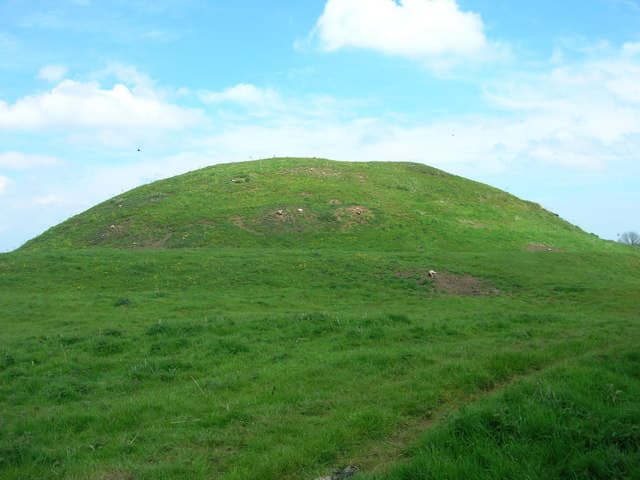
The castle was established in the aftermath of the Harrying of the North, a brutal campaign led by William the Conqueror to subdue northern England. Its construction on a prominent natural and modified mound provided a commanding view of the surrounding landscape, enhancing its defensive capability. The motte, standing approximately 11 metres high and about 100 metres across, supported a wooden keep at its summit, while a possible stone gatehouse may have fortified the south-east corner of the motte, although timber was the primary building material used throughout the castle.
Surrounding the motte was an artificial lake known as Skipsea Mere, created by damming marshland. This water feature separated the motte from the bailey, an enclosed courtyard extending around the west and south sides of the motte. The bailey covered approximately 3.3 hectares (8.25 acres) and was protected by substantial clay ramparts reaching up to 4 metres in height and a wide ditch about 10 metres across. The main entrance to the bailey was through a southern gate called Bail Gate, secured by a gatehouse, while a secondary northern entrance connected the bailey to other parts of the site.
Strategic and economic importance
Skipsea Castle’s position was key to controlling a trade route leading to the North Sea. The artificial lake and an associated curved water channel about 25 by 200 metres linked the inland harbour formed by the mere to the sea, allowing boats to access wharves inside the bailey. A likely boatyard was situated at the eastern end of this channel. Historical records from the 13th century mention eel-catching in a section of the mere, which was isolated by causeways and probably functioned as a freshwater fishery.
In the late 11th century, a church was established east of the castle across the mere, around which the village of Skipsea grew. By the mid-12th century, William le Gros, a prominent noble, founded the fortified settlement of Skipsea Brough nearby to promote trade and strengthen regional defense.
Ownership changes and military events
During the early 12th century, the castle passed to the Aumale family. In 1221, William de Forz, Count of Aumale, rebelled against King Henry III. Royal forces besieged and captured Skipsea Castle, after which the king ordered its destruction. While the exact extent of the demolition is unclear, a breach known as Scotch Gap in the earthworks likely dates from this event. The castle changed ownership multiple times in the following centuries but gradually lost its military significance.
Decline and abandonment
By the late 14th century, Skipsea Castle had fallen into disuse. The artificial lake was drained, and the grounds were converted for agricultural use. The adjacent fortified town of Skipsea Brough also declined and was largely deserted. Further land drainage in the 18th century reclaimed more territory, although the area remained marshy into the early 20th century.
Archaeological investigations and preservation
The site came under state protection in 1911 and is currently managed by English Heritage. Extensive archaeological excavations between 1987 and 2001 revealed detailed insights into the castle’s construction, layout, and historical phases. These investigations confirmed the castle’s motte and bailey design, the scale of its earthworks, and its sophisticated water management system integrating the mere and navigable channels.
Today, the earthworks remain well preserved, although ongoing environmental changes caused by modern land drainage and drying pose challenges to conservation. The remains of the nearby medieval town of Skipsea Brough survive only as a few buildings and earthworks. Skipsea Castle stands as an important example of Norman military architecture combined with innovative landscape engineering to control waterways and support trade.
Architectural features and defensive structures
The castle’s motte is a large natural mound enhanced by human modification, measuring roughly 11 metres in height with a summit area of about a quarter of an acre. The motte was surrounded by a ditch up to 10 metres wide and a low bank approximately 1.5 metres tall, which reinforced its defenses. The bailey’s clay ramparts, up to 4 metres high, and accompanying ditch provided formidable protection for the enclosed courtyard.
Two raised causeways cross Skipsea Mere, connecting the motte to the bailey and to the church and village. These causeways also isolated a section of the mere used as a fishery. The curved water channel along the southwest edge of the motte connected the mere to the North Sea, facilitating boat access to the bailey’s wharves and likely a boatyard.
Legacy and visitor experience
Visitors to Skipsea Castle today can explore the extensive earthworks and appreciate the scale of the Norman fortification. The site’s integration with the surrounding landscape, particularly the artificial mere and water channels, reflects the strategic and economic considerations of medieval castle builders. Interpretive signage and archaeological findings enhance understanding of the castle’s history and function.
Skipsea Castle’s story illustrates the Norman approach to consolidating power through military architecture combined with control of trade routes and local resources. Its preservation offers valuable insights into medieval defensive design and landscape management in the East Riding of Yorkshire.
Frequently asked questions (FAQ)
- How do I get to Skipsea Castle?
- Skipsea Castle is located near the village of Skipsea in East Riding of Yorkshire, England. It is accessible by local roads, with parking available nearby. The site is open to visitors managed by English Heritage.
- What is the historical significance of Skipsea Castle?
- Skipsea Castle was built shortly after the Norman Conquest to secure control over the region and protect trade routes to the North Sea. It also played a role in regional defense against potential Danish raids and was an administrative centre for the Norman lords.
- When was Skipsea Castle built?
- The castle was constructed around 1086 by Drogo de la Beuvrière, a Flemish mercenary and the first Lord of Holderness, during the Norman period in England.
- Can I visit the remains of Skipsea Castle?
- Yes, Skipsea Castle is open to the public and managed by English Heritage. Visitors can explore the well-preserved earthworks and learn about the castle’s history through onsite information panels.
- Why is Skipsea Castle important architecturally?
- Skipsea Castle is a classic example of a Norman motte and bailey castle, featuring a large motte built on an Iron Age mound, extensive earthworks, and an innovative water management system including an artificial lake and navigable channels.
Photo gallery

Information
Sources & official resources
Verify the information above using these authoritative references.
Loading map...
Visitor reviews
No reviews yet. Been here? Write the first review and help other travelers!
Write the first reviewVisited this castle? Share your experience
Your review helps other travelers and adds first-hand knowledge to our encyclopedia.