Scarborough Castle
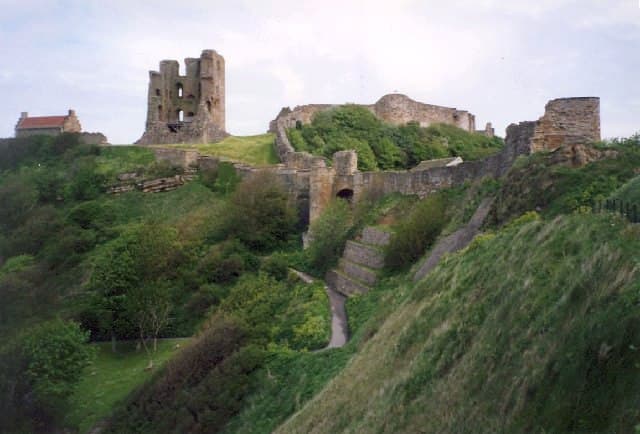
Scarborough Castle stands prominently on a rocky promontory overlooking the North Sea in the town of Scarborough, North Yorkshire, England. This hill castle occupies a strategic natural headland with steep cliffs rising about 91 meters on three sides, connected to the mainland by a narrow isthmus. Its commanding position has made it a vital defensive site from ancient times through to the modern era.
The site’s earliest known human activity dates back to the Iron Age (900–500 BC), when a hill fort was established here. This early fortification exploited the natural defensive advantages of the headland. During the Roman period in the 4th century AD, a signal station was constructed on the site, underscoring its continued strategic importance for coastal surveillance and communication along the northeastern English coast.
By around 1000 AD, the promontory supported an Anglo-Scandinavian settlement, including a chapel, indicating sustained occupation through the early medieval period. This settlement laid the groundwork for the later medieval fortress.
Medieval origins and royal fortification
The transformation of Scarborough into a significant medieval fortress began in the 12th century. William le Gros, Count of Aumale, constructed the first timber castle fortifications in the 1130s after receiving the Earldom of York in 1138. These initial wooden defenses marked the beginning of Scarborough’s role as a defensive stronghold.
Between 1157 and 1169, under the reign of King Henry II, the timber structures were replaced by a substantial stone castle. This phase of construction established the core of the castle’s defensive walls, curtain walls, and the imposing keep (donjon). Henry II’s investment reflected the castle’s importance in guarding England’s northern coast against potential invasions and asserting royal authority.
Subsequent monarchs enhanced Scarborough Castle’s defenses and facilities. King John (1199–1216) reinforced the castle with new curtain walls on the west and south sides and built a large hall known as the King’s Chambers or Mosdale Hall. This hall became a key residential and administrative space within the castle. King John’s expenditures on Scarborough were the largest royal outlay recorded for the site, emphasizing its strategic and symbolic value.
Henry III added a barbican to the castle’s main entrance, completed by 1343. This fortified gateway featured two half-circular towers and replaced earlier defensive structures, enhancing the castle’s protection against siege warfare.
Military history and sieges
Scarborough Castle played an active role in England’s turbulent medieval and early modern history. It endured a notable siege in 1312 during baronial opposition to King Edward II linked to his favorite, Piers Gaveston. The castle also faced attacks during the Hundred Years War, highlighting its ongoing military significance.
During the Tudor era, the castle withstood an unsuccessful siege in 1536 amid the Pilgrimage of Grace, a widespread northern uprising against King Henry VIII’s religious and political reforms. Later, in the English Civil War (1642–1648), Scarborough Castle was fiercely contested, changing hands seven times and enduring a prolonged siege lasting five months in 1645. This period inflicted significant damage on the castle’s structures.
In the 18th century, the castle regained military importance during the Jacobite Rebellion of 1745. Gun batteries were installed, and barracks were built to house a permanent garrison of 120 soldiers. The castle also served as a detention center for French prisoners during late 18th-century conflicts.
In the 20th century, Scarborough Castle suffered damage from German naval artillery during World War I, which destroyed key buildings such as the barracks and damaged the keep and curtain walls. During World War II, it was used as a covert listening post, reflecting its ongoing strategic utility.
Architectural features and layout
Defensive walls and barbican
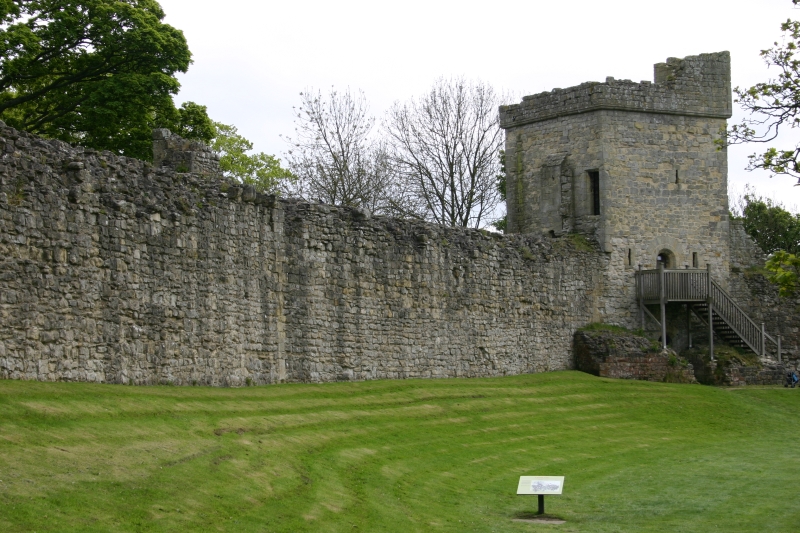
The castle’s large curtain wall dates from the late 12th to early 13th century, extending approximately 210 meters. It is reinforced by twelve round towers spaced at intervals, designed to provide overlapping fields of fire and strong defensive coverage. However, the wall does not fully enclose the interior buildings, a somewhat unusual feature for castles of this period.
The main landward approach is guarded by a 14th-century barbican situated on raised ground. This fortified gateway comprises two half-circular towers and replaced earlier defenses. The barbican stands near the site of an 11th-century Anglo-Saxon chapel and the remains of the Roman signal station, linking layers of historical occupation.
Gateways and baileys
A stone bridge built between 1337 and 1338 connects the main gate to the castle’s baileys, replacing two earlier drawbridges. The castle has an unusual layout where the inner bailey is accessed before the outer bailey, which is separated by a stone wall, ditch, and bank with two defended gateways.
The outer bailey historically contained spaces for gatherings, vegetable gardens, animal enclosures, a graveyard, and the former St Mary’s Chapel. Only fragments of these survive today, while the remains of the older Anglo-Saxon chapel lie on the site of the Roman signal station.
The keep and inner bailey structures
At the heart of the inner bailey stands the castle’s 12th-century keep, a square, four-storey structure originally over 30 meters tall, now 26 meters in height due to damage. The keep’s walls are exceptionally thick, between 3.3 and 5 meters, with the western wall being the strongest to face anticipated attacks. The keep is missing its west wall, roof, and interior floors, losses attributed to bombardments in the 17th century.
Surviving features of the keep include several windows—some blocked—rounded decorative moldings at the corners, and traces of a hearth on the first floor where the Great Hall once stood. The upper floors were divided into chambers for important guests and the castle governor, while the basement served as storage.
Late 20th-century electrical resistivity surveys revealed outlines of additional 12th-century buildings within the inner bailey, indicating a once more extensive complex than visible today.
Outer bailey buildings and residential towers
The outer bailey contains foundations of a large 12th-century building approximately 30 meters long, which accommodated royal visitors. This building included a main hall, private chamber with fireplace, and rooms for food preparation and storage. It was demolished before 1538 but excavated in 1888.
The King’s Chambers or Mosdale Hall, built in the 13th century and upgraded after 1397, was converted into red brick barracks in the 18th century. It sustained heavy damage during the German bombardment of 1914, with only red brick remains visible from South Bay.
The Queen’s Tower, a 13th-century residential tower built into the curtain wall, was enhanced over time with large windows, a porch, and private latrines. After 1320, windows overlooking the bay were added, though some were later blocked or modified.
Water supply and ancillary structures
A vital feature of the castle is its 150-foot (46 meters) deep well, which ensured water supply during sieges. The Master Gunner’s House, built in 1748, served as living quarters until the early 20th century and now functions as the visitor exhibition space.
Heritage status and visitor experience
Today, Scarborough Castle is a scheduled monument preserving its extensive archaeological remains. Visitors can explore the surviving battlements and viewing platforms, gaining panoramic views of the coastline and town. The visitor center displays artifacts recovered from the site and surrounding area, including a Bronze Age sword found in 1980, which connects the castle’s heritage back to ancient times.
The castle’s layered history, from Iron Age fortifications through Roman, Anglo-Scandinavian, medieval, Tudor, and modern military uses, makes it a significant cultural landmark in North Yorkshire. Its impressive ruins and commanding location continue to attract visitors interested in England’s rich past and castle architecture.
Frequently asked questions (FAQ)
- How do I get to Scarborough Castle?
- Scarborough Castle is located on a rocky headland in Scarborough, North Yorkshire. It is accessible by foot from the town center, with clear signposting and parking available nearby.
- What are the opening hours of Scarborough Castle?
- The castle is open daily from 10:00 to 17:00. Hours may vary seasonally, so it is advisable to check the official website before visiting.
- Is there an admission fee to visit Scarborough Castle?
- Yes, admission fees apply. Tickets cost £8.50 for adults and £5.10 for children. English Heritage members may have free entry.
- What can I see at Scarborough Castle?
- Visitors can explore the castle’s extensive ruins, including the keep, curtain walls, barbican, and residential towers. The visitor center offers exhibits with artifacts and historical information.
- Is Scarborough Castle suitable for families?
- Yes, the castle is family-friendly with accessible paths and educational displays. Children often enjoy exploring the battlements and learning about medieval history.
- When is the best time to visit Scarborough Castle?
- Spring and summer months offer the best weather for visiting, with longer daylight hours and vibrant coastal views. Early autumn can also be pleasant and less crowded.
Photo gallery

Information
Opening hours
10:00-17:00, daily
Ticket prices
£8.50 adult, £5.10 child
Current owner
English Heritage
Website
Visit websiteSources & official resources
Verify the information above using these authoritative references.
Loading map...
Visitor reviews
No reviews yet. Been here? Write the first review and help other travelers!
Write the first reviewVisited this castle? Share your experience
Your review helps other travelers and adds first-hand knowledge to our encyclopedia.