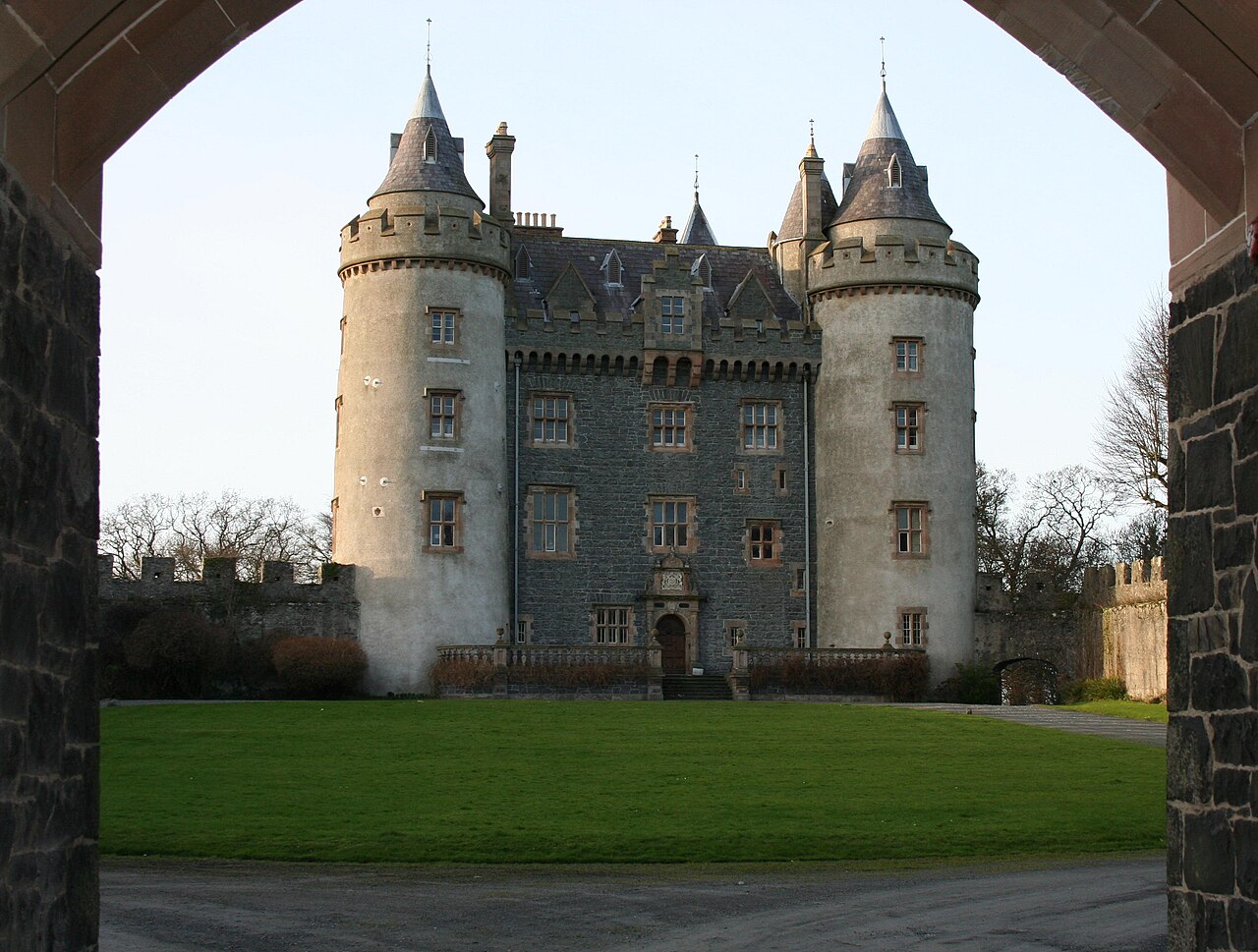
Sketrick Castle
Sketrick Castle is a significant late medieval tower house situated on Sketrick Island in Strangford Lough, southeast of Comber in County Down, Northern Ireland. This castle is a remarkable example of Anglo-Norman military architecture that played a crucial role in the turbulent history of the region during the 15th and 16th centuries.
Although local tradition attributes the castle's construction to the Vikings, historical evidence strongly supports an Anglo-Norman origin, likely dating from the late 12th century. The castle's first recorded mention appears in the Annals of the Four Masters, which describe its capture in 1470 by an army led by the O'Neill clan to aid the MacQuillan clan. This event underscores the castle's strategic importance in controlling access to the surrounding lands and waterways during a period marked by clan conflicts and shifting allegiances.
Architectural design and features
Sketrick Castle was constructed as a rectangular, four-storey tower house, typical of Anglo-Norman fortifications designed for both defense and residence. The castle measures approximately 17.3 meters in height, 15.5 meters in length, and 8.2 meters in width, with robust stone walls featuring joist holes that once supported wooden floors and ceilings.
Ground floor layout
The ground floor was divided into four chambers, with the largest chamber notable for its vaulted ceiling constructed on wicker centring. This chamber contained two brick-lined recesses, likely used as ovens, indicating the space's function for cooking or heating. One smaller, windowless room is believed to have served as a lock-up or treasury, reflecting the castle's role in safeguarding valuables or prisoners.
Defensive elements and access
The castle's entrance was located on the eastern wall and was protected by a murder-hole, a defensive feature allowing defenders to attack assailants attempting to breach the door. A straight mural stairway adjacent to the entrance provided access to the upper floors, while a spiral staircase near the northeast corner led to the highest levels of the tower.
A distinctive feature of Sketrick Castle was its boat bay, a central ground-floor space that allowed direct access to the surrounding waters, emphasizing the castle's control over the causeway and maritime routes to the island. In medieval times, access to the island was through a narrow passage at the base of the tower, which was later blocked but has been restored in recent years to highlight this unique aspect of the castle's design.
Historical significance and events
Sketrick Castle's strategic position on Sketrick Island enabled it to guard the causeway connecting the island to the mainland, making it a key defensive and control point in the region. Its history is marked by several military engagements, particularly during the 15th and 16th centuries when clan rivalries and territorial disputes were frequent.
The castle's capture in 1470 by the O'Neill-led army to assist the MacQuillans is well documented and illustrates the complex alliances and conflicts that shaped the political landscape of medieval Ireland. Ownership of the castle also passed through notable figures such as Sir Robert Savage in the 14th century, a Norman feudal lord who held lands in County Down.
Later history and preservation
Despite its robust construction, Sketrick Castle suffered significant damage over the centuries. By 1833, it was described as a plain stone building approximately 40 feet high but unroofed and open to the elements, lacking flanking towers or outworks. The castle remained largely intact until 1896, when a severe storm caused the collapse of half the structure.
In 1957, archaeological exploration uncovered a subterranean stone passage beneath the castle's bawn wall. This passage, less than one meter high and about 15 meters long, leads eastwards to a chamber with a corbelled roof situated over a freshwater spring. This ingenious feature provided a secure water supply within the castle's defensive perimeter, highlighting medieval engineering adapted to the island's environment.
Today, the castle stands in ruins, with fragments of the surrounding bawn wall still visible to the north and east. The site is freely accessible to visitors and remains an important cultural and historical monument, offering insights into the Anglo-Norman presence in Northern Ireland and the architectural characteristics of medieval tower houses.
Architectural and cultural legacy
Sketrick Castle exemplifies the typical late medieval Anglo-Norman tower house that combined residential and defensive functions. Its architectural features, including the murder-hole, boat bay, and subterranean water passage, demonstrate a sophisticated approach to fortification and survival in a challenging island environment.
The castle's history reflects the broader narrative of Norman expansion, Irish clan warfare, and the evolution of military architecture in Ireland. As a protected historic monument, Sketrick Castle continues to attract interest from historians, archaeologists, and visitors eager to explore Northern Ireland's rich medieval heritage.
Visitors to Sketrick Castle can appreciate its scenic location within Strangford Lough and the tangible remnants of its defensive structures. The castle's accessibility and the restoration of key features, such as the narrow access passage, enhance its appeal as a site of both historical and architectural significance.
Frequently asked questions (FAQ)
- How do I get to Sketrick Castle?
- Sketrick Castle is located on Sketrick Island in Strangford Lough, County Down, Northern Ireland. Visitors can reach the island by boat or access the causeway from the mainland during low tide, but it is advisable to check local conditions before planning your visit.
- What is the historical significance of Sketrick Castle?
- Sketrick Castle is a notable example of late medieval Anglo-Norman architecture, historically significant for its role in regional clan conflicts, including its capture by the O'Neill clan in 1470 to assist the MacQuillans.
- Can I explore the interior of Sketrick Castle?
- The castle is currently in ruins, with no roof and partially collapsed walls. Visitors can explore the exterior and surrounding grounds freely, but caution is advised due to uneven terrain and structural instability.
- When was the subterranean passage discovered and what was its purpose?
- The subterranean passage was discovered in 1957. It runs beneath the bawn wall to a chamber over a freshwater spring, providing a secure water supply within the castle's defenses.
- Is Sketrick Castle accessible year-round?
- As an outdoor ruin, Sketrick Castle is accessible year-round, but visitors should consider weather conditions and tidal schedules for safe access to Sketrick Island.
Information
Website
Visit websiteSources & official resources
Verify the information above using these authoritative references.
Loading map...
Visitor reviews
No reviews yet. Been here? Write the first review and help other travelers!
Write the first reviewVisited this castle? Share your experience
Your review helps other travelers and adds first-hand knowledge to our encyclopedia.