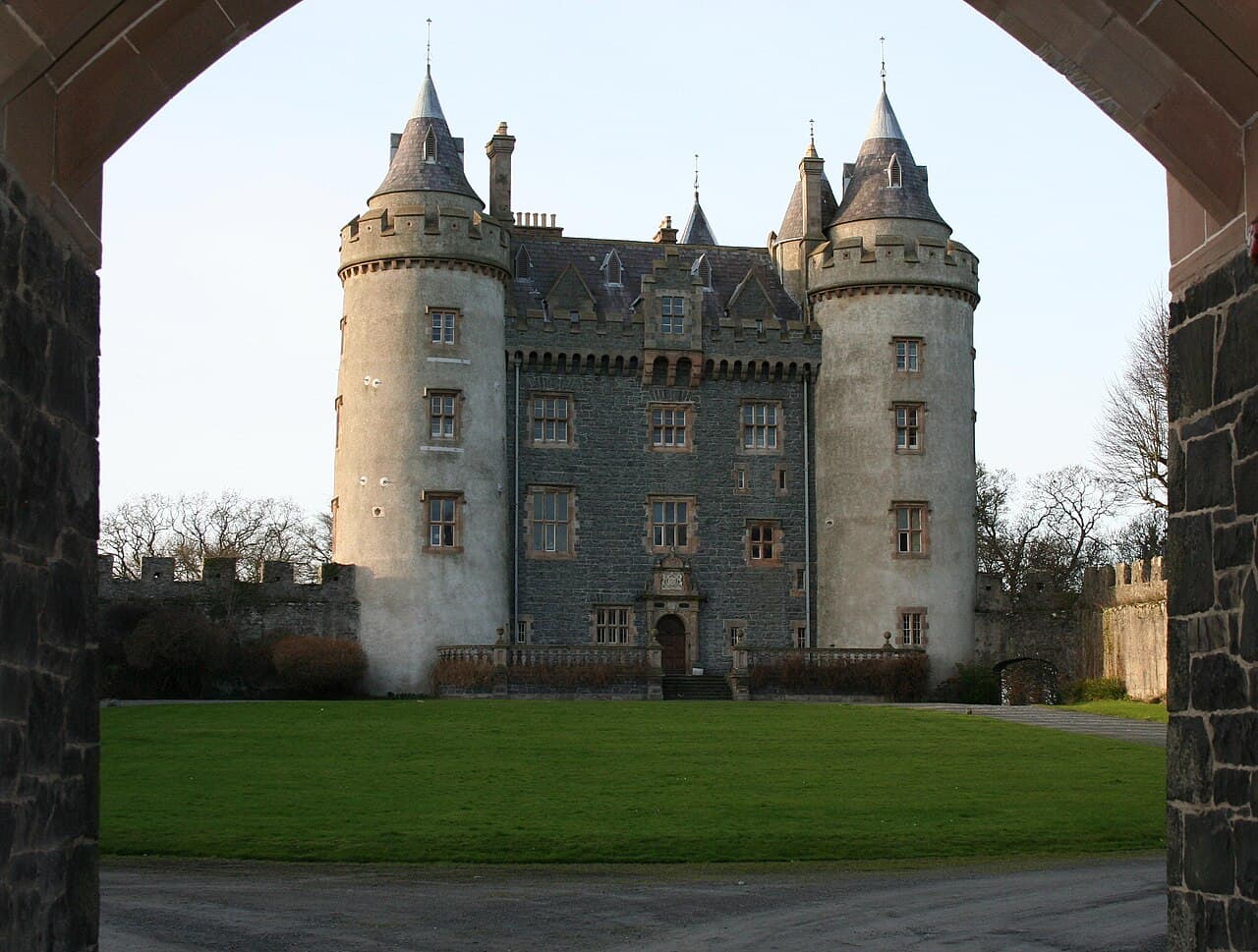
Killyleagh Castle
Killyleagh Castle stands as a remarkable testament to Norman architecture and history in County Down, Northern Ireland. Known as the oldest inhabited castle in Ireland, it has evolved through centuries from a 12th-century fortification into a romantic château-style residence that continues to captivate visitors and historians alike. Situated in the quaint village of Killyleagh, the castle’s enduring presence reflects the turbulent history and cultural heritage of the region.
Early foundations and medieval origins
The origins of Killyleagh Castle date back to around 1180, when the Norman knight Sir John de Courcy established the first fortifications on the site. This initial structure was part of a strategic defensive network around Strangford Lough, designed to secure newly conquered territories from native Irish clans and Viking incursions. De Courcy’s castle began as a wooden fortification, typical of early Norman military architecture, but was soon destroyed during local conflicts.
Following the destruction of the original wooden structure, the Savage family, descendants of de Courcy, constructed a second wooden castle in the early 13th century. This too was destroyed in 1316 amid ongoing clashes between English settlers and Irish forces. The current stone castle, built in the late 14th century by the Savages, marked a significant advancement in defensive architecture, featuring robust stone walls, towers, and a moat designed to withstand siege warfare.
The savage family legacy and early expansions
The Savage family held Killyleagh Castle for over three centuries, establishing themselves as a dominant Anglo-Norman lineage in the region. Their military prowess and political influence were crucial during the volatile medieval period in Northern Ireland. The castle was expanded over time, incorporating additional towers, a fortified gatehouse, and a protective moat, symbolizing the family's wealth and status.
Local folklore from this era includes the legend of the "White Lady", a ghostly figure said to haunt the castle corridors. This spectral tale, tied to a tragic family history, adds a layer of mystique to the castle’s rich narrative.
Transition to the hamilton family and 17th-century transformations
In the early 17th century, ownership of Killyleagh Castle transferred to the Hamilton family, another prominent Anglo-Norman dynasty. This transition occurred amid the complex political landscape shaped by the Plantation of Ulster, when lands were redistributed to English and Scottish settlers. The Hamiltons undertook significant renovations, including the construction of a new gatehouse and a grand staircase, enhancing both the castle’s defensive capabilities and residential comfort.
James Hamilton, 1st Viscount Claneboye, established the Hamilton presence at Killyleagh around 1625, building the courtyard walls and expanding the castle’s footprint. His son, the 1st Earl of Clanbrassil, added a second tower, creating the distinctive two-tower layout that defines the castle’s silhouette today.
Siege and rebuilding after the english civil war
The castle’s strategic importance made it a target during the English Civil War. In 1649, Oliver Cromwell’s forces besieged Killyleagh Castle, employing gunboats on Strangford Lough to bombard the gatehouse. The castle was heavily damaged, with the Earl fleeing and leaving his family behind. Following the restoration of the monarchy, the 2nd Earl of Clanbrassil undertook a major rebuilding campaign in 1666, reconstructing the north tower and restoring the fortified bawn (defensive wall) that still surrounds the castle today.
Inheritance disputes and architectural evolution
The late 17th century saw complex inheritance disputes following the deaths of the 2nd Earl and his wife, Lady Alice Moore. Conflicting wills and legal battles resulted in the estate being divided among Hamilton cousins and a niece in 1697. This division led to structural changes, including the creation of a new entrance on the north side to accommodate the divided ownership.
Throughout the 18th and 19th centuries, the castle remained in the Hamilton family, passing through successive generations. Notably, Archibald Hamilton Rowan, an Irish nationalist and member of the United Irishmen, resided at Killyleagh between 1806 and 1834 after returning from exile in America.
Sir charles lanyon's romantic restoration
In the mid-19th century, the castle underwent a significant transformation under the direction of renowned architect Sir Charles Lanyon. Commissioned by Archibald Rowan-Hamilton and his wife, Lanyon remodeled the castle to reflect the romanticized aesthetic of a Loire Valley château. He added characteristic turrets with conical roofs, often described as "candle snuffers," which define the castle’s roofline today. Lanyon’s work preserved many original features, including vaulted rooms and window placements, blending medieval robustness with Victorian romanticism.
During this period, the gatehouse was rebuilt in the 1860s by architect Benjamin Ferrey in a baronial style to complement the castle’s appearance. The gate lodges were later converted into self-catering holiday accommodations, integrating modern uses while respecting historical integrity.
20th-century history and modern use
Killyleagh Castle witnessed conflict again during the Irish Civil War in the 1920s when it was attacked by the Irish Republican Army. Gunfire exchanged from the battlements underscored the castle’s ongoing strategic relevance.
In recent decades, the castle has served as a private residence of the Hamilton family, currently occupied by Gawn Rowan Hamilton and his family. It occasionally opens for special events, including weddings and concerts, allowing the public to experience its historic ambiance. From 2012 to 2014, Killyleagh Castle was also featured as a filming location for television series such as the CBBC show "Dani’s Castle," highlighting its cultural significance.
Architectural features and layout
Killyleagh Castle is a fine example of Norman military architecture fused with Victorian romanticism. Its layout centers on two main stone towers positioned on the south and north sides, connected by a residential block. The castle is enclosed by a fortified bawn, a defensive wall rebuilt or restored in 1666, which adds to its imposing presence.
The original south tower dates back to the 12th century, while the north tower was added in the 17th century. The castle’s courtyard walls and gatehouse reflect successive phases of construction and restoration, with the 19th-century gatehouse designed to harmonize with the castle’s romantic silhouette.
Inside, the castle contains interconnected rooms such as a drawing room, dining room, and library, all oriented southward towards the gardens. Decorative plasterwork attributed to craftsman Mr. Fulton adorns these interiors, showcasing the blend of functional and aesthetic considerations in the castle’s design.
Unlike many Irish castles, Killyleagh shows no architectural traces of a traditional Irish tower house, emphasizing its Norman and French influences. The castle’s well-preserved state and continuous habitation make it a rare and valuable example of evolving castle architecture in Ireland.
Visiting killyleagh castle and the surrounding area
Although Killyleagh Castle remains a private residence and is not generally open for public tours, visitors can enjoy the surrounding gardens and the village of Killyleagh. The gardens offer a peaceful setting for picnics and leisurely strolls, while the village features charming architecture and local shops.
The nearby Killyleagh Heritage Centre provides rich historical context with exhibits and artifacts tracing the castle’s and village’s history back to the 12th century. For a unique perspective, boat rides on Strangford Lough offer stunning views of the castle and the surrounding natural beauty, with opportunities to observe local wildlife such as seals.
Visitors can also experience traditional Irish cuisine at local establishments like the Dufferin Arms, enhancing the cultural experience of a visit to this historic area.
Getting there and planning your visit
Killyleagh Castle is located approximately 30 minutes by car from Belfast, accessible via the A24 and local roads. Public transportation options include bus routes from Belfast to the village center, with a short walk to the castle grounds.
The best time to visit is during the summer months when the gardens are in full bloom and the weather is mild. While the castle itself is not open for general tours, special events and weddings occasionally allow public access to parts of the property.
Accommodation options nearby range from cozy bed and breakfasts in Killyleagh village to luxurious resorts such as the Slieve Donard Resort and Spa, providing visitors with choices for a comfortable stay.
Cultural significance and legacy
Killyleagh Castle remains a symbol of the rich and complex history of Northern Ireland, embodying centuries of architectural evolution, political change, and family legacies. Its continuous habitation by the Hamilton family links the present to a storied past, while its architectural features tell a story of adaptation and resilience.
The castle’s blend of Norman military design and Victorian romanticism makes it a unique landmark, reflecting broader European influences on Irish castle architecture. Its role in historical conflicts, from medieval clan wars to the English Civil War and the Irish Civil War, underscores its strategic importance.
Today, Killyleagh Castle stands not only as a private home but also as a cultural icon, attracting interest for its historical, architectural, and social significance in the region.
Frequently asked questions (FAQ)
- How do I get to Killyleagh Castle?
- Killyleagh Castle is located in the picturesque village of Killyleagh in Northern Ireland. It is accessible by car and is approximately 25 miles from Belfast. Public transportation options may also be available, but checking local schedules is recommended for the most accurate information.
- What is the historical significance of Killyleagh Castle?
- Killyleagh Castle is one of the oldest inhabited castles in Ireland, with a history dating back to the 12th century. It has been the ancestral home of the Ward family for over 400 years and has played a significant role in the region's history. The castle's architecture and historical events make it a fascinating destination for history enthusiasts.
- When was Killyleagh Castle built?
- Killyleagh Castle was originally constructed in 1180, making it a remarkable example of medieval architecture. Over the centuries, it has undergone various renovations and expansions, particularly in the 19th century, which have added to its unique charm. The castle's long history is evident in its structure and surrounding landscape.
- Can I visit Killyleagh Castle?
- Yes, Killyleagh Castle is open to visitors, allowing them to explore its rich history and beautiful grounds. However, it's advisable to check the castle's official website or contact them directly for the latest visiting hours and any restrictions. Guided tours may also be available to enhance your experience.
- Why is Killyleagh Castle popular among tourists?
- Killyleagh Castle attracts tourists due to its stunning architecture, historical significance, and beautiful surroundings. The castle's picturesque setting by the water and its well-preserved grounds make it a popular spot for photography and leisurely walks. Additionally, the castle's connection to local history adds to its allure for visitors.
- Is it possible to host events at Killyleagh Castle?
- Yes, Killyleagh Castle offers event hosting services for a variety of occasions, including weddings and corporate events. The castle's enchanting atmosphere and beautiful grounds provide a unique backdrop for any celebration. Interested parties should contact the castle directly for availability and specific arrangements.
- What are the opening hours for Killyleagh Castle?
- Killyleagh Castle's opening hours may vary seasonally, so it's best to check their official website for the most updated information. Typically, the castle is open during the day, allowing visitors ample time to explore its grounds. Keep in mind that certain areas may have restricted access on specific days.
- Are there any nearby attractions to visit?
- Yes, Killyleagh is surrounded by several attractions, including the scenic Strangford Lough and the historic town of Downpatrick. Visitors can explore the nearby Inch Abbey and the traditional Irish pubs that showcase local culture. Combining a visit to Killyleagh Castle with these nearby sites can make for an enriching day trip.
- What are the ticket prices for Killyleagh Castle?
- Ticket prices for Killyleagh Castle can vary based on the type of visit, such as guided tours or special events. It's recommended to check the castle's official website for the most current pricing information and any available discounts for families or groups. Planning ahead can help you budget for your visit.
Photo gallery

Photo by Peter Clarke (talk) Original uploader was Peter Clarke at en.wikipedia•CC BY-SA 3.0
Information
Website
Visit websiteSources & official resources
Verify the information above using these authoritative references.
Loading map...
Visitor reviews
No reviews yet. Been here? Write the first review and help other travelers!
Write the first reviewVisited this castle? Share your experience
Your review helps other travelers and adds first-hand knowledge to our encyclopedia.

