Skelbo Castle
Skelbo Castle stands as a notable example of a medieval stone keep situated near the town of Dornoch in Scotland. Constructed in the 14th century, this fortress was strategically placed on a high bank overlooking Loch Fleet to control a vital ferry crossing and monitor access to the surrounding waters. Its commanding position allowed the castle's occupants to oversee maritime and land routes, underscoring its military and administrative significance during the Middle Ages.
The castle's origins trace back to the early 13th century when the lands were first recorded under the ownership of the de Moravia family. In 1235, Gilbert de Moravia, then Bishop of Caithness, transferred the estate to his brother Richard de Moravia. This family connection established the site as an important regional stronghold. Throughout the 13th century, Skelbo Castle gained prominence, notably in 1290 when commissioners of King Edward I of England convened here while awaiting the arrival of Margaret, Maid of Norway, the designated heir to the Scottish throne. Her untimely death before reaching Scotland precipitated a succession crisis that deeply affected Scottish history.
Architectural features and construction
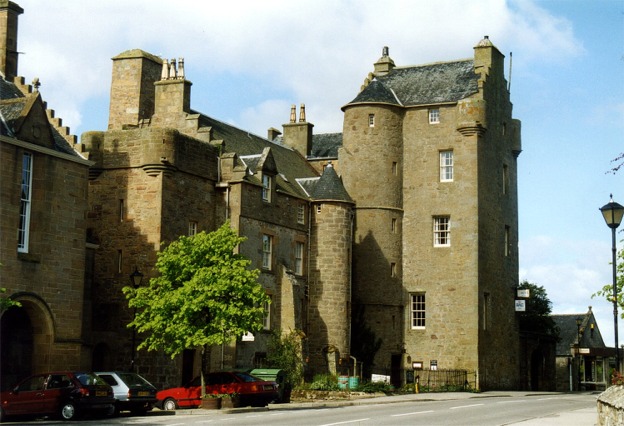
The surviving structure of Skelbo Castle primarily consists of the ruins of a 14th-century stone keep. This keep was constructed using locally sourced stone, typical of Scottish castles of the period, designed to provide a fortified residence capable of withstanding attacks. The keep's walls on the northern side remain the most intact, showcasing the robust defensive masonry that characterized medieval fortifications.
Adjacent to the original tower, a 16th-century residential house was built, reflecting a shift from pure military functionality to more comfortable domestic living. This later addition illustrates the evolution of castle architecture in Scotland, where fortresses increasingly incorporated elements of Renaissance domestic design while retaining defensive features.
Strategic location and defensive elements
Skelbo Castle's placement on a high bank overlooking Loch Fleet was a deliberate choice to secure control over a key ferry crossing. The castle's position allowed for extensive views of the waterway and surrounding land, essential for early warning against potential threats. Defensive features likely included thick curtain walls, battlements, and narrow windows designed for archers, although much of these details have been lost to time.
Historical significance and ownership
During the wars of Scottish independence in the early 14th century, Robert the Bruce captured Skelbo Castle in 1308. At that time, the castle was held by the Sutherland clan, a prominent noble family in the region. The castle's control was contested in the late 15th century, with figures such as Marjory Mowat, Thomas of Kinnaird, and the Murrays of Aberscross vying for possession. Eventually, it became the property of the Kinnaird family, descendants of Richard de Moravia.
In the early 16th century, ownership passed to William Sutherland, 6th of Duffus, who purchased the castle and its estates from John Kinnaird in 1529. This transaction linked the property to the earldom of Sutherland. The castle remained a noble residence for several centuries, adapting to changing architectural and domestic needs.
Modern history and preservation
Skelbo Castle was occupied until the early 20th century but was eventually abandoned. Its last known owner, Mikhail de Buar, died in 2009, leaving the estate's future uncertain due to legal disputes. Today, the site is protected as a scheduled monument, recognizing its archaeological and historical importance.
The ruins provide valuable insight into medieval Scottish castle construction and noble life. The remaining stonework, particularly the northern walls of the keep, allows visitors to appreciate the scale and defensive capabilities of the fortress. The juxtaposition of the medieval keep with the later residential house offers a tangible narrative of architectural evolution over several centuries.
Visiting skelbo castle
While the castle is in a ruined state, its dramatic setting overlooking Loch Fleet makes it a compelling destination for those interested in Scottish history and medieval architecture. Visitors can explore the remains of the keep and the adjoining house, gaining a sense of the site's strategic importance and residential adaptations.
The castle's location near Dornoch provides access to other historical and natural attractions in the region, enriching the visitor experience. Preservation efforts ensure that Skelbo Castle remains a protected cultural heritage site, offering educational opportunities and a window into Scotland's medieval past.
Frequently asked questions (FAQ)
- How do I get to Skelbo Castle?
- Skelbo Castle is located in Dornoch, United Kingdom, and is easily accessible by car. The nearest major town is Dornoch, which is well-connected by public transport, making it convenient for visitors to reach the castle.
- What is the historical significance of Skelbo Castle?
- Skelbo Castle dates back to the 14th century and is known for its architectural features that reflect the medieval period. It has played a crucial role in the history of the region, serving as a residence for various clans and witnessing significant historical events.
- When was Skelbo Castle built?
- Skelbo Castle was constructed in the 14th century, with various modifications and additions made in subsequent centuries. Its long history contributes to its charm and makes it a fascinating site for history enthusiasts.
- Can I take guided tours of Skelbo Castle?
- Yes, guided tours are available for visitors who wish to learn more about the castle's history and architecture. These tours are typically offered during the peak tourist season, providing a deeper insight into the castle’s past and its significance.
- Why is Skelbo Castle considered an architectural gem?
- Skelbo Castle showcases unique medieval architectural styles, including its impressive stonework and layout. The castle's design reflects the era's building techniques, making it a valuable example of Scotland's architectural heritage.
- Is it possible to visit Skelbo Castle year-round?
- Skelbo Castle has specific opening hours, typically operating from late spring to early autumn. It is advisable to check the official website or contact local tourism offices for the most accurate and up-to-date information on visiting hours.
- What are the ticket prices for visiting Skelbo Castle?
- Ticket prices for Skelbo Castle vary depending on the season and type of tour. It is recommended to check the official website for the latest pricing information and any discounts that may be available for families or groups.
- When is the best time to visit Skelbo Castle?
- The best time to visit Skelbo Castle is during the late spring and summer months when the weather is more favorable for outdoor exploration. Additionally, this period often coincides with extended opening hours and special events.
- What nearby attractions can I explore while visiting Skelbo Castle?
- While visiting Skelbo Castle, you can explore the charming town of Dornoch, known for its beautiful cathedral and stunning beaches. Nearby attractions also include the Dornoch Firth and the Royal Dornoch Golf Club, making it a great destination for a full day of activities.
Information
Loading map...
Visitor reviews
No reviews yet. Been here? Write the first review and help other travelers!
Write the first reviewVisited this castle? Share your experience
Your review helps other travelers and adds first-hand knowledge to our encyclopedia.