Dunrobin Castle
Dunrobin Castle stands as a monumental testament to Scotland's rich medieval and aristocratic heritage. Located near Golspie in the Highlands of Scotland, it is the most northerly of the great Scottish houses and the largest in the Northern Highlands, boasting an impressive 189 rooms. The castle has been the ancestral seat of the Earls and later Dukes of Sutherland since the 13th century, making it one of the oldest continuously inhabited houses in Britain. Its name, derived from Gaelic, means "Robin's Hill" or "Robin's Fort," likely referencing Robert, the 6th Earl of Sutherland, who died in the early 15th century.
The castle's origins trace back to the early 1300s, with the earliest surviving structures dating from the early 15th century. It is believed to have been built on the site of an earlier medieval fortification, serving as a strategic stronghold overlooking the North Sea. The original fortress was a formidable square keep with walls over six feet thick and vaulted stone ceilings, designed for defense and residence. This keep stood isolated for approximately two centuries before expansions transformed Dunrobin into the grand estate visible today.
Medieval origins and early history
Dunrobin Castle's early history is deeply intertwined with the powerful Clan Sutherland and the complex social and political landscape of medieval Scotland. The lands were acquired before 1211 by Hugh, Lord of Duffus, and formalized as the Earldom of Sutherland around 1235 under his son William. The castle itself was first recorded as a family stronghold in 1401.
The 15th and 16th centuries saw the castle embroiled in turbulent clan conflicts and political struggles. The castle was named in honor of Robert Sutherland, the 6th Earl. During the early 1500s, the Sutherland and Gordon families contested control of the estate, leading to violent confrontations. Notably, in 1518, Alexander Sutherland briefly seized the castle but was quickly defeated and executed, his fate serving as a grim warning to rivals. His son John died in the castle gardens while attempting to reclaim the stronghold in 1550.
Jacobite uprisings and 18th-century transformations
In the 18th century, Dunrobin Castle played a role in the Jacobite uprisings. During the 1745 rebellion, Jacobite forces led by Charles Edward Stuart captured the castle unexpectedly, despite the allegiance of Clan Sutherland to the British government. The 17th Earl escaped and later joined government forces. Following the death of the 18th Earl in 1766, the estate passed to his daughter Elizabeth, who married George Leveson-Gower, later the 1st Duke of Sutherland. This union initiated significant expansions and alterations to the castle and estate during the late 18th century.
19th-century remodelling by sir charles barry
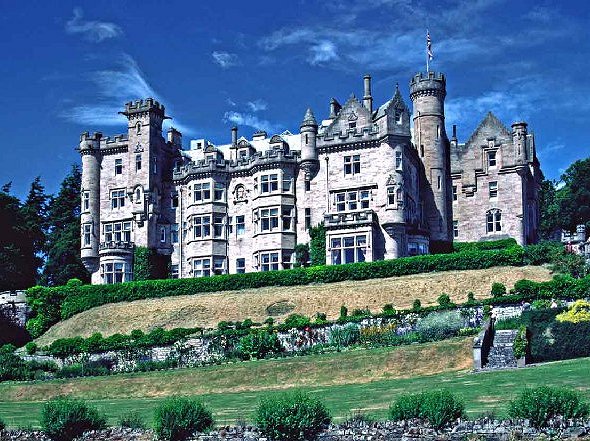
The most transformative period in Dunrobin Castle's architectural history occurred between 1835 and 1850 under the direction of Sir Charles Barry, a preeminent British architect famed for designing the Houses of Parliament in London. Barry was commissioned to remodel the castle extensively, shifting its character from a medieval fortress to a grand Scottish Baronial mansion that reflected the tastes of the Victorian aristocracy.
Barry’s design introduced a strong French influence, inspired by the châteaux of the Loire Valley and the gardens of Versailles. The castle’s exterior was adorned with conical spires, turrets, and a pyramidal roof over the main entrance, blending the romantic aesthetic of the Scottish Baronial style with châteauesque elements. The extensive formal gardens, laid out in the 1850s, featured intricate parterres centered on a circular pool with an optical illusion fountain, amplifying the grandeur of the estate.
Interior design and later restoration
Tragically, a fire in 1915 destroyed much of Barry’s interior work. The restoration that followed was led by the distinguished Scottish architect Sir Robert Lorimer, who incorporated elements of the Scottish Renaissance style, particularly in the remodeling of the main tower and clock tower. Lorimer’s work preserved and enhanced many historic interiors, including woodcarvings by the renowned craftsman Grinling Gibbons.
The castle’s interiors are richly appointed, featuring a grand entrance hall decorated with the armorial bearings of the Earls of Sutherland, a sweeping main staircase adorned with family portraits, and a panelled dining room with an Italian Grisaille frieze and exquisite furnishings. The drawing room overlooks both the sea and the gardens and contains significant artworks by Canaletto, Hoppner, and Reynolds. The library houses over 10,000 books, a portrait by Philip de László, and a mahogany table crafted by Thomas Chippendale. An unusual aeolian orchestrelle, a pressure-operated harmonium, reflects the castle’s rich cultural heritage.
20th century uses and modern status
During the First World War, Dunrobin Castle was repurposed as a naval hospital, serving the war effort. Later, from 1965 to 1972, the castle operated as a boys’ boarding school, reflecting its adaptability through changing times. After this period, it returned to private family ownership and was partially opened to the public.
The castle remains a family home and is recognized as a Category A listed building, highlighting its architectural and historic importance. Its gardens are protected within Scotland’s Inventory of Gardens and Designed Landscapes, underscoring their national significance.
Architectural features and garden design
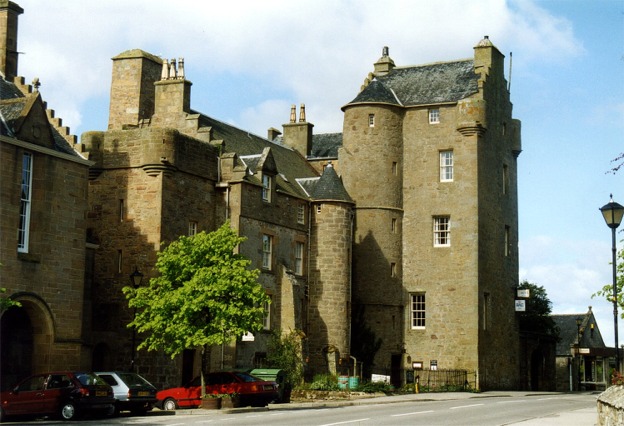
Dunrobin Castle is a vast quadrangular structure with four stories, flanked by towers at each corner. The main entrance tower rises approximately 135 feet (41 meters), with smaller round towers reaching 115 feet (35 meters), and a clock tower standing 125 feet (38 meters) tall. The original medieval keep remains visible in the interior courtyard, featuring thick walls and vaulted ceilings, along with an original iron yett – a heavy iron gate dating back to at least 1401.
The castle’s gardens cover 1,379 acres (558 hectares) and were designed in the French formal style, inspired by Versailles. The formal parterres are centered on a circular pool with a fountain that creates an optical illusion, making the garden appear larger from above. An 18th-century summerhouse on the grounds serves as a museum, preserving Victorian-Edwardian displays of the family’s extensive collections of trophies, ethnographic artifacts, and archaeological finds.
Transport and estate features
Adjacent to the castle is the Dunrobin Castle railway station, established in 1870 as a private station for the estate. The station building, constructed in 1902, is a Category B listed structure and includes a waiting room that reflects the estate’s historic prestige and accessibility.
Legend and cultural significance
The castle is steeped in local legend, including a haunting tale of the "evil Count of Sutherland" who allegedly kidnapped a girl and locked her in a chamber within the castle. According to the story, she attempted to escape by descending from a window using a rope, but the Count cut the rope, leading to her tragic death. Visitors and locals claim to witness the ghost of a man wandering the area where the girl died, adding to the castle’s mystique and cultural lore.
Dunrobin Castle remains a symbol of Scottish heritage, aristocratic power, and architectural grandeur. Its layered history, from medieval fortress to Victorian mansion, combined with its cultural legends and stunning gardens, make it a remarkable destination for visitors interested in Scotland’s past and architectural evolution.
Frequently asked questions (FAQ)
- How do I get to Dunrobin Castle?
- Dunrobin Castle is located in the Highland region of Scotland, approximately 5 miles north of the town of Golspie. The castle is accessible by car, and there is ample parking available on-site. Additionally, local bus services operate in the area, making it convenient for visitors using public transport.
- What is the historical significance of Dunrobin Castle?
- Dunrobin Castle is one of the oldest continuously inhabited castles in Scotland, with a history dating back to the 13th century. It has been the ancestral home of the Earls and Dukes of Sutherland and showcases a rich tapestry of Scottish heritage and history. The castle played a significant role in the region's development and is a testament to the architectural and cultural evolution over centuries.
- When was Dunrobin Castle built?
- Dunrobin Castle's origins can be traced back to the early 13th century, although the current structure reflects a blend of medieval and Victorian architecture. Major renovations and expansions were undertaken in the 19th century, particularly by the renowned architect Sir Robert Lorimer. These changes have contributed to the castle's unique appearance, merging traditional Scottish style with elements of French château design.
- Can I visit the gardens at Dunrobin Castle?
- Yes, the gardens at Dunrobin Castle are open to visitors and are a highlight of the estate. The beautifully landscaped gardens feature a variety of plant species, stunning views, and a formal layout that reflects the Victorian era's gardening trends. Visitors can stroll through the gardens and enjoy the tranquil atmosphere.
- Is it possible to take guided tours of Dunrobin Castle?
- Yes, guided tours are available at Dunrobin Castle, providing visitors with insightful information about its history, architecture, and the Sutherland family. The tours are led by knowledgeable guides who can answer questions and share fascinating stories about the castle's past. Self-guided audio tours are also offered for those who prefer to explore at their own pace.
- What are the opening hours for Dunrobin Castle?
- Dunrobin Castle typically opens to visitors from April to October, with specific hours varying by season. During peak months, the castle is usually open daily from 10 AM to 5 PM. It's advisable to check the official website or contact the castle directly for the most current information regarding opening times, especially during off-peak seasons.
- What are the ticket prices for visiting Dunrobin Castle?
- Ticket prices for Dunrobin Castle vary depending on age and type of visit, with discounts often available for children, seniors, and families. As of the latest information, adult tickets are around £12, while children under 16 may enter for a reduced fee or free. It's recommended to check the official website for the most accurate and updated pricing information before your visit.
- When is the best time to visit Dunrobin Castle?
- The best time to visit Dunrobin Castle is during the late spring and summer months when the gardens are in full bloom and the weather is generally milder. Visiting during these months also allows you to enjoy outdoor events and activities that the castle hosts. However, autumn can also be a beautiful time to visit, offering stunning fall foliage and fewer crowds.
- Are there any nearby attractions to Dunrobin Castle?
- Yes, there are several attractions near Dunrobin Castle that visitors can explore. The nearby village of Golspie offers beautiful beaches and walking trails, while the historic town of Dornoch, known for its cathedral and golf course, is just a short drive away. Additionally, the stunning landscapes of the Highlands provide ample opportunities for outdoor activities and sightseeing.
Information
Website
Visit websiteSources & official resources
Verify the information above using these authoritative references.
Loading map...
Visitor reviews
No reviews yet. Been here? Write the first review and help other travelers!
Write the first reviewVisited this castle? Share your experience
Your review helps other travelers and adds first-hand knowledge to our encyclopedia.