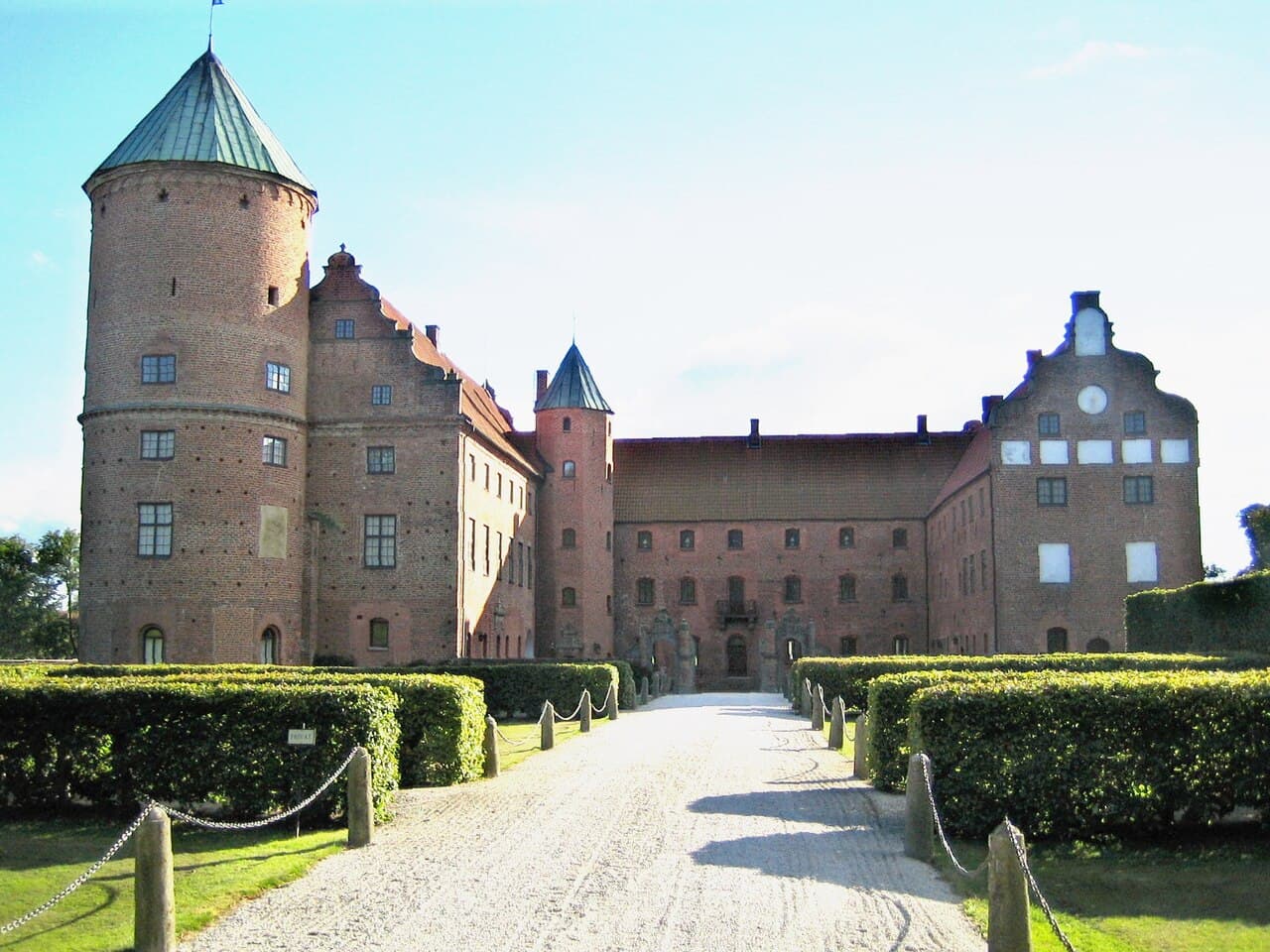
Skarhult Castle
Skarhult Castle is a prominent Renaissance-era hill castle located in Eslöv Municipality, in the historic region of Scania in southern Sweden. Constructed primarily in the 1560s by the Danish noble Sten Rosensparre, the castle incorporates elements from an earlier medieval fortification, reflecting its long-standing strategic and residential significance.
Historical origins and early ownership
The estate originally known as Skarholta or Skarolt is documented as far back as the 14th century. During the mid-1300s, the property was owned by the Danish judge John Nielsen, indicating the site's importance well before the Renaissance reconstruction. The castle remained under the control of the Rosensparre family, who also used the name Skarholt, until 1624. Subsequently, ownership passed through the Ruud and Trolle families, both notable noble houses in the region.
Renaissance construction and architectural features
The current main structure of Skarhult Castle was erected in the 1560s during the Renaissance period under the direction of Sten Rosensparre, a member of the Danish riksråd (council). The castle exemplifies Renaissance architectural principles adapted to a defensive hilltop site, combining residential comfort with fortification elements. While the castle’s Renaissance style is dominant, some parts of the building predate this era, preserving medieval construction techniques and materials.
The castle’s layout features characteristic Renaissance elements such as symmetrical façades, large windows, and ornamental details, while still maintaining robust defensive features typical of earlier periods. The castle is surrounded by a park that includes the medieval Skarhult Church, which adds to the historical ambiance of the estate.
Transition from Danish to Swedish rule
In 1658, the province of Scania was ceded from Denmark to Sweden as part of the Treaty of Roskilde, a significant geopolitical shift that affected many estates including Skarhult Castle. In 1661, the castle was purchased by Count Pontus Fredrik De la Gardie, a prominent Swedish nobleman. However, the actual management and ownership were effectively controlled by his wife, Beata Elisabet von Königsmarck, a wealthy and influential figure who managed the estate from 1661 until her death in 1723. Due to legal restrictions on married women owning property, the castle was officially listed under her name only after she became a widow in 1692.
Later noble ownership and 19th-century renovations
After Beata Elisabet von Königsmarck’s death, Skarhult Castle was inherited by Count Erik Brahe, her grandson through her daughter. The Brahe family maintained ownership until Magnus Fredrik Brahe sold the estate to Charles XIV John of Sweden in 1826. Subsequently, the castle was sold by King Oscar I to Baron Jules von Schwerin, who undertook significant renovations in the 1840s. These updates modernized parts of the castle while respecting its Renaissance character.
Architectural and cultural significance
Skarhult Castle stands as an important example of Renaissance architecture in southern Sweden, illustrating the transition from medieval fortresses to stately noble residences. Its combination of defensive features and Renaissance elegance reflects the social and military changes of the 16th century. The castle’s continuous ownership by prominent noble families such as the Rosensparre, Brahe, and De la Gardie families highlights its role in regional history and aristocratic culture.
The presence of the medieval Skarhult Church within the castle park adds a religious and historical dimension to the site, linking the castle to the spiritual life of the community over centuries.
Current status and accessibility
Today, Skarhult Castle remains privately owned and is not open to the public. Its well-preserved condition allows it to retain much of its historical and architectural integrity, although access is restricted. The castle and its grounds continue to be a significant cultural landmark in Scania, representing centuries of Scandinavian noble heritage and architectural evolution.
Frequently asked questions (FAQ)
- When was Skarhult Castle built?
- Skarhult Castle was primarily constructed in the 1560s during the Renaissance period by Sten Rosensparre.
- Is Skarhult Castle open to the public?
- No, Skarhult Castle is privately owned and not open for public visits.
- What architectural style characterizes Skarhult Castle?
- The castle is mainly built in the Renaissance style, with some parts dating back to earlier medieval fortifications.
- Who were some of the notable owners of Skarhult Castle?
- Notable owners include the Rosensparre family, the Brahe family, the De la Gardie family, and later Baron Jules von Schwerin.
- Where is Skarhult Castle located?
- It is located in Eslöv Municipality, in the Scania region of southern Sweden.
Photo gallery

Information
Current owner
Private owner
Loading map...
Visitor reviews
No reviews yet. Been here? Write the first review and help other travelers!
Write the first reviewVisited this castle? Share your experience
Your review helps other travelers and adds first-hand knowledge to our encyclopedia.


