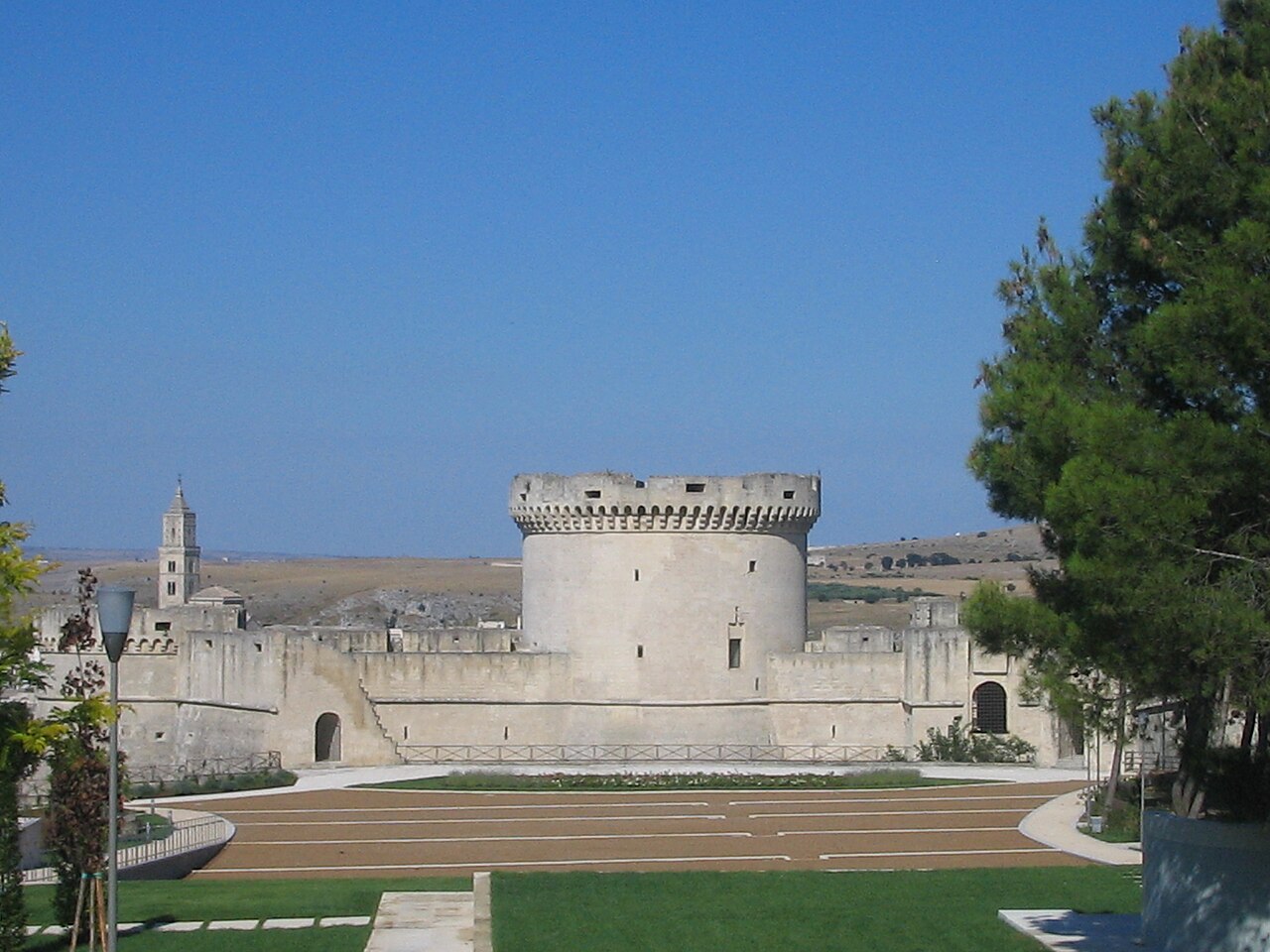
Sichinulfo Castle
Sichinulfo Castle, located in the historic town of Grottole, Italy, stands as a remarkable example of an early medieval hill castle with deep roots tracing back to the Lombard era. Although first documented by the Muslim geographer Muhammad al-Idrisi in 1154, local tradition holds that the fortress was originally constructed in 851 AD. This duality in its recorded origins highlights the castle's enduring significance in the shifting political landscape of southern Italy during the early Middle Ages.
The castle's strategic position atop the Contrada della Motta hill provided commanding views over the Basento and Bradano river valleys, crucial for controlling important trade and military routes. Its elevated location and robust construction made it a formidable defensive stronghold through centuries of regional conflict and noble rule.
Historical origins and early significance
The origins of Castello Sichinulfo are intertwined with the complex history of Lombard rule in southern Italy. Early accounts suggest its foundation by Lombard occupants from Benevento around 604 AD, a period marked by territorial fragmentation and frequent warfare. Alternatively, the castle is traditionally linked to Prince Siconolfo of Salerno in the 9th century, following the division of Lucanian lands between the principalities of Salerno and Benevento. This connection not only gives the castle its name but also situates it within the broader narrative of Lombard political dynamics and territorial disputes.
Throughout the medieval period, the fortress served primarily as a military bastion overseeing the vital valleys, guarding against incursions and asserting control over the surrounding region. Its role was pivotal in the feudal structure of the Kingdom of Naples, where it was successively governed by prominent noble families such as the Gianvilla, Sanchez, Caracciolo, Sanseverino, and Spinelli. Each lineage left its mark through architectural modifications and enhancements that balanced defensive needs with residential comfort.
Architectural features and construction details
Sichinulfo Castle occupies approximately 1,500 square meters on the hilltop, characterized by its integration of natural and man-made defensive elements. The term "Motta" refers to the raised earthwork typical of medieval fortifications, which in this case was reinforced with stone walls constructed from local limestone and tuff. These materials were bonded using traditional lime and sand mortar, ensuring durability and resistance against siege warfare.
The fortress consists of two main floors containing a total of 47 rooms, arranged around a series of courtyards that facilitated both defense and daily life. The main entrance, located on the west side, features a large arched gateway leading into a small covered courtyard before opening onto a larger open courtyard measuring about 96 square meters. This layout reflects typical medieval military architecture, designed to slow and expose attackers.
The square tower and defensive structures
A dominant feature of the castle is its square tower, rising approximately 21 meters above the covered courtyard. This tower likely served multiple purposes, including lookout, defense, and residence for the castle's lord or garrison commander. The tower's height and robust construction made it a formidable obstacle for any attacking force.
Adjoining the tower, a grand fireplace surmounted by a stucco shell bears the emblem of the Sanseverino family of Bisignano, linking the castle to one of its most influential noble owners. Nearby walls and vaults contain fragments of frescoes, though many are obscured by later plastering, indicating the castle's evolution from a purely military fortress to a noble residence with decorative elements.
Interior spaces and functional areas
The ground floor includes several vaulted rooms that open onto courtyards and covered passageways, facilitating internal movement and defense. A notable feature is the remains of a wood-fired oven under a large arch, once used for baking bread, alongside a stone basin that served as a water trough or sink. These elements underscore the castle's role as a self-sufficient estate capable of supporting its inhabitants during sieges.
Additionally, the castle contains underground cellars and stables, essential for storing provisions and sheltering animals. These facilities highlight the practical aspects of medieval castle life, emphasizing sustainability and preparedness.
Cultural transformations and noble patronage
In the 18th century, Pietrantonio Sanseverino, prince of Chiaromonte, undertook significant modifications to the castle, reflecting changing tastes and functions. He transformed a large hall on the first floor into a theater, which hosted traveling theatrical companies. This adaptation marks a shift from the castle's martial origins towards a role as a cultural and social center within the feudal domain.
Subsequent noble owners continued to enhance the castle's residential and representative features, balancing its defensive heritage with comfort and prestige. These changes illustrate the broader trend of medieval fortresses evolving into stately homes during periods of relative peace.
Legends and modern cultural significance
Sichinulfo Castle is also enveloped in local legend, most notably the tragic story of Abufina, a young woman who drowned in the Basento River while hurrying to meet her lover. The castle's lord commemorated her memory by sealing the door to the room where she awaited and placing a plaque in her honor. This poignant tale adds a human dimension to the castle's history and enriches its cultural heritage.
In contemporary times, the castle's enduring presence was highlighted when it served as a filming location for the 2018 movie "Moschettieri del re – La penultima missione". This usage underscores the site's atmospheric qualities and its continued relevance as a historic monument.
The medieval village and surrounding fortifications
The castle was once the centerpiece of a fortified medieval village, enclosed by defensive walls featuring multiple towers. One such tower was integrated into the bell tower of the now-ruined church of Saints Luca and Giuliano, symbolizing the intertwined military and ecclesiastical significance of the site. These fortifications further emphasize the strategic and communal importance of the castle within the region.
Today, Castello Sichinulfo stands as a testament to the layered history of southern Italy, reflecting centuries of military, noble, and cultural transformations. Its well-preserved structures offer valuable insights into medieval fortification techniques, Lombard heritage, and the evolution of feudal residences.
Frequently asked questions (FAQ)
- When was Sichinulfo Castle originally built?
- Sichinulfo Castle is traditionally believed to have been built in 851 AD, although it was first mentioned in historical records in 1154 by Muhammad al-Idrisi.
- What is the architectural style of Sichinulfo Castle?
- The castle reflects early medieval military architecture typical of Lombard hilltop fortresses, characterized by stone construction with limestone and tuff, vaulted rooms, and a prominent square tower.
- Can visitors explore the interior of Sichinulfo Castle?
- While the castle is partially preserved, visitors can explore its courtyards, vaulted rooms, and the prominent square tower, though some areas may be in ruins or undergoing preservation efforts.
- What noble families were associated with Sichinulfo Castle?
- The castle was governed by several noble families over the centuries, including the Gianvilla, Sanchez, Caracciolo, Sanseverino, and Spinelli families, each contributing to its history and modifications.
- Is there any legend linked to Sichinulfo Castle?
- Yes, the legend of Abufina, a young woman who drowned in the Basento River while rushing to meet her lover, is associated with the castle and commemorated by a sealed room and plaque.
Information
Website
Visit websiteSources & official resources
Verify the information above using these authoritative references.
Loading map...
Visitor reviews
No reviews yet. Been here? Write the first review and help other travelers!
Write the first reviewVisited this castle? Share your experience
Your review helps other travelers and adds first-hand knowledge to our encyclopedia.