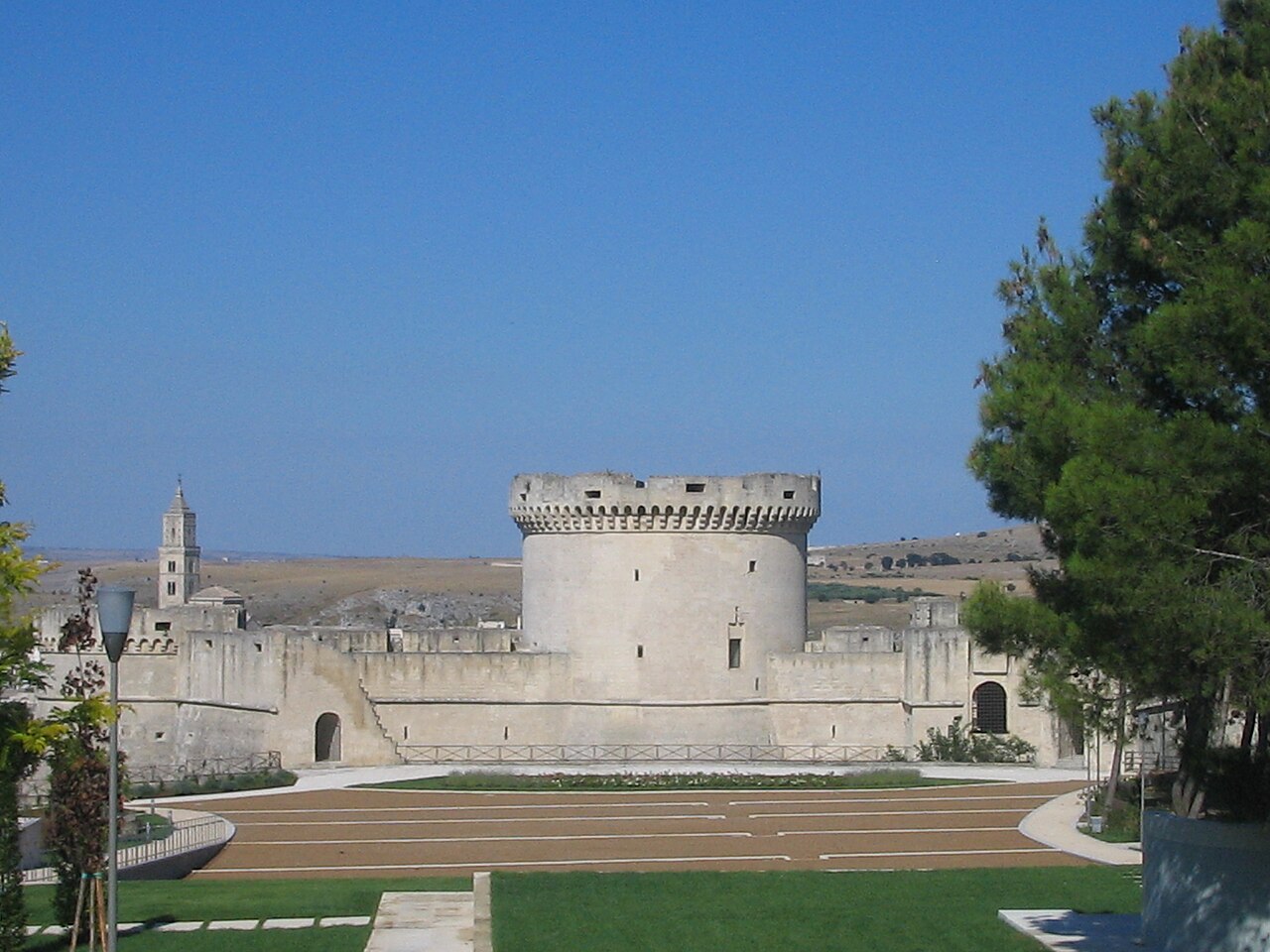
Malconsiglio Castle
Malconsiglio Castle stands as a remarkable example of early medieval military architecture in the Basilicata region of southern Italy. Located in the town of Miglionico, this imposing fortress was originally constructed in the 9th century AD on a strategic hilltop overlooking the Bradano valley. Its commanding position allowed control over the surrounding territory, serving both defensive and administrative functions through the centuries. The castle's name, "Malconsiglio," meaning "bad counsel," derives from the infamous 1485 Barons' Conspiracy, a bloody event in which rebellious nobles plotted against King Ferdinand I of Aragon within its walls, culminating in a brutal massacre in the castle's great hall.
Early origins and strategic importance
The origins of Malconsiglio Castle trace back to the early medieval period, specifically the 8th or 9th century, when fortifications were erected to secure the region during a time of frequent conflict and political instability. The castle's location on a hilltop was typical of hill castles, designed to maximize visibility and defensive advantage. Archaeological evidence suggests that the site had been inhabited even earlier, with layers of settlement from ancient Italic peoples predating the medieval fortress.
Throughout the early medieval period, the castle primarily served military and defensive purposes, guarding the approaches to Miglionico and the wider Bradano valley. Its robust construction and commanding position made it a key stronghold for various noble families who controlled the area over time.
Architectural evolution and structural features
Layout and towers
The castle is characterized by its roughly parallelogram shape, enclosed by seven towers of varying forms that reflect the different phases of construction and renovation. Among these, the oldest towers have square bases, typical of early medieval fortifications, while others are circular or double towers (bitorri) strategically placed at corners to enhance defensive coverage. The presence of a tall mastio or keep on the northeast side provided a commanding vantage point over the valley.
Entrances and defensive walls
Originally, the castle's main entrance faced south, adorned with sculptural decorations including stone tigers and the coat of arms of the Bisignano barons, reflecting the castle's noble associations. This portal was destroyed in the 1857 earthquake, but fragments were preserved and integrated into interior spaces. The current main entrance, created after the earthquake, is located on the northeast side, altering the castle's historical access and circulation patterns.
The defensive perimeter consists of crenellated walls with regular openings for archers and wooden beams supported by holes above the rooms, allowing for protected walkways along the battlements. The towers protrude beyond the curtain walls, a common medieval design to improve fields of fire.
Interior spaces and vaulting
Internally, the castle is built on two levels, with ground-floor rooms featuring groin vaults supported by slender pointed arches, showcasing sophisticated medieval engineering. The upper floors exhibit architectural variety, including large semicircular arches and ribbed groin vaults, indicating phases of construction and stylistic evolution.
Noteworthy rooms include the Sala del Malconsiglio, the great hall where the 1485 conspiracy unfolded, and the Sala della Stella or Hall of Spirits, famed for its star-shaped ceiling and niches carved into the walls that once stored treasures and valuable documents of the castle's inhabitants.
Historical significance and noble ownership
Ownership of Malconsiglio Castle passed through several noble families, beginning with Count Alessandro di Andria and later the powerful Sanseverino family from Bisignano, who made it a center of regional power. The castle's most notorious historical event, the Barons' Conspiracy of 1485, involved rebellious nobles plotting against King Ferdinand I of Aragon. The conspiracy ended in a bloody massacre within the castle, forever marking its history and lending the fortress its ominous name.
In the early 17th century, control of the castle shifted to the Revertera family, Dukes of Salandra, who initiated significant renovations to transform the fortress into a more comfortable noble residence. These included the construction of a gallery with elegant semicircular arches and a bastioned section on the southern face, reflecting the adaptation of the castle to evolving military technologies such as artillery.
Damage, restoration, and modern use
The castle has endured considerable damage from natural disasters, notably the 1857 Basilicata earthquake, which destroyed the original southern entrance and caused the collapse of the vaults in the Sala del Malconsiglio. These vaults were never rebuilt, and the castle's access was subsequently rerouted to the northeast side. A further earthquake in 1980 inflicted additional structural damage, including partial collapse of the loggia along the courtyard, which is currently undergoing restoration.
Throughout the 20th century, the castle was subdivided into multiple residential units and underwent various demolitions and restorations. Today, Malconsiglio Castle serves as a center for the research and documentation of medieval history, preserving its rich legacy. Its striking architecture and dramatic history have also made it a popular filming location, featured in movies such as "Il demonio" by Brunello Rondi and "Wonder Woman" directed by Patty Jenkins.
Architectural influences and stylistic elements
The castle's architecture reflects a blend of styles and influences spanning several centuries. Early elements show connections to the military fortifications of Frederick II, with Gothic pointed portals and windows dating to the early 14th century. Later modifications emphasize residential comfort without sacrificing defensive functionality.
The presence of a chapel, documented from the 14th century but located outside the original walls, indicates the castle's religious and social functions. Over time, this chapel was repurposed for various uses, including an olive mill and carpentry workshop, complicating precise dating of its architectural fabric.
The castle's external walls are constructed from local stone, showcasing visible layers of repair and intervention that narrate its long history. Defensive features such as crenellations, battlements, and strategically placed towers highlight the evolution of military architecture from the early medieval period through the Renaissance and beyond.
The castle in the cultural landscape
Malconsiglio Castle remains a dominant landmark in Miglionico, its silhouette visible across the Bradano valley. The town itself developed around the fortress, underscoring the castle's central role in shaping the region's history and identity. Its dramatic past, architectural complexity, and enduring presence make it a significant cultural and heritage site in southern Italy.
Visitors today can explore the castle's varied spaces, from the imposing towers and battlements to the richly storied halls like the Sala della Stella. The castle's blend of military and residential architecture offers a tangible connection to the medieval and Renaissance periods, while its ongoing restoration efforts aim to preserve this heritage for future generations.
Frequently asked questions (FAQ)
- How do I get to Malconsiglio Castle?
- Malconsiglio Castle is located in Miglionico, Italy, easily accessible by car or public transportation. If you are driving, the castle is situated just off the SS7 road, and there is parking available nearby. For those using public transport, local buses connect Miglionico to major cities like Matera and Potenza.
- What is the historical significance of Malconsiglio Castle?
- Malconsiglio Castle dates back to the 10th century and played a crucial role in the defense of the region during the Middle Ages. It is known for its strategic location and has witnessed various historical events, including battles and sieges. Today, the castle stands as a testament to the rich history and culture of the area.
- When was Malconsiglio Castle built?
- The construction of Malconsiglio Castle began in the 10th century, with significant modifications made in the subsequent centuries. Its architecture reflects the military needs of the time, showcasing elements of both Norman and medieval styles. The castle has been preserved over the years, allowing visitors to appreciate its historical architecture.
- Can I enter Malconsiglio Castle?
- Yes, visitors can enter Malconsiglio Castle during its opening hours. The castle offers guided tours that provide insights into its history and architecture. Be sure to check the schedule, as the hours may vary by season, and some areas may be restricted for preservation.
- Why is Malconsiglio Castle a popular tourist attraction?
- Malconsiglio Castle attracts tourists due to its stunning views of the surrounding landscape and its fascinating history. The castle's unique architecture and well-preserved structures offer a glimpse into the past, making it a favorite for history enthusiasts and photographers alike. Additionally, its proximity to other attractions in the region enhances its appeal.
- Is it possible to visit nearby attractions from Malconsiglio Castle?
- Absolutely! Malconsiglio Castle is conveniently located near other historical sites and natural attractions. Visitors can explore the town of Miglionico, known for its charming streets and local cuisine, as well as the UNESCO World Heritage site of Matera, which is just a short drive away.
- What are the opening hours for Malconsiglio Castle?
- Malconsiglio Castle typically opens to visitors from 9 AM to 6 PM, although hours may vary depending on the season. It's recommended to check the official website or contact local tourism offices for the most current information before planning your visit. Special events may also affect the regular schedule.
- What are the ticket prices for visiting Malconsiglio Castle?
- Ticket prices for Malconsiglio Castle are generally affordable, with discounts available for children, students, and seniors. Admission fees help support the maintenance and preservation of the castle. For the latest pricing information and any special offers, please refer to the castle's official website or visitor center.
Information
Website
Visit websiteSources & official resources
Verify the information above using these authoritative references.
Loading map...
Visitor reviews
No reviews yet. Been here? Write the first review and help other travelers!
Write the first reviewVisited this castle? Share your experience
Your review helps other travelers and adds first-hand knowledge to our encyclopedia.